The Politics of Museums: Who Owns Egyptian Antiquities?
by Taylee Holland
Franklin College of Arts and Sciences
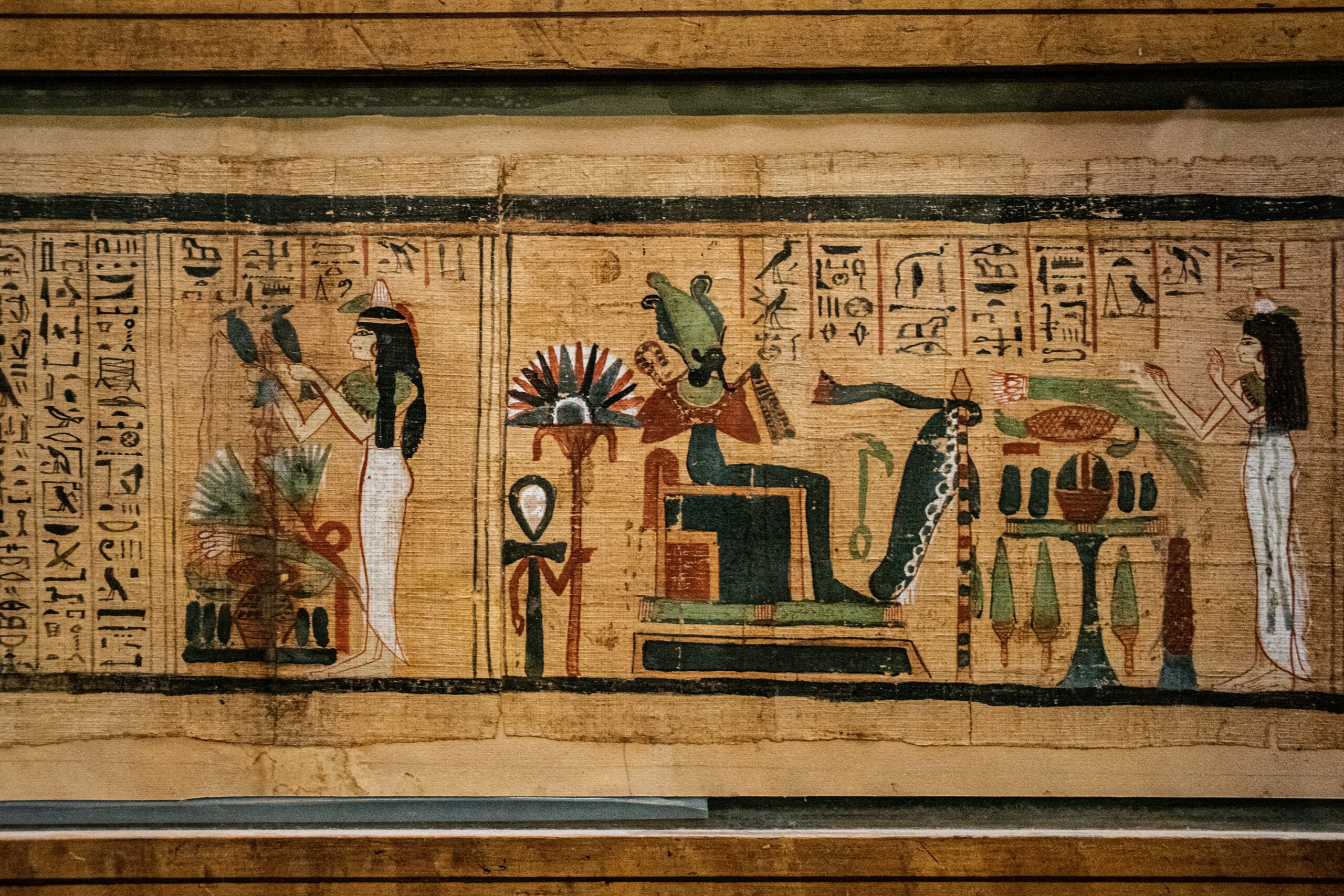
Ownership of Egyptian antiquities remains one of the most contested issues in modern museum and heritage politics. Many Western museums house extensive collections of Egyptian artifacts that were acquired during the nineteenth and early twentieth centuries, often within the context of European imperial expansion and colonial administration. While museums often justify their possession of these artifacts by emphasizing education, preservation, and universal access to world heritage, Egyptian institutions argue that many objects were removed under unequal power structures and should be returned to their country of origin. Understanding how political narratives are constructed by museums through the display and interpretation of Egyptian antiquities can better support the identification of the correct owners. By analyzing the historical development of Egyptology, the emergence of museum collections during the colonial era, and the concept of the “universal museum,” this study highlights the political frameworks that continue to shape debates about cultural ownership. Two major case studies, the Rosetta Stone and the Bust of Nefertiti, demonstrate how these artifacts became symbols of both Western institutional authority and Egyptian cultural identity. Ultimately, this research argues that modern repatriation debates cannot be separated from the colonial conditions under which many museums were formed.
Egyptian antiquities, museum politics, repatriation, colonialism, cultural heritage, Egyptology
One important question of modern heritage politics within Egyptology has long been contested: who owns Egyptian antiquity? Many museums around the world have curated extensive collections of artifacts from Egypt, helping to shape the understanding of Ancient Egypt for millions of people. But because, the way these artifacts ended up in these museums was due to colonialism, scholarly authority over cultural identity, and political manipulation, there is a conflict of interest between museums in the West and modern Egyptians who claim these artifacts as theirs. How does this Western display of artifacts affect the ongoing struggle of reparation and lost cultural heritage? I argue that museums construct political narratives through their display and interpretation of Egyptian antiquities to legitimize Western control over artifacts while also undermining Egyptian cultural heritage. Additionally, these debates are not only political but are shaped by the academic traditions within Egyptology, a field historically rooted in European scholarship that has influenced how Egyptian history is studied, interpreted, and displayed. Western museums claim that they keep Egyptian artifacts to help educate a broader range of people, while Egyptian institutions argue that the artifacts belong in the country they came from. Both sides harbor underlying political agendas about history to back their claims. The question of who owns Egyptian antiquity goes far beyond legal or ethical issues but is rather tied up into competing national interests and institutional priorities.
Many museums often use the concept of the “universal museum,” a style of museum that displays different cultural artifacts over many periods of time to showcase the broader scope of humanity in one place, to defend having Egyptian artifacts. According to art historian and museum director, James Cuono, the reason museums claim this title is “to authorize retention of cultural heritage by those who claim it and have the means of enforcing it” (76). In addition, cultural historian, Tiffany Jenkins states that universalism is an unpopular concept now because it is commonly aligned with “imperialistic values… or taken to mean that we are all somehow the same” (187). Egyptologist Elliot Colla further challenges this idea by stating that it is a common argument that Egyptian antiquities belong to everyone; however, this is just a ploy to make it seem as though they should belong in the West (103). Together these scholars demonstrate that the concept of the universal museum is not a neutral framework, but rather a politically charged justification that allows Western museums to maintain control over Egyptian cultural heritage.
In addition to political and national interests, academic traditions within Egyptology have also shaped how Egyptian antiquities are understood and displayed. Because Egyptology developed primarily within European institutions during the nineteenth century, Western scholars played a central role in interpreting Egyptian history and material culture. This created a system in which knowledge production about Egypt was often controlled by those outside of it, reinforcing Western authority not only over artifacts, but also over their meaning. As a result, museums continue to reflect these academic traditions in the way they present Egyptian antiquities to the public.
As a movement to regain and preserve much of their cultural heritage, Egypt created the Egyptian Antiquities Museum in Cairo in the nineteenth-century according to Christina Riggs, an Egyptologist and museum studies scholar (Colonial Visions par. 4). However, like many museums, its creation is a result of politics and colonialism that also caused the Counsel of the Egyptian Government to establish rules:
1. That the future export of antiquities of all kinds be strictly prohibited.
2. That all such objects which the government possesses or shall come to possess through future excavations and exploration, be deposited in a special place in Cairo where they can be preserved and conveniently arranged for public exhibition, particularly for travelers and foreigners who arrive daily to view them throughout the country.
3. That not only is it expressly forbidden to destroy the ancient monuments of Upper Egypt, but the government should take measures to insure their preservation everywhere (Colla 117).
Thus, the effects of colonialism and the push to keep Egyptian antiquities contained within Egypt, were directly responsible for the creation of the Egypt Antiquities Museum as well as Egypt’s Ministry of Tourism and Antiquities (Riggs Colonial Visions par.7).
In many museums, the way an artifact is presented in its display allows for there to be a political aspect in the way it is viewed. According to Riggs, “making an object conform to expectations, whether in a display case or (I would add) a catalogue, does not make it more “real,” truthful, or authentic” (Unwrapping Ancient Egypt 33). Likewise, there have been many debates on the ethics of museums, especially on the treatment of mummies (Riggs Unwrapping Ancient Egypt 44). On one end of the argument, the discussion revolves around the sex and race of a mummy which can be hard to identify, thus, leading to assumptions being made about the identity of the individual. However, one the other end, there is an argument that the display of mummies helps the West to make the exotic nature of Egypt seem familiar (Riggs Unwrapping Ancient Egypt 44). Likewise, cultural policy scholar, Clive Gray, adds that with the added complexity of different ideologies and legitimizing principles, it is no surprise that there is not a “set of uncontested principles, agreements, decisions and standards that is appropriate for all actors” (61). He argues that there are no universally accepted standards governing museum practices. Gray also adds, “In these circumstances it is equally as unsurprising that those areas of museum policy where some form of international unanimity has been created are those where technical considerations have acquired a position of prime importance” (61). Thus, museums are not a neutral institution, but a political entity.
The earliest removal of Egyptian antiquities occurred within the context of European exploration and scientific ambition, establishing patterns of extraction that defined the nineteenth century. Egyptology was formed during a time of “violence, imperialism, and Anglo-French rivalry” (Reid 31). During the French military conquest of 1799, the Expédition d’Égypte, French soldiers would uncover what is known today as the Rosetta Stone in the small village of El Rashid. The scholars who accompanied the soldiers knew that the Rosetta Stone was an important discovery even then, with the stone being the key element to decipher Egyptian hieroglyphics (Jenkins 65). However, after defeating the French in 1801, the British seized the Rosetta Stone as a war trophy and put it on display at the British Museum (Reid 31). In fact, Jenkins mentions, “Upon arrival in Britain, the Rosetta Stone was received in nationalistic terms, as a symbol of triumph over the French” (72). Subsequently, a frenzy of Egyptomania would take Europe by a storm and artifacts would be appropriated by many European countries to expand their knowledge of foreign civilizations (Jenkins 66).
European Egyptomania caused many artifacts to be excavated and taken by amateur archaeologists who had no standards in place for excavation and would ignore all warnings about removing the artifacts from their original context (Jenkins 66). In fact, there is evidence in William Hamilton’s Aegyptiaca (1809) that French explorers used explosives while attempting to move a statue of the younger Memnon even when it had been noted that the head could have been moved by the local villagers (Colla 30). Likewise, Jenkins mentions that the British went on to stamp English writing on the Rosetta Stone to “reinforce ownership” (72). The writing reads as such, “’Captured in Egypt by the British Army in 1801’ and ‘Presented by King George III’… ‘a GLORIOUS TROPHY OF BRITISH PROWESS, which the VANQUISHED THEMSELVES have been compelled to supply’” (Jenkins 72-73). This reinforces that the British ownership of the Rosetta Stone was primarily used to declare victory over France rather than to protect its historical value and significance. The meaning of the artifact was shaped not by its Egyptian origins but by the European political rivalries. By framing the Rosetta Stone as a symbol of national triumph, the British Museum transformed it into a tool of imperial identity rather than an object of cultural heritage. In this way, museums actively construct narratives that reflect the political priorities of those who control them.
According to Riggs, “The growth of museums in the late nineteenth and early twentieth centuries stood in symbiotic relationship to the expansion of archaeology in the colonial era, since museums offered a destination (and justification) for the division of artifacts discovered in Egypt” (191). Furthermore, museums justify their holding of Egyptian antiquities by controlling “what is shown, how it is shown, and who it is shown to” (Gray 21). Interestingly, according to Valerie Egan, a scholar of cultural heritage and post-colonial museum studies, “…the Rosetta Stone cannot be defined as stolen nor illegally exported, and no conventions address its 1801 removal from Egypt. Although Egypt’s Law No. 14 of 1912 declares that every antiquity found on, or in the ground, shall belong to the Public Domain of the State of Egypt, this patrimony law was formalized far too late to address pre-1912 archaeology” (28). This law, however, requires further clarification. Egypt’s Law No. 14 of 1912 declared that antiquities found within the country belonged to the state, but it did not fully prohibit their removal. It established a system known as partage, in which excavation finds were divided between Egypt and foreign archaeologists. While Egypt could select the most valuable objects, the remaining artifacts could still be legally exported (Egan 31). As a result, the law regulated the distribution of antiquities rather than preventing their removal entirely, and because it was enacted after many major discoveries, it does not apply to artifacts such as the Rosetta Stone. Moreover, in 2007, Zahi Hawass, a prominent Egyptologist and former Minister of Tourism and Antiquities, requested for the Rosetta Stone to be loaned to Egypt during the opening of the Grand Museum of Cairo. However, the British Museum rejected the request on the grounds that loans meet their legal requirements, including a clear educational purpose, accessibility throughout the world, and a guarantee of the artifacts return (Egan 29). Although when asked how Egypt would guarantee the Rosetta Stone’s return, Hawass fired back saying, “We are not pirates of the Caribbean. We are a civilized country.” Egan argues that repatriation, or the act of returning an artifact to its country of origin, is often used as a political tool to disguise cultural politics within legal battles (30). Repatriation debates are often packaged along with broader social, political, economic, and cultural issues. The political nature of repatriation debates is further illustrated through the actions of key cultural figures and international institutions. One of the institutions is none other than The United Nations Educational, Scientific, and Cultural Organization or UNESCO. In 1945, 35 participating countries established UNESCO with the purpose of promoting cultural preservation, education, and global cooperation. This organization plays a major role in establishing guidelines for the protection of cultural heritage. In 2009, just days after Farouk Hosny, Egypt’s cultural minister, failed to become director-general of UNESCO, a position that would have given Egypt greater influence over global cultural policy, Zahi Hawass launched his repatriation claims. As Egan argues, the timing of these actions only further highlight that repatriation efforts are often politically motivated and not solely about cultural justice (30).
Moreover, questions of a fraudulent removal of the Bust of Nefertiti which was found in December of 1912 after Law No. 14 was issued in June of 1912 has led to investigations into its authenticity and the circumstances surrounding its removal from Egypt. In 2009, Spiegel International reported on potentially damning evidence, implying that Ludwig Borchardt misled the Egyptian partage inspector during the artifact division process. According to the report, Borchardt described the object as a simple plaster bust, when it was actually a finely crafted limestone sculpture covered with plaster. By downplaying its significance, he was able to ensure that the bust qualified for export under the laws of the time, which permitted foreign archaeologists to take artifacts considered to have little value. Because more significant antiquities were required to remain in Egypt by law, these allegations have strengthened Egypt’s argument that the bust was obtained through deception and should be repatriated (Egan 31-32). Notably, during a 2004 conference, there were two sides argued over repatriation of the Nefertiti Bust (Egan 32). One side argued that it should be given back due to Egypt lack of awareness that they had allowed for it to be taken to Germany, but the other side argued that there is not really any cultural connection between the bust and modern Egypt, so there was no wrong that needed to be righted (Egan 32).
The Rosetta Stone and the bust of Nefertiti have different histories, yet they both demonstrate how far Western museums will go to defend their possession of artifacts and how Egypt will continue to fight for artifacts to be repatriated back to their original home. Both artifacts were removed from Egypt before they had laws in place preventing the removal of Egyptian antiquities during colonial occupation. When viewed together, these two case studies show us that the politics of museums are rooted not just in laws, but in the legacies of colonialism that still shape the question of culture and ownership today.
In the end, the question of who owns Egyptian antiquities cannot be reduced to a simple legal or ethical answer. The debates of Egyptian antiquities are deeply tied to political narratives, colonial history, and institutional authority. The histories of the Rosetta Stone and the Bust of Nefertiti reveal that many museum collections were formed within systems of colonial power that gave museums the privilege of ownership and allowed them to create their own interpretations of the artifacts by controlling their historical interpretations. While museums continue to present themselves as universal institutions serving global audiences, their practices often reinforce historical inequalities in cultural authority. At the same time, modern Egypt calls for repatriation in the push to highlight the importance of cultural heritages as a living and nationally significant resource. Debates over the ownership of Egyptian antiquities are not just about the past, but about who has the right to define and represent the past in the present. Recognizing the political and academic structures that have shaped museum collections is essential in moving toward more ethical and fair approaches to cultural heritage in the future. Ultimately, the struggle over antiquities allows us to confront the realities of how Western collections have been formed, and who benefits from them the most. As repatriation becomes a global conversation, the future of Egyptian antiquities will depend on the willingness to rethink the narratives of the past to resolve the questions of the future.
References
Colla, Elliott. Conflicted Antiquities: Egyptology, Egyptomania, Egyptian Modernity. Duke University Press, 2007.
Cuno, James B. Who Owns Antiquity?: Museums and the Battle over Our Ancient Heritage. Princeton University Press, 2011.
Egan, Valerie R. “Post-Colonial Politics and Cultural Heritage.” Scholarsbank.Uoregon.Edu, June 2010, scholarsbank.uoregon.edu/server/api/core/bitstreams/498be1fb-3622-411b-8b4c-846cb40c34ea/content.
Gray, Clive. The Politics of Museums. Palgrave Macmillan, 2017.
Hassan, Fekri A. “Imperialist Appropriations of Egyptian Obelisks.” Views of Ancient Egypt since Napoleon Bonaparte: Imperialism, Colonialism and Modern Appropriations, Routledge, New York, New York, 2007, pp. 19–68.
Jenkins, Tiffany. Keeping Their Marbles: How the Treasures of the Past Ended up in Museums…and Why They Should Stay There. Oxford University Press, 2018.
Reid, Donald M. Whose Pharaohs?: Archaeology, Museums, and Egyptian National Identity from Napoleon to World War I. University of California Press, 2002.
Riggs, Christina. “Colonial Visions: Egyptian antiquities and contested histories in the Cairo museum.” Museum Worlds, vol. 1, 2013, p. 65. Gale Academic OneFile, http://dx.doi.org/10.3167/armw.2013.010105.
Riggs, Christina. Unwrapping Ancient Egypt. Bloomsbury Academic, 2014.
Acknowledegments: I would like to thank Dr. Christian Langer and Natalie Schott for their guidance and instruction in the course that supported the development of this research. I would also like to thank my parents for believing in my dreams.
Citation style: MLA