The Dome of the Rock:
The Origin of Memorial in the Islamic World and a Palimpsest of Meaning
by Roland Kimsey
Department of Anthropology
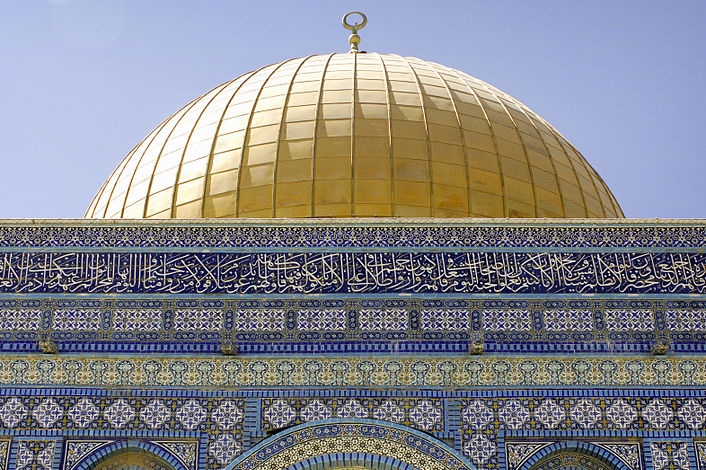
War memorials are as common as warfare, creating legitimacy and forming identity through powerful collective commemoration of emotionally charged events. War memorials often overlap with political and religious monuments. This essay argues that the Dome of the Rock, which has consistently been analyzed as either a political or a religious monument, can also be interpreted as a war memorial. This conclusion is supported with evidence drawn from the architecture and iconography of the monument alongside the historical context. From an architectural standpoint, the structures design to inspires awe, competes with comparable Christian monuments in the city, and directs visitors into a collective religious practice whilst witnessing the power and wealth of the Umayyads. Within the historical context, the motivations for ‘Abd al-Malik’s commission become clear. It is built immediately following the conclusion of civil war and the resumption of a long-standing pattern of wars with Rome. In the 7th century, the Dome of the Rock would’ve presented the Umayyads and Islam as a unified polity that were victorious over internal dissent and foreign enemies. So, the Dome of the Rock took on a politico-religious meaning by commemorating Islamic military might to grant legitimacy to the Umayyad Caliphate. After the Umayyads, the Dome of the Rock would continue to be used for this same purpose. Subsequent regimes would undertake restorations and leave their names marked inside the Dome, each one using it to assign themselves as the new steward of Islam and thereby claim the victories of Islam. Even to the modern period, the Dome of the Rock is used as a war memorial to commemorate the violent struggle of the Palestinians.
monumentality, memorialization, Dome of the Rock, Islamic architecture, commemoration, archaeology
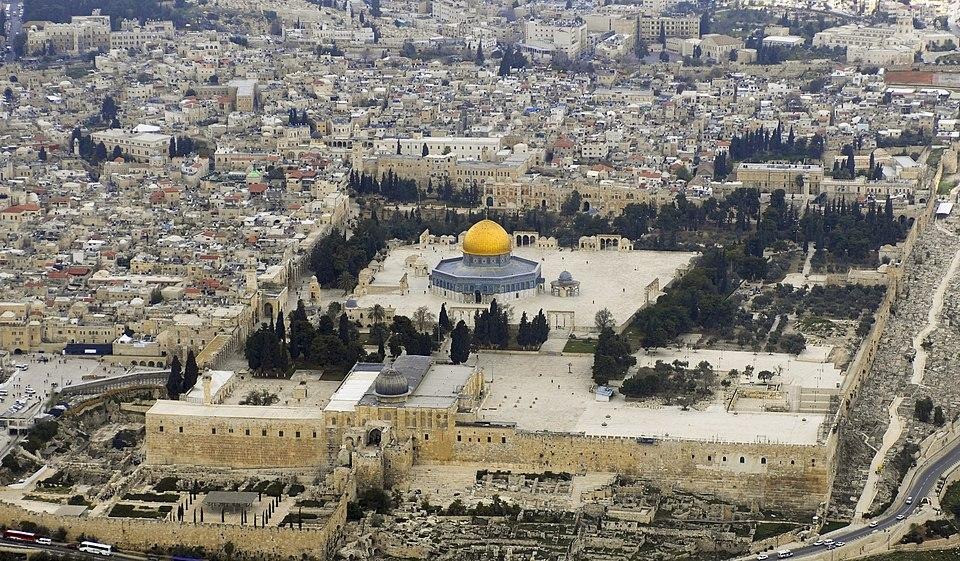
Note. From Aerial views of the Temple Mount and parts of the Old City of Jerusalem [Photograph], by A. Shiva, 2007, Wikipedia). (https://commons.wikimedia.org/wiki/File:Temple_Mount_(Aerial_view,_2007)_01.jpg). CC BY-SA 4.0
_01.jpg)
Jerusalem is the holiest city in Christianity and Judaism, and the third holiest in Islam. Over its 5,000-year history, Jerusalem has changed hands countless times (Asali, 1994). These various peoples and rulers have left enduring marks on a city now filled with monuments, imposing walls, churches, and the iconic Dome of the Rock. Situated atop the Haram al-Sharif, formerly home to the Jewish Temples, the Dome of the Rock dominates the Old City’s skyline, its golden dome visible from every angle (Avner, 2010; Carswell, 2000). For Muslims, the Dome and the adjacent al-Aqsa Mosque form one of Islam’s three holiest sites and have drawn pilgrims for over 1,300 years (Clark, 2012; Laurent, 1998). For scholars, the Dome has been a subject of debate for roughly a century, beginning with restoration efforts under the British Mandate (Carswell, 2000; Laurent, 1998). Many scholars view it as asserting Islam’s theological dominance over the other Abrahamic faiths; others see it as a challenge to the Roman Empire’s architectural legacy (Clark, 2012; Avner, 2010; Grabar, 1959). For many Muslims, it enshrines the sacred rock where Muhammad undertook his Miraj (night journey, when the Prophet miraculously traveled to Jerusalem and then Ascended to heaven), or where God ascended after creation (Levy-Rubin, 2017; Clark, 2012; Rabbat, 1989; Grabar, 1959). These interpretations are not mutually exclusive. Monuments and memory are dynamic, reshaped by audience and context (Maurantonio, 2014). They are also multivalent, holding simultaneous and sometimes conflicting meanings (Maurantonio, 2014). As such, the Dome of the Rock’s meaning and function has changed throughout time, being repurposed continuously by the various peoples and regimes that have occupied it: from the Umayyads to modern Palestinians. Regardless of this diversity, its role as a religious monument and, as will be argued, a war memorial has persisted through time adopting new adornment and layering meanings to continuously provide legitimacy for the various Islamic peoples of Jerusalem.
This essay hopes to propose a novel interpretation of the Dome of the Rock: that it functions as war memorial which does not commemorate one specific conflict but rather triumphs and struggles that legitimize the claimant groups throughout time. The kind of legitimacy and the specific conflict narratives depend on context, but it has always commemorated the success of Islam and its associated regimes or people. Even in the modern period this function is adopted by the Palestinians, who employ it as a symbol of their resistance and legitimacy for their continued existence in Jerusalem. However, framing it as a commemorative monument to the early Islamic state’s military and ideological victories, particularly over the Roman Empire and internal rivals of the Second Fitna, integrates traditional readings and a new perspective on its enduring role in Islamic collective memory.
While political, religious, and commemorative meanings often overlap, their primary functions are distinct. A political monument asserts regime legitimacy through iconography and spatial design. A religious monument defines sacred space or conveys theological principles. A war memorial centers on conflict and remembrance, commemorating military struggle, victory, or the significance of war-related events (Tveskov and Bissonnette 2023; Messenger, 2020; Maurantonio, 2014). Their ties to violence and trauma grant war memorials a unique power to shape collective identity, either by facilitating mass grief or celebrating triumph. So, when war memorials overlap with religious and political symbols, they can offer a unique and powerful method to embed political and religious meanings through the powerful emotions of collective grief and pride. Because of the active engagement that war memorials evoke, they can be used to shape identity and legitimize authorities or entire peoples. These operations are embedded in the form and history of the monuments, as the shape, iconography, and memory of the monuments direct the commemorative acts of the audience. Since the Dome of the Rock is explicitly a religious pilgrimage site rather than a site tied to a specific conflict—an example being the Vietnam Veterans Memorial—a deeper examination of its form, structure, and history is required to validate its role as a war memorial.
Form and Structure
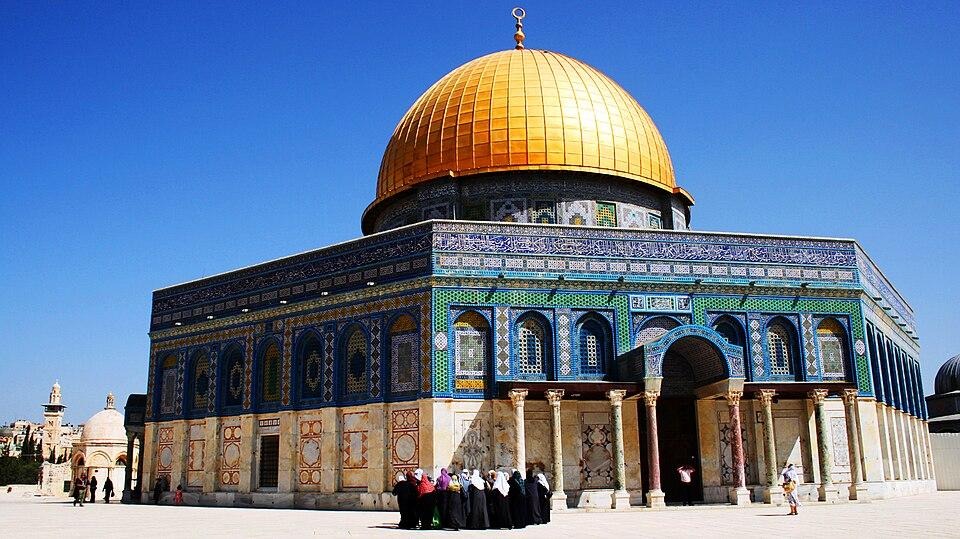
Note. From The Dome of the Rock in Jerusalem with women in the foreground [Photograph], by O. Havelka, 2012) Wikipedia). (https://commons.wikimedia.org/wiki/File:The_Dome_of_the_Rock_in_Jerusalem_with_women_in_the_foreground.jpg). CC BY-SA 4.0

Typical of most monuments, the Dome of the Rock engages visitors visually through its form, art, and spatial context. It sits atop the Haram al-Sharif, elevated above most of the Old City and roughly level with the Church of the Holy Sepulchre, Jerusalem’s most important Christian site. Its contrast with the Church of the Holy Sepulchre is immediately apparent from its more ornate exterior featuring a golden dome and colorful tilework. Its orientation allows visibility from both the Church of the Holy Sepulchre and the Church of the Ascension, being directly visible when exiting the main doorway of the former (Clark, 2012; Avner, 2010; Carswell, 2000). The Dome is built in the Byzantine style seen elsewhere in the region, echoing 7th-century Levantine churches like those mentioned above, in addition to the Church of the Virgin Mary, and the archaeologically recorded Kathisma Church (Avner, 2010). It consists of an octagon with eight 18-meter-wide, 11-meter-high walls, topped by a 20-meter-diameter golden dome that rises at roughly 30 meters.
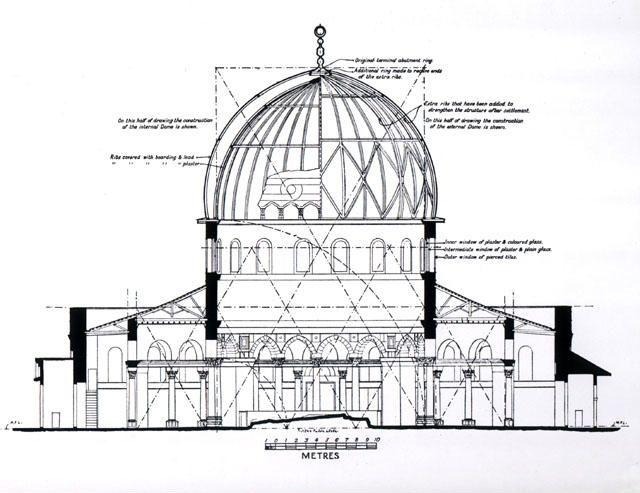
Note. From A sectional view of the dimensions of the Dome of the Rock [digital image], by K.A.C. Creswell, n.d., Ashmolean Museum, Oxford. (https://www.archnet.org/collections/1256) CC BY-SA 4.0
The exterior is clad in intricate tiles painted in the 7th-century Iranian and Syrian traditions, though many have been replaced over time (Clark, 2012; Carswell, 2000; Laurent, 1998). Inside, a 240-meter continuous mosaic wraps around the dome’s double arcade. This frieze features vine motifs, golden vases and palm trees—in accordance with Islamic aniconism, the rejection of idols—and displays inscriptions that include Qur’anic verses, prayers, construction dates, and the names of construction patrons (Avner, 2010; Carswell, 2000; Laurent, 1998; Grabar, 1959). Clark (2012) suggests the inclusion of diacritic marks was intended to aid foreign, possibly non-Muslim, visitors, who may have had access to the site at the time of its construction.
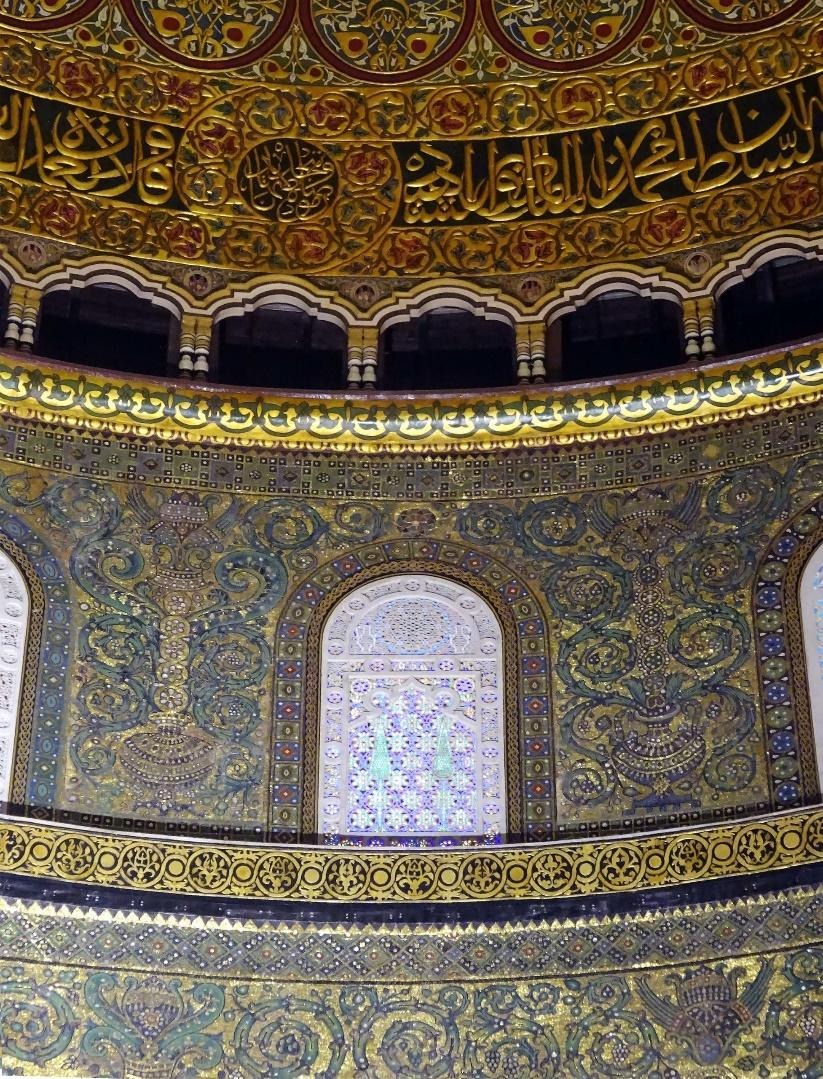
Note. From Dome of the Rock inside viewing upwards, golden ornaments and Arabic writing [Photograph], by Virtutepetens, 2018, Wikipedia. (https://commons.wikimedia.org/wiki/File:Ornament_and_writing_at_Dome_of_the_Dome_of_the_Rock_inside_2.jpg). CC BY-SA 4.0

The Dome’s interior encourages active engagement through its architecture by being designed for double circumambulation, wherein one reverses direction after the first circuit. This ritual movement is common within Islamic practice, most notably at the Kaaba. Though, it is also prominent in Christian monuments of the period, namely the Kathisma Church which also facilitated double circumambulation (Avner, 2010). This motion is necessary to read the inscriptions in the correct order, so that groups of visitors or devotees would be marching around the dome together, eyes up at the inscriptions before wheeling in unison to march back the other way continuing to read about the unity, power, and nature of God (Levy-Rubin, 2017, Clark, 2012). Finally, at the Dome’s center there lies a sacred stone, beneath which is a cave. This structural feature echoes contemporary Christian shrines like the Rotunda of Anastasis, the Martyrium, the Nativity Church, and the Church of the Ascension (Clark, 2012; Avner, 2010; Carswell, 2000; Laurent, 1998). The sacred stone has since taken on various roles in Islamic theology, in particular as the site of Muhammad’s Mi’raj or the footprints of God—both beliefs emerge only after the construction of the Dome was completed, so cannot be considered the incitement to construction. Another popular theological association connects the sacred stone to the site of the Binding of Isaac, but this results from a conflation between the land of Moriah and Mount Moriah, and again does not seem to be a valid description the original purpose of the monument (Levy-Rubin, 2017; Rabbat, 1989; Grabar, 1959).
History: Civil War and Roman Rivalry
According to the interior inscriptions, the Dome of the Rock was constructed in 692 CE by the Umayyad Caliph ‘Abd al-Malik (Clark, 2012; Avner, 2010; Grabar, 1959), though Omer (2015) argues that the construction could not have started until after 692 CE due to resource limitations. It marks the triumph of Islam, and by extension the Umayyads, in two conflicts (Clark, 2012; Kennedy, 2004; Kaegi, 1995). The internal conflict was a civil war from 680 CE to 692 CE called the Second Fitna, ignited by the death of the first Umayyad Caliph Mu’awiya and concluded by the fifth ‘Abd al-Malik. The Second Fitna ended when rival Caliph ‘Abd Allah ibn al-Zubayr was slain in an Umayyad siege (Omer, 2015; Clark, 2012; Hawting, 2000). The external conflict emerged as an inherited series of wars with the Roman Empire, initiated by Umar and Uthman and resumed by ‘Abd al-Malik at the battle of Sebastopolis in 692 CE (Kaegi, 1995). Though the siege of ibn al-Zubayr or the battle of Sebastopolis make alluring candidates to attribute to the Dome, the traditional dating of construction renders both unlikely, unless Omer’s argument is accepted.
These conflicts emerge from the events following Muhammad’s death in 632 CE. Though the Caliphate was briefly united by Abu Bakr, factions soon emerged between supporters of oligarchic elections and supporters of Muhammad’s closest relative, Ali (Clark, 2012; Kennedy, 2004; Rabbat, 1989). Abu Bakr was followed by Umar, Uthman, and finally Ali who collectively comprise the Rashidun Caliphs (Clark, 2012; Kennedy, 2004). In 656 CE, Ali’s suzerainty was challenged by Uthman’s family, led by Mu’awiya, over the circumstances of Uthman’s death. This First Fitna was concluded in 661 when Ali was assassinated, establishing Mu’awiya as the leader of the Umayyad Caliphate (Kennedy, 2004). Divisions deepened and shifted under Mu’awiya, who engaged in the unpopular policies of nepotistic political appointments, exclusion of Hejazi elites, and the adoption of Roman and Persian administration. When Mu’awiya pronounced his son Yazid his heir, the precedent of oligarchic elections was broken and a schism between the cosmopolitan Umayyads and the conservative Hejazi elites was cemented (Clarke, 2012; Kennedy, 2004). In 680 CE Mu’awiya’s death ignited the Second Fitna with Muhammad’s grandson. After 683 CE the Second Fitna continued between successive Umayyad Caliphs and ibn al-Zubayr, who was a Meccan Caliph that seized control of Arabia. ‘Abd al-Malik acceded in 685 CE, a private and public rivalry with ibn al-Zubayr following (Kennedy, 2004; Carswell, 2000; Rabbat, 1989; Grabar, 1959). Although both were capable, charismatic, and acclaimed religious scholars (Clarke, 2012), ‘Abd al-Malik ultimately prevailed in 692 CE, establishing Umayyad supremacy until the Abbasids rose half a century later (Kennedy, 2004).
The conflict with Rome leading up to the Dome’s construction unfolded in three periods. First, the Rashidun Caliphate under Umar and Uthman expanded into Roman territories, capturing the Levant, Syria, and Egypt (Clark, 2012). Umar personally accepted Jerusalem’s surrender, and upon entry found the Haram al-Sharif neglected, allegedly covered in refuse by the Romans (Clark, 2012; Avner, 2010; Grabar, 1959). Islamic narratives of the era depict the Romans as oppressors of the Jews and as negligent, having allegedly left Jerusalem in a state of utter disrepair and squalor (Clark, 2012; Avner, 2010). The second period was marked by Mu’awiya’s failed siege of Constantinople in 678 CE resulting in a peace treaty that cost the Umayyads the island of Rhodes, and imposed an annual tribute of gold, captives, and horses for 30 years (Omer, 2015; Kaegi, 1995). The third began with the victory at Sebastopolis, that put an end to the prior treaty obligations and reasserted Islamic strength (Kaegi, 1995).
Two key takeaways emerge: 1) after Muhammad’s death, ideological and geographic fractures emerged between Peninsular (Hejazi Elites) and Levantine (Umayyads) Muslims. This divide intensified before the Dome’s construction and was resolved by ‘Abd al-Malik, who sought to present Islam and the Umayyads as unified victors; and 2) A trend of wars with Rome during periods of strength and regime change. So, The Dome of the Rock was constructed to commemorate Umayyad, and thereby Islamic, victory as well as the capacity to end internal strife and resume expansion (Carswell, 2000; Laurent, 1998; Rabbat, 1989).
Meaning and Memorialization
The history of Islam and the Umayyads serves as a foundation for this interpretation of the Dome of the Rock as a commemoration to the military and spiritual victories of the Caliphate, simultaneously heralding a new era of Islam through its architectural expression. With the defeat of Ibn al-Zubayr, the Hejazi Elites were subjugated, and power was consolidated within the Umayyad family. The Umayyads’ new system of governance—inclusion of conquered peoples, centered in Syria, and dynastic rule—was proven superior, at least temporarily, through ‘Abd al-Malik’s triumph. The Dome of the Rock, constructed in a Byzantine-Jerusalemite tradition and adorned with Persian-style tiling, encapsulates key tenets of Umayyad authority: dynastic and bureaucratic power. Moreover, it inaugurates the tradition of Islamic monumental architecture blending Byzantine and Persian styles, and emphasizing symmetry, ornate geometry, calligraphy, and aniconism. So ‘Abd al-Malik visually and symbolically asserted his presence in the third holiest city in Islam, thereby influencing all subsequent Islamic constructions, including the Great Mosques of Damascus and Kairouan, Ottoman architecture, and the Taj Mahal (Clark, 2012). The many inscriptions inside the Dome emphasize the unity and superiority of Islam by directly critiquing Christianity with statements such as “God has no partner in divinity,” asserting the role of Muhammad as the final prophet, including sura that focus on God’s power like the Sura Al-Ikhlas, and including dedications to ‘Abd al-Malik which leave no confusion as to who is the builder of the monument and the new sole steward of the Caliphate (Clark, 2012; Avner, 2010; Laurent, 1998; Grabar, 1959).
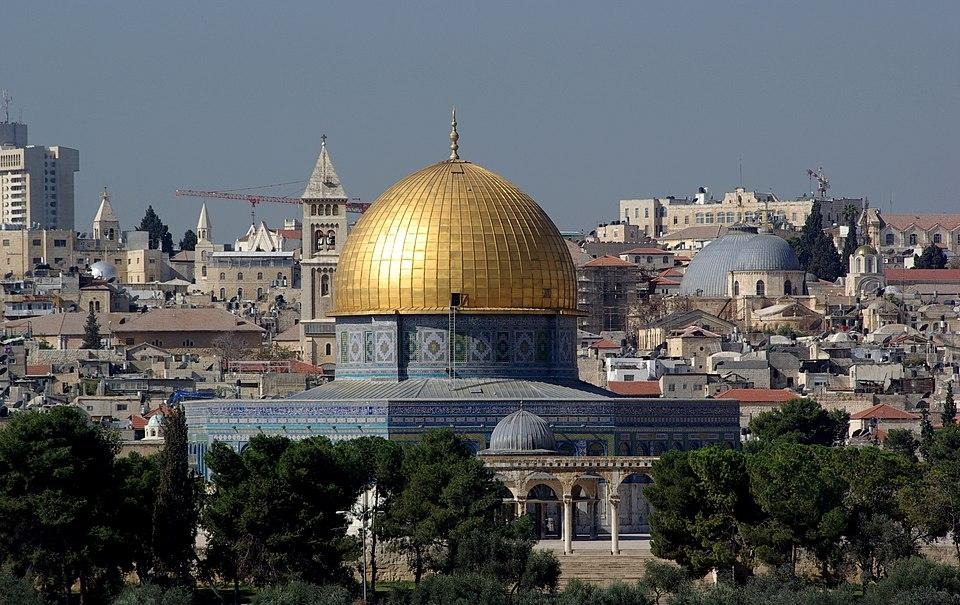
Note. From Jerusalem, Dome of the Rock [Photograph], by B. Werner, 2008, Wikipedia. (https://commons.wikimedia.org/wiki/File:Jerusalem_Dome_of_the_rock_BW_3.JPG). CC BY-SA 4.0

As the first Islamic monument (the Kaaba was built by Arab polytheists), the Dome of the Rock presented a direct challenge to Christian Rome’s longstanding dominance in the region (Levy-Rubin, 2017). It reclaimed the previously neglected Haram al-Sharif, transforming it from a degraded Jewish holy site into a resanctified Islamic space thus asserting Islam’s spiritual and political presence. To be a suitable rival, the Dome of the Rock matched the scale and spatial prominence of the most important holy sites for Christians in the City, the Church of the Holy Sepulchre and the Church of the Ascension. Foremost, the original golden dome would have contrasted sharply with the blue and grey domes of the Christian churches, and the bright blue tiles covered in intricate geometric patterns would be the first of their kind to adorn a holy building in the City. Both of the Christian churches were constructed at some of the highest points in the city, such that they can be seen from most of the Old City, and the Dome of the Rock followed this practice, being situated atop the Haram al-Sharif about equal in height to the Christian churches but without neighboring buildings to obscure it (Levy-Rubin, 2017; Clark, 2012; Laurent, 1998; Rabbat, 1989; Grabar, 1959). Furthermore, the Dome’s position can be seen by parishioners of both major churches as they walk to or away from their churches. So, in a city filled with Christian monuments, the Dome of the Rock visually signified Islam’s capacity to equal or even surpass Rome’s religious influence, architectural and artistic ability, and wealth by forcing Jerusalemites of all faiths to recognize its presence. This architectural assertion complements Jerusalemite narratives about Roman rule at the time of construction and aligns with the inscriptions within the Dome which praise Jesus but deny Christian doctrine, in a sense reclaiming him. Prime example being praise for Jesus as the Messiah, “the Messiah, Jesus son of Mary, honorable in this world and the next…”; while denying Jesus’s divinity, “Jesus, son of Mary. The word of truth about which they are disputing” (Clark, 2012; Rabbat, 1989; Grabar, 1959).
At the time of its construction, the intended audience presumably included all inhabitants of Jerusalem, since diacritical marks in the inscriptions inside the Dome could help non-Arabic speakers to read them (Clark, 2012). Visitors would have been actively engaged with the structure by circumambulating the sacred rock, a practice familiar to local Christians, while reading the Dome’s proclamations of Islam as the fulfillment of previous Abrahamic faiths. As people ambulated, the material wealth of the Umayyads would have been unmistakable in the Dome’s design (Clark, 2012; Avner, 2010; Rabbat, 1989). In a large city with many pilgrims and travelers such as Jerusalem, visitors would likely have knowledge about the Umayyad’s major victories over ibn al-Zubayr and the Romans, and so the Dome of the Rock’s architectural message may have been digested with this in mind, thus projecting the image of the Umayyads as victorious and as inseparable with Islam. Within this context, the Dome of the Rock functioned as a communal monument for the residents of Jerusalem and Islamic pilgrims that asserted the Islamic presence in the city and commemorated the anticipated future of Islamic civilization as guided by the Umayyads. In other words, the Dome of the Rock evoked a religious experience to commemorate the prowess of the Umayyads in war, entangle the Umayyad dynasty with the future of Islam, and to establish Islamic roots in Jerusalem. Though ‘Abd al-Malik’s dynasty would fall less than 60 years later, the Dome of the Rock has continued to function the way it was designed for 1300 years, just with different audiences.
Changing Perspectives
This essay has sought to synthesize the political and religious messaging of the Dome of the Rock with the commemorative functions of its design. However, as evidenced by the extensive historical developments following its construction, the Dome’s meaning has always been highly context-dependent (Levy-Rubin, 2017; Clark, 2012; Rabbat, 1989). A brief consideration of both historical and contemporary interpretations is therefore warranted. According to the literature, after the fall of the Umayyads, the Dome of the Rock continued to be employed by subsequent regimes as a medium for asserting legitimacy and celebrating the establishment of new leadership (Levy-Rubin, 2017; Laurent, 1998). The Abbasids, Fatimids, Ayyubids, Ottomans, and Hashemites all undertook significant restorations of the Dome, often inserting symbolic markers of their involvement such as inscribing the names of their Caliphs or introducing embellishments reflective of their own artistic styles (Carswell, 2000; Laurent, 1998). Over these successive regimes the Dome developed a palimpsest quality, with some tiles being replaced while others were refurbished or remained unchanged, or with inscriptions that were simply written over older ones. There were the Ottoman tile restorations, some of which emulated the original style while others adopted newer techniques from Southern Turkey. Those were eventually replaced again by the British Colonial Government and then the Hashemites who attempted to replicate the original 7th century work. Inside the Dome, many Abbasid and Fatimid Caliphs wrote new dedications, with Abbasid Caliph al-Mu’man even writing his dedication over the top of ‘Abd al-Malik, possibly as a political statement since his Dynasty overthrew ‘Abd al-Malik’s (Levy-Rubin, 2017; Carswell, 2000; Laurent, 1998). In each instance, these rulers effectively rebranded the monument to commemorate their own victories and to proclaim the unification of Islam under their leadership.
Even today, the Dome of the Rock continues to serve as a commemorative, spiritual, and explicit political symbol. For Palestinians, it has become a cornerstone of national identity and a symbol of resistance in an environment where their cultural spaces are being appropriated (Luz, 2023; Bar, 2022; Fischer, 2016). It frequently appears in graffiti, souvenirs, political ads, martyria, and in engravings above doorways as a representation of sumud, meaning “steadfastness,” and Palestinian identity (Fischer, 2016). It has gained a function in the nation-building project of Palestinians, becoming a symbol of their sovereignty and legitimate claim to Jerusalem (Luz, 2023; Fischer, 2016). Furthermore, the pilgrimage to the Dome of the Rock and other sacred sites has become embedded within Palestinian collective memory. It is fulfilling the mechanical role of a war memorial by giving the Palestinians a collective behavior to commemorate the Nakba and the 1967 war, and to protest the reduced Palestinian access to cultural sites (Luz, 2023; Bar, 2022; Fischer, 2016). At the same time, exclusive access to the site (only Muslims are allowed to enter) further fosters a distinct Islamic identity and presents the Dome as a space that belongs specifically to Muslims (Fischer, 2016). So, for many modern Palestinians, the Dome of the Rock has become a powerful monument to the collective memory of the violent struggle to remain in Jerusalem and an assertion to their claimed identity as the legitimate rulers of Jerusalem.
From its inception, the Dome of the Rock has served to commemorate military and spiritual victories over Islam’s adversaries, by establishing a connection between Islam and a particular faction within the broader Islamic world. Through its commemorative function, the monument conveys messages of Islamic theological supremacy and asserts the legitimacy of the claimant faction’s association with Jerusalem. While it continues to serve as a symbol of Islamic identity, it has also become emblematic of the ongoing conflicts and struggles that have characterized the region in the past century. Its meaning remains fluid, shaped by the communities that interact with it. War memorials take many forms, and some, like the Dome of the Rock, may not directly reference a particular conflict or military event. This monument is designed to commemorate both material and spiritual victories, and its invocation of a grand narrative of Islamic exceptionalism allows it to remain adaptable to new contexts. Whether or not this adaptability was intended by its original designers, it contributes to the Dome’s enduring power and relevance as a war memorial and palimpsest of meaning.
References
Asali, K. J. (1994). Jerusalem in history: Notes on the origins of the city and its tradition of tolerance. Arab Studies Quarterly, 16(4), 37-45). http://www.jstor.org/stable/41858101.
Avner, R. (2010). The Dome of the Rock in light of the development of concentric martyria in Jerusalem: architecture and architectural iconography. Muqarnas Online, 27(1), 31–49. https://doi.org/10.1163/22118993_02701003
Axel Tveskov, M., & Bissonnette, A. A. (2023). Conflict archaeology, historical memory, and commemoration. In M. Axel Tveskov & A. A. Bissonnette (Eds.), Conflict archaeology, historical memory, and the experience of war: Beyond the battlefield (pp. 1-15). University Press of Florida. https://doi.org/10.2307/j.ctv33jb3sv.5
Bar, D. (2022). The changing identity of Muslim/Jewish holy places in the State of Israel, 1948–2018. Middle Eastern Studies, 59(1), 139–150. https://doi.org/10.1080/00263206.2022.2047655
Carswell, J. (2000). The deconstruction of the Dome of the Rock. In S. Auld & R. Hillenbrand (Eds.), Ottoman Jerusalem: The living city: 1517-1917 Part 1 & 2 (pp. 425–430). Council for British Research in the Levant. https://www.jstor.org/stable/jj.21570566
Clark, G. (2012). The Dome of the Rock: the historical, political and religious motivations behind its construction. Electronic Theses and Dissertations, Paper 225. https://doi.org/10.18297/etd/255
Creswell, K. A. C. (n.d.). A sectional view of the dimensions of the Dome of the Rock [digital image]. In Creswell Archive, Ashmolean Museum, Oxford. https://www.archnet.org/collections/1256
Fischer, N. (2016). Seeing and unseeing the Dome of the Rock: Conflict, memory, and belonging in Jerusalem. In A. Björkdahl & S. Buckley-Zistel (Eds.), Spatializing peace and conflict: Mapping the production of place, sites and scales of violence (pp. 242–264). Houndsmills: Palgrave Macmillan. https://doi.org/10.1057/9781137550484_13
Grabar, O. (1959). The Umayyad Dome of the Rock in Jerusalem. Ars Orientalis, 3, 33–62. http://www.jstor.org/stable/4629098
Havelka, O. (2012). The Dome of the Rock in Jerusalem with women in the foreground [Photograph]. Wikipedia. https://commons.wikimedia.org/wiki/File:The_Dome_of_the_Rock_in_Jerusalem_with_women_in_the_foreground.jpg
Hawting, G.R. (2000). The first dynasty of Islam: The Umayyad Caliphate AD 661-750. Routledge. https://doi.org/10.4324/9780203137000
Kaegi, W.E. (1995). Byzantium and the early Islamic conquests. Cambridge University Press. https://doi.org/10.1017/CBO9780511470615
Kennedy, H. (2004). The Prophet and the Age of Caliphates. Pearson Education. https://doi.org/10.4324/9781315673516
Laurent, B. S. (1998). The Dome of the Rock and the politics of restoration. Bridgewater Review, 17(2), 14–20. https://vc.bridgew.edu/br_rev/vol17/iss2/8
Levy-Rubin, M. (2017). Why was the Dome of the Rock built? A new perspective on a long-discussed question. Bulletin of the School of Oriental and African Studies, 80(3), 441–464. https://doi.org/10.1017/S0041977X17000908
Luz, N. (2023). Transformations in Islamic pilgrimage patterns and meanings: Piety, politics, resistance, and places of memory in Islamic pilgrimage sites in Israel/Palestine. Religions, 14(8), 1043. https://doi.org/10.3390/rel14081043
Maurantonio, N. (2014). The politics of memory. In K. Kenski & K. Hall Jamieson (Eds.), The Oxford handbook of political communication (pp. 219-232). Oxford University Press. https://doi.org/10.1093/OXFORDHB/9780199793471.013.026
Messenger, D. A. (2020). War and public memory: Case studies in twentieth-century europe. University of Alabama Press. https://doi.org/10.1086/715303
Omer, S. (2015). The Dome of the Rock: an analysis of its origins. Journal of Islam in Asia, 12(1). https://doi.org/10.31436/jia.v12i1.466
Rabbat, N. (1989). The meaning of the Umayyad Dome of the Rock. Muqarnas Online, 6, 12–21. https://doi.org/10.1163/22118993-90000230
Shiva, A. (2007). Aerial views of the Temple Mount and parts of the Old City of Jerusalem [Photograph]. Wikipedia. https://commons.wikimedia.org/wiki/File:Temple_Mount_(Aerial_view,_2007)_01.jpg
Virtutepetens. (2018). Dome of the Rock inside viewing upwards, golden ornaments and Arabic writing [Photograph]. Wikipedia. https://commons.wikimedia.org/wiki/File:Ornament_and_writing_at_Dome_of_the_Dome_of_the_Rock_inside_2.jpg
Werner, B. (2008). Jerusalem, Dome of the Rock [Photograph]. Wikipedia. https://commons.wikimedia.org/wiki/File:Jerusalem_Dome_of_the_rock_BW_3.JPG
Citation Style: APA 7th edition