The Okefenokee Swamp, Spirituality, and Resource Management:
From Native Americans to Contemporary Naturalists
by Liza Porras
College of Agriculture and Environmental Science
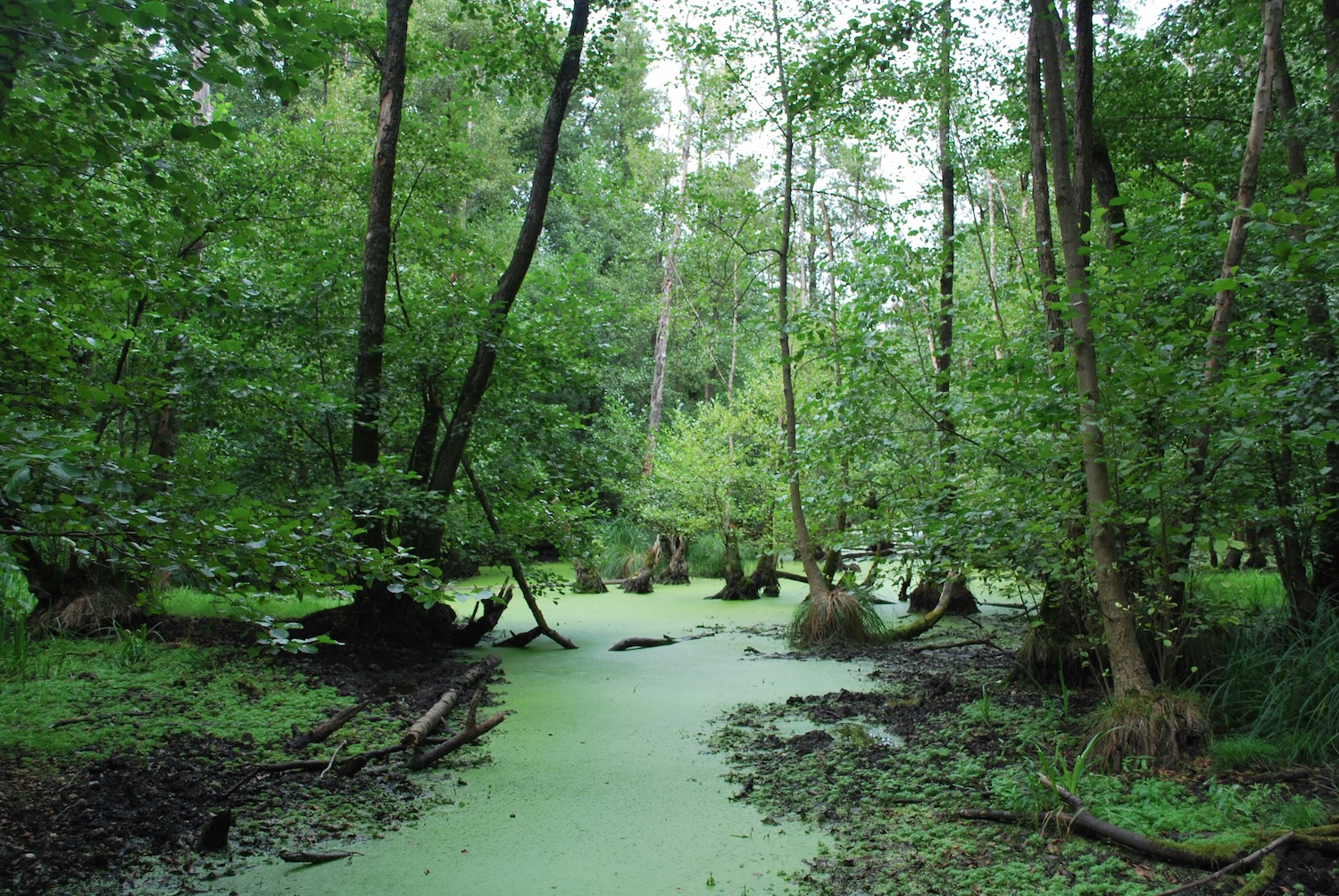
The Okefenokee swamp is a large swamp that has hosted several groups of people who each used the land, water, and wildlife differently, each with different beliefs that they felt validated this usage. Before the white colonizers came to the Okefenokee Swamp, there were several Indigenous tribes with their own beliefs and traditions around maintaining the swamp. Once the colonizers came, their numbers—and thus, their legends—were largely wiped out. Okefenokee Swamp lore was then largely developed by the African slaves who were brought over, as they spent more time inside the swamp working rice plantations and used natural media from the swamp for spiritual protection. For decades before and after the Civil War, free Blacks and poor whites scraped out a living on the edges of the swamp, spinning yarns about ‘haints’ and strange creatures that roamed the mist. Later, the ‘swampers’ who were primarily Primitive Baptists focused their lives on the swamp, sustaining themselves with simple living—still with idiosyncrasies exclusive to the ‘piney woods life.’ Most inhabitants were further driven from the swamp after its establishment as a National Wildlife Refuge, and now the Okefenokee mainly serves as a tourist and recreation site. Those who visit even now feel a connection with the land and the life contained there, with the legends of the past serving as a backdrop to land management practices focused on careful maintenance, protection, and preservation of this area.
Okefenokee Swamp, folklore and legend, cultural land use, swamp communities, environmental history
Introduction to the Okefenokee
The Okefenokee Swamp is an ecosystem unlike any other. Located in Southern Georgia and part of Florida, it spans over 600 square miles and is the largest blackwater swamp in North America.1 Within its large range, there are 21 distinct habitats, each hosting its own unique blend of species.2 The most iconic habitat is the baldcypress swamp—as shown in Figure 1—but this amazing location is also home to floating peat bogs, longleaf pine forests, and sedge prairies.3 While paddling through the swamp, you could see an American alligator lurking beneath the surface or a diamondback rattlesnake slithering through the forested shore of an island, all while the songs of herons, woodpeckers, and hawks filter down from the sky.4
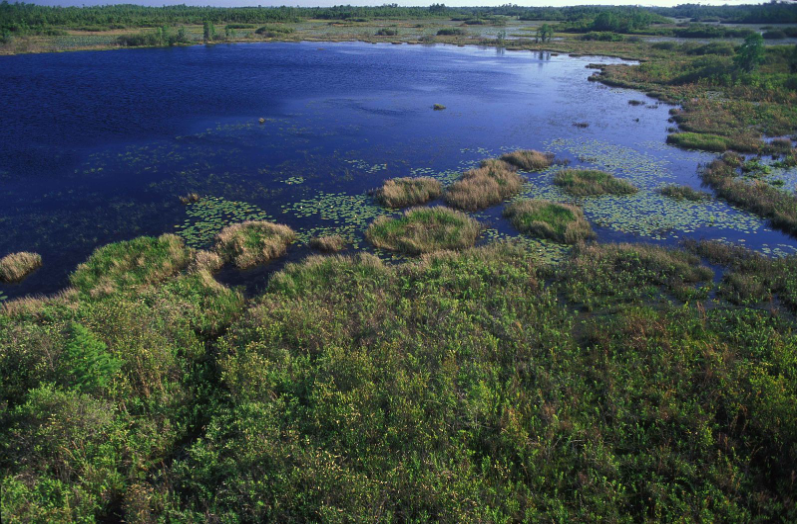
Photograph by Ryan Hagerty, Aerial view of wetlands in Okefenokee, 28 February 2013, photograph, U.S. Fish & Wildlife Service, Okefenokee Swamp, https://commons.wikimedia.org/wiki/File:Aerial_view_of_wetlands_in_Okefenokee.jpg
Humans and Resources in the Okefenokee
The lush habitat and abundant wildlife have made this area one of increasing interest to humans for resources like food, timber, cash crops, and even mineral deposits. The specific resources people focus on, the methods people use to harvest these resources, the frequency with which they are harvested, and other ways the swamp is manipulated in relation to these vital resources are of great interest to the health and longevity of both the resource in question and Okefenokee as a whole. Often, when considering resource management, the quickest economic gain comes from improper resource management, where a resource is overharvested or harvested in a manner that harms the surrounding environment. While this method allows for higher profit in the short term, such prosperity fades as resources dwindle and the landscape quality degrades. For a location like the Okefenokee, ideal resource management is intentional and limited in its impacts. This would allow it to continue serving as a habitat for wildlife, a carbon sink, a place of scientific study, and a cultural refuge.
This has not always been the case in the past, as every group of people has had different ideologies surrounding the environment and how the resources should be managed, each with distinct impacts and benefits. There are four main periods of life and work in the swamp, which can be broken up into the following: pre-colonization Native American inhabitants, pre-Civil War overseers and slaves, Reconstruction Era ‘crackers’ and loggers, and post-1937 visitors. The core social ideas of each group will be explored through their spiritual beliefs as a representation of their attitudes around the Okefenokee as a whole and how its resources should be managed.
Native Americans
The Okefenokee Swamp was first inhabited by several Native American tribes who mainly managed the swamp for food, which is reflected in the various remaining legends and religious practices surrounding the harvest of crops. Artifacts found in the swamp have shown that humans have lived in and around the area for at least 4,000 years, indicating the substantial period during which humanity has had to benefit from the swamp and change the ecosystem to further benefit human society.5
The main tribe in the area was the Muscogee Creek tribe; however, once colonizers began to push the Seminole people and other tribes out of the surrounding regions, the swamp acted as a catch-all for those displaced—to the point where ‘Seminole’ eventually became a term that was applied to any Native Americans in the area, regardless of their tribe of origin.6 Due to the forced mixing of tribes, racist biases when documenting discoveries, and mass death as a result of disease, it is likely that more tribes lived in the swamp, and these tribes were either not properly researched or were not alive when such research was being performed.7 It is important to acknowledge that a comprehensive cultural history unfortunately does not exist, but that does not mean there is nothing left for us to study and retell. Despite losses from disease and their eventual removal by the U.S. government, many aspects of Creek and Seminole culture were immortalized in writings from explorers and tribe members, giving a glimpse of what these tribes believed and how that impacted their use of resources.8
Based on the limited available spiritual readings about festivals and sacred rites, the swamp was mainly likely used for farming, hunting, and gathering.9 Farming is important to the propagation of any society, and in many non-industrial civilizations, it is the main resource that matters at a management level—for example, managing a parcel of land for pine would be illogical if you are starving and could use that land for domesticated livestock. The importance of food is apparent in the religious ceremonies developed around planting and harvest times to ensure a good crop yield.
For the Creek, the cornerstone of one’s diet was corn—also known as maize—and the Creek held much respect for nature’s ability to provide them with such a versatile crop.10 The legends about the creation of corn vary by region, but many involve a grandmother figure producing corn from her body—sometimes from the soles of her feet, other times from her blood— and teaching people how to plant it.11 Such a legend shows the personification of nature and food, the act of which decreases motivations for resource exploitation. The Creek did not see a harsh divide between them and their ecosystem, contrasting with Western beliefs. There were also various ceremonies held throughout the year involving corn, one being the “Poskita”, which has been compared to a sort of New Year’s.12 Descriptions vary, but the common historical consensus speculates that this ceremony was based around fasting, with a large feast and dancing combined with the burning of food and old crops occurring at the end of the fast.13 This ceremony again shows respect for the food provided by the ecosystem, and signals an era of rebirth. It is also known that these tribes used controlled burns to encourage deliberate regrowth of the land and provide nourishment for next year’s crop.14 While such an example of resource management might seem harmful, controlled burns are incredibly beneficial. Ash from burned vegetation helps with nutrient cycling in ecosystems, provides more room and sunlight for desired crops, and can also lessen the severity of natural wildfires by making smaller and more easily controlled fires.
Other surviving stories are about the landscape, with one of the most well-known ones being the Creek tale of ‘The Legend of the Enchanted Island in the Okefenokee Swamp,’ with this particular version coming from the Works Progress Administration: Georgia Writers Project.15 The legend goes that there were some starving hunters lost in the mazes of the swamp who stumbled upon a hidden island inhabited by a tribe with exceptionally beautiful women called the ‘Daughters of the Sun.’ The island was surrounded by crystalline streams, live oaks, strange flowers, and delicious fruits, and the hunters gratefully indulged in the food offered by the Daughters of the Sun. They wanted to take these women for their wives, but the women vanished, never to be seen again. As a result, both the hunters in this story and in real life took special care to avoid venturing too far into the depths of the swamp, only taking what they needed so as not to get lost.16 This story, with its discouragement of exploitation, exemplifies the conscious and respectful resource management practiced by the native tribes in the area. This folktale not only minimizes the willingness to exploit the area, but also encourages kinship amongst hunters and discourages them from wandering off into unsafe and unexplored areas. While there was a large element of fear and mysticism to the vast, unexplored environment, the Indigenous peoples responded by honoring the area they relied on. This fear and devotion kept the Creek from abusing the Okefenokee, but to newcomers the swamp remained an area ideal for exploration and, namely, exploitation.
Pre-Civil War
After the removal of Native Americans from the area, whites attempted to manage the area for monetary purposes, while Black individuals managed the area for their own protection. As Christian colonizers encountered the Okefenokee, initial reactions ranged from very distrustful to, occasionally, very favorable. The dichotomy of the reactions to the swamp can be summarized in the following quote: “[the] Okefenokee has been variously described ‘as a terrifying bog, a Garden of Eden, a dismal swamp and the most blissful place on earth,’” demonstrating the way different value systems impact one’s view of resources.17 Some saw the Okefenokee as beautiful and valuable on its own, akin to the bountiful Christian Garden of Eden, whereas the people who had the more popular, European idea of an area only being valuable if it could provide profit, found it inadequate. Despite the amazement and ambition some settlers felt upon seeing the Okefenokee, reasons such as the fear of dangerous wildlife and threats of disease caused mostly slaves to be used as the point of ‘first contact’ with any swampland, as whites attempted to turn the area into money-making rice plantations.18
As opposed to the settlers, the enslaved peoples who were put to work in the swamp found spiritual value and safety within the swamp’s various waters and islands. Slaves coming from various regions of Africa brought with them their spiritual and cultural beliefs, but the ways in which they were allowed to partake were restricted by overseers. In many pieces of literature contemporary to this time, whites called the practices they did not understand ‘Vodou,’ when in actuality, it was most likely Hoodoo they were witnessing.19 Hoodoo was created by enslaved African Americans in the South to invoke change in their daily lives using the natural world around them, and was commonplace in slave quarters and in the homes of free Blacks around this time.20 In this region, it would later be mostly replaced by or mixed with Christianity; however, Hoodoo remains practiced by groups like the Gullah Geechee.21 Upon introduction to this new landscape, Hoodoo mainly showed up in the various charms and signs in and around the Okefenokee that were said to hold meanings for the future and protection from harm.22 This also encouraged resource management around the cultivation of certain wildlife deemed spiritually meaningful, changing the overall makeup of the swamp.
In an area where being a person of color brought with it the threat of violence, it is no surprise that those persecuted turned to the swamp for help. Several rituals intended to either shelter the spellworker or harm an adversary involved animal parts from various swamp creatures.23 One such ritual that was referred to in primary source documents involved “conjur bags,” which were potentially intended to curse an overseer.24 They would contain various hairs or literal pieces of animals that could be taken from the swamp, helping Black people deal with the intense oppression that ran rampant during this era.25 The swamp was also rumored to be home to stores of gold and fresh water, an enticing promise that led many enslaved individuals to look for them with special “divining rods,” usually fashioned from the branches of certain tree species.26 Based on spiritual beliefs, the swamp was offering a way to survive, or even a way out of poverty. Although technically the slaves did not have the resources to even attempt to exploit the swamp, such beliefs in the supernatural elements contained within it kept them from considering it as an option outright. Instead, people of color turned to the swampland for a better life and a greater sense of agency. The same ‘humble’ lifestyle of subsistence management persisted in some poor Christians who later moved into the area.
Reconstruction
Many post-Civil War poor settlers of the Okefenokee Swamp—often called ‘crackers’ or ‘swampers’—managed the area for livestock and small farms, while other inhabitants heavily logged the area. The crackers were heavily isolated by the area’s geography and hyper-religious in nature.27 The development of this tight-knit community could be tied to the relative safety, privacy, and subsistence offered by the seemingly endless vegetation, game, and distance from modern society after the social turbulence of the Civil War and the economic losses experienced during and after wartime. These private ideals appealed to both formerly enslaved people of color who were facing persecution after the Civil War and needed to make a living, as well as poor whites who needed a cheap place to make a meager living or who were unhappy with how society was progressing.
The main religion in the area at this time was a unique brand of Primitive Baptist Christianity that came from New England immigrants and evolved in the isolated area, and it fostered a community-based way of resource management centered around the morals of the Bible.28 Due to the protective nature of the swamp and their isolated religious disposition, these groups of people aimed to change the landscape as little as possible, as they believed God intended.29 In fact, many sermons openly preached about the evils of greed, like the story of Dives and Lazarus. Dives was rich, selfish, and unwilling to help the poor Lazarus. The preacher proclaims that by Dives refusing to help, “Inter hell he leaped”—spoiling his soul with his greed.30 By discouraging his congregation from being greedy using religion, he is simultaneously saving the natural resources of the Okefenokee from exploitation and encouraging communal management for the moral betterment of the inhabitants.
Just as the swamp gave an image of safety and sanctity, it provided a sense of uncertainty and fear that kept people from truly utilizing and monetizing the resources. There are many warnings about going out at night for fear of coming upon ghosts and various other monstrous entities, including ‘St. Elmo’s Fire,’ ‘Will-o-the-Wisps,’ and ‘Fog Wraiths.’31 There were also a myriad of tales about witches, men rising from their graves, and strange bodily fits that would take hold of someone who spent too much time in the swamp.32 Such stories convey a risk of messing with ecological equilibrium or other such devilish pursuits, and signal an intermediary period between the spiritual Hoodoo management of the past and the new wave of Christian abstinence.
Groups like the Hebards most likely operated under the spiritual assumption that the world is for God’s greatest creation to use as they cut down large swaths of old-growth cypress. This undid centuries of growth and careful ecological balance as trees were removed much faster than they could grow back. Interestingly, this is an example of the same spiritual matrix having the complete opposite effect on one’s view of resource management. Once the area was no longer profitable enough for the loggers because the remaining trees were too hard to reach, it lay destitute and largely abandoned until FDR eventually declared the area a National Wildlife Refuge.33
Contemporary: Life After 1937
Today, no people currently inhabit the Okefenokee Swamp; however, that does not mean it has lost its spiritual and cultural value. The Okefenokee National Wildlife Refuge was created in 1937 and forcibly pushed out any remaining settlers from the region.34 However, as science has continued to advance and societal spiritual inclinations are changing, the swamp has drawn in more people than ever. The rich diversity of the area continues to captivate all manner of people—whether they have generations of connection or are just discovering it.35 In fact, the area is so culturally and ecologically unique, there are current efforts to have Okefenokee declared a UNESCO World Heritage Site.36 Even with the potential of many more tourists coming to visit if the proposal goes through, it seems that all visitors can agree that there is something larger than mankind in the Okefenokee that demands respect and propagates art.37 As Mark Albertin, a videographer from Augusta, says, “The closest you can get to God, whatever you believe in, is within the earth, within the planet, within the waters”.38 Due to the area’s status as a National Wildlife Refuge, visitors are encouraged to adopt a preservationist management approach to keep the beauty and magic of the Okefenokee around for generations to come—a stark contrast from the Native Americans, who managed the area for food, or the loggers, who clear-cut the area for timber.39 Many photographers, from amateur tourists or seasoned professionals, emphasize the importance of leaving this space as it is.40 The same goes for boaters, fishers, hunters, and hobbyists.41 While spirituality in the form of magical women bearing fruit or eerie cryptids may be less common now, the rise of the belief in humans as kin with the cohesive, responsive entity of nature encourages responsible resource management and respect instead of exploitation.
Conclusion
The Okefenokee Swamp has always been an abundant resource of both physical and spiritual sustenance, and it has been managed for its resources in accordance with the beliefs of those who inhabit it. Despite the separate groups that have experienced the swamp, they all share the idea of dependence on and belief in the diverse natural world contained in the Okefenokee, whether that world is natural or supernatural. The native peoples believed in the swamp’s strange but bountiful harvests, those enslaved turned to Hoodoo rituals using swamp animal parts for safety, those after the Civil War claimed St. Elmo’s Fire would engulf them if they fell victim to avarice or that the land was a glorious gift from God for them to use, and now people go there to see and pay homage to nature in its now-rare wild state.
With the efforts to potentially create a UNESCO World Heritage Site at the Okefenokee that would recognize the cultural history of the area, the spirituality that has remained even when the inhabitants have gone could be felt by many more, and the area could be saved from development. From the Seminoles to the freed slaves, the loggers to the photographers, the Okefenokee Swamp has always been valuable, unique, and otherworldly in some way, and provided a quality to life that would otherwise be lacking, and that should be remembered and felt by all.
Notes
- “The Okefenokee Swamp,” University of Georgia’s River Basin Center, accessed September 28, 2025, https://rivercenter.uga.edu/the-okefenokee-swamp/. ↩︎
- “Natural History of the Okefenokee Swamp,” University of Georgia’s River Basin Center, accessed September 28, 2025, https://rivercenter.uga.edu/the-okefenokee-swamp/okefenokee-swamp-natural-history/. ↩︎
- “Natural History of the Okefenokee Swamp.” ↩︎
- “Okefenokee National Wildlife Refuge,” U.S. Fish & Wildlife Service, accessed September 28, 2025, https://www.fws.gov/refuge/okefenokee. ↩︎
- “Human History and Recreation & Tourism of Okefenokee,” University of Georgia’s River Basin Center, accessed September 28, 2025,
https://rivercenter.uga.edu/the-okefenokee-swamp/okefenokee-human-history-recreation-tourism/. ↩︎ - M. K. Nelson, Trembling Earth: A Cultural History of the Okefenokee Swamp, University of Georgia Press, 2005. ↩︎
- M. K. Nelson, Trembling Earth: A Cultural History of the Okefenokee Swamp. ↩︎
- Bill Grantham, Creation Myths and Legends of the Creek Indians, The University Press of Florida, 2002, https://ufdcimages.uflib.ufl.edu/AA/00/01/16/79/00001/CreationMythsofCreekIndians.pdf ↩︎
- Grantham, Creation Myths and Legends. ↩︎
- Grantham, Creation Myths and Legends. ↩︎
- Grantham, Creation Myths and Legends. ↩︎
- Grantham, Creation Myths and Legends. ↩︎
- Grantham, Creation Myths and Legends. ↩︎
- “Okefenokee National Wildlife Refuge.” ↩︎
- W.P.A. Georgia Writers Project, MS 1500. Hargrett Rare Book and Manuscript Library, The University of Georgia Libraries, Boxes 41-3. ↩︎
- W.P.A. Georgia Writers Project. ↩︎
- E. Merton Coulter, “The Okefenokee Swamp, Its History And Legends,” The Georgia Historical Quarterly, vol. 48, no. 2, 1964, pp. 166–92, JSTOR, http://www.jstor.org/stable/40578461. ↩︎
- M. K. Nelson, Trembling Earth: A Cultural History of the Okefenokee Swamp. ↩︎
- W.P.A. Georgia Writers Project. Georgiana Vertical Files collection – General topical files, ms3609, Hargrett Rare Book and Manuscript Library, University of Georgia Libraries, Cartons 5, 12, 23, 46. “Hoodoo,” Sankofpedia. https://www.sankofapedia.org/wiki/Spiritualities:Hoodoo# ↩︎
- “Hoodoo.” ↩︎
- “Hoodoo.” ↩︎
- W.P.A. Georgia Writers Project. ↩︎
- W.P.A. Georgia Writers Project. ↩︎
- W.P.A. Georgia Writers Project. ↩︎
- W.P.A. Georgia Writers Project. ↩︎
- W.P.A. Georgia Writers Project. ↩︎
- Georgiana Vertical Files collection. ↩︎
- “Exhibits at the Okefenokee Heritage Center,” Okefenokee Heritage Center, 2025, https://okefenokeeheritagecenter.org/. ↩︎
- Georgiana Vertical Files collection. ↩︎
- W.P.A. Georgia Writers Project. ↩︎
- W.P.A. Georgia Writers Project. ↩︎
- W.P.A. Georgia Writers Project. ↩︎
- “Human History and Recreation & Tourism of Okefenokee.” ↩︎
- M. K. Nelson, Trembling Earth: A Cultural History of the Okefenokee Swamp. ↩︎
- “About Okefenokee Swamp Park, Inc,” Okefenokee Swamp Park and Adventures, https://okeswamp.org/osp-inc/. ↩︎
- “The Okefenokee – UNESCO Bid,” Okefenokee National Wildlife Refuge World Heritage Bid, https://okefenokeeworldheritage.org/the-okefenokee-unesco-bid/. ↩︎
- “The Okefenokee – UNESCO Bid.” Jim Garvey and Mark Albertin, “Sacred Waters,” Athens Magazine, https://athensmagazine.com/2023/02/17/sacred-waters/. ↩︎
- Jim Garvey and Mark Albertin, “Sacred Waters.” ↩︎
- “Okefenokee National Wildlife Refuge.” ↩︎
- “The Okefenokee – UNESCO Bid.” Jim Garvey and Mark Albertin, “Sacred Waters,” Athens Magazine, https://athensmagazine.com/2023/02/17/sacred-waters/. ↩︎
- “The Okefenokee – UNESCO Bid.” ↩︎
Bibliography
“About Okefenokee Swamp Park, Inc.” Okefenokee Swamp Park and Adventures. Accessed September 28, 2025. https://okeswamp.org/osp-inc/.
Coulter, E. Merton. “The Okefenokee Swamp, Its History And Legends.” The Georgia Historical Quarterly, vol. 48, no. 2, 1964, pp. 166–92. JSTOR, http://www.jstor.org/stable/40578461. Accessed 16 Nov. 2024.
“Exhibits at the Okefenokee Heritage Center.” Okefenokee Heritage Center. Accessed September 28, 2025. https://okefenokeeheritagecenter.org/.
Garvey, Jim and Mark Albertin. “Sacred Waters.” Athens Magazine, https://athensmagazine.com/2023/02/17/sacred-waters/.
Georgiana Vertical Files collection – General topical files, ms3609, Hargrett Rare Book and Manuscript Library, University of Georgia Libraries. Cartons 5, 12, 23, 46.
Grantham, Bill. Creation Myths and Legends of the Creek Indians. The University Press of Florida, 2002, https://ufdcimages.uflib.ufl.edu/AA/00/01/16/79/00001/CreationMythsofCreekIndians.pdf
“Hoodoo.” Sankofpedia. Accessed September 28, 2025. https://www.sankofapedia.org/wiki/Spiritualities:Hoodoo#
“Human History and Recreation & Tourism of Okefenokee.” University of Georgia’s River Basin Center. Accessed September 28, 2025. https://rivercenter.uga.edu/the-okefenokee-swamp/okefenokee-human-history-recreation-tourism/.
“Natural History of the Okefenokee Swamp.” University of Georgia’s River Basin Center. Accessed September 28, 2025. https://rivercenter.uga.edu/the-okefenokee-swamp/okefenokee-swamp-natural-history/
Nelson, M. K. Trembling Earth: A Cultural History of the Okefenokee Swamp. University of Georgia Press, 2005.
“Okefenokee National Wildlife Refuge.” U.S. Fish & Wildlife Service. Accessed September 28, 2025. https://www.fws.gov/refuge/okefenokee
Hagerty, Ryan, Aerial view of wetlands in Okefenokee, 28 February 2013, photograph, U.S. Fish & Wildlife Service, Okefenokee Swamp, https://commons.wikimedia.org/wiki/File:Aerial_view_of_wetlands_in_Okefenokee.jpg

“The Okefenokee – UNESCO Bid.” Okefenokee National Wildlife Refuge World Heritage Bid. Accessed September 28, 2025. https://okefenokeeworldheritage.org/the-okefenokee-unesco-bid/.
“The Okefenokee Swamp.” University of Georgia’s River Basin Center. Accessed September 28, 2025. https://rivercenter.uga.edu/the-okefenokee-swamp/.
W.P.A. Georgia Writers Project, MS 1500. Hargrett Rare Book and Manuscript Library, The University of Georgia Libraries, Boxes 41-3.
Acknowledgements: I would like to thank Dr. Jason Gordon for introducing me to the Okefenokee Swamp, Holly McMasters for her guidance in finding resources, Jake Knox for his insightful comments, Dr. Laura German for her information on the development of human societies, and numerous peers and editors for their grammar and organizational help. I would also like to thank the helpful staff at the Special Collections and Main Libraries for their time and the retrieval of needed archives.
Citation Style: Chicago