Promoting Agrivoltaics Through Law and Policy: A VIPR Literary Review and Proposal
by Katie Leslie
SPIA and Franklin College of Arts and Sciences
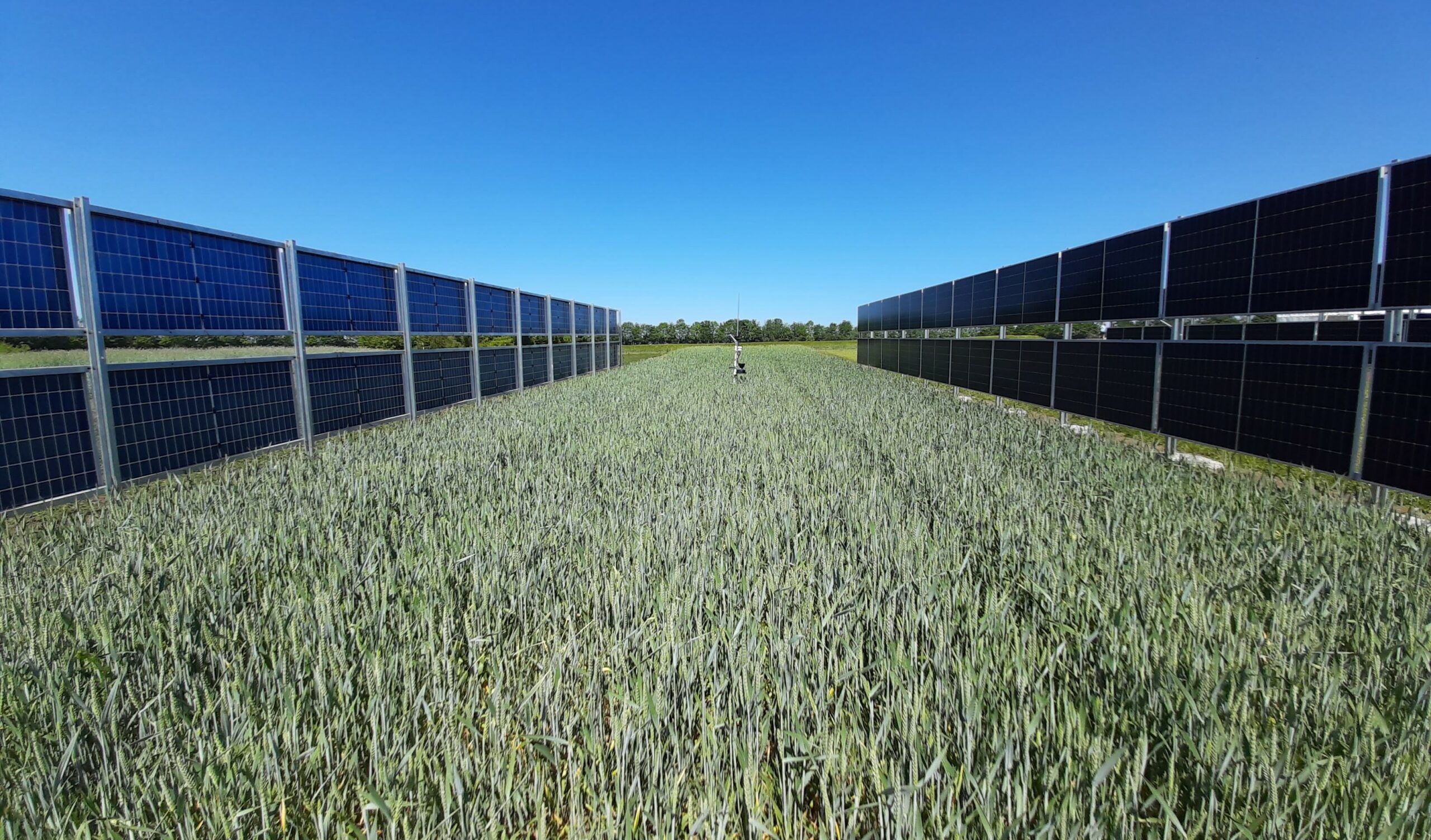
Agrivoltaics (AV) is a system that combines or co-locates solar panels with farmland, allowing for a multifunctionality that resolves a major point of contention, excessive land-use, in constructing solar sites. The numerous benefits of AV include additional revenue for farmers from generating solar energy, a greater use of renewable energy for electricity and crop production, and increased biodiversity. Since this system is new, few are informed of these benefits, and current law fails to address AV enough or consists of many barriers to further support its implementation. My research question focuses on how to improve law and policy to reinforce, prioritize, and protect AV. I hypothesize that if laws have a clear definition of agrivoltaics and related terms, improved zoning and siting rules, and community incentives, the number of agrivoltaics systems will increase. My qualitative data is gathered from a variety of literature on AV like studies on current policies and legal barriers, case studies of U.S. state governments, international AV laws, and primary sources regarding siting and zoning laws or legislation. Any quantitative data will relate to the number of solar farms or AV acreage compared to the number of AV-friendly laws. Since the law determines the implementation of solar projects, there is great significance in analyses on current environmental and agricultural regulations and their effect on multi-use systems like AV. My research aims to develop a multi-faceted, sustainable legal framework to expand AV worldwide and secure an environmentally focused future.
Agrivoltaics, solar energy, sustainability, environmental law and policy, agriculture, solar farm
From Fossil Fuels to Sustainable Energy
Sustainable energy systems are at the forefront of finding solutions to environmental concerns, such as fossil fuels’ impact on climate change. The burning of fossil fuels emits harmful amounts of greenhouse gases into the atmosphere, leading to increased pollution and unhealthy air quality (Lindsey, 2025; Sturchio & Knapp, 2023). Greenhouse gases like carbon dioxide have the effect of trapping in heat, which raises the temperature on Earth. Carbon dioxide’s impact on temperature has detrimental outcomes such as melting ice caps, damaged ecosystems (e.g. the degradation of coral reefs, a crucial habitat for much of marine life), and rising sea levels (Lindsey, 2025). To illustrate the environmental damage over the last three decades, NASA reported that Greenland lost an average of 279 billion tons of ice each year from 1993 to 2019, and Antarctica saw 148 billion tons in that time. The Earth’s oceans have also risen around 8 inches over the last century, and the rate continues to rise (NASA). A deteriorating environment also threatens the abundance of organisms (biodiversity) that support natural habitats and human necessities derived from the environment (called ecosystem services). The unnatural levels of greenhouse gases from human activity will render the Earth uninhabitable for all living organisms if harmful practices are left unchanged. This is where the law and policy can make a significant difference in requiring communities and companies to follow sustainable measures and mitigate greenhouse gas emissions.
Fortunately, there are sustainable alternatives like clean and renewable energy to fossil fuels that are often promoted through the law (Sturchio & Knapp, 2023). Many countries, such as China, have adopted legislation on renewables that enacted a set of clean energy goals to offset pollution and energy shortages (Zhao, Guo, & Fu, 2014). Similarly, Germany’s Renewable Energy Sources Act (EEG) focuses on the green energy transition and prioritizes renewable energy systems with better grid connection (Vollprecht & Trommsdorff, 2024). The recent global emphasis on switching to renewables points to their promise for a cleaner, healthier environment without reliance on fossil fuels.
Solar Energy and Agrivoltaics
Solar energy is a renewable option that has gained popularity in recent years due to its affordability and efficiency (Bacon et al., 2025; Nijsse et al., 2023). Photovoltaic (PV) panels capture sunlight during the day and use that energy for electricity and other power sources. Yet issues remain with implementing solar energy infrastructure since the panels absorbing light take up considerable areas of land (Bacon et al., 2025; Diffendorfer et al., 2024). Compared to fossil fuels, solar panels require 20 times more land to produce enough electricity for effective use. But a new system called agrivoltaics (AV) co-locates solar panels with farmland to both provide energy for the landowners or surrounding community and continue crop production (Sturchio & Knapp, 2023). AV has an added economic benefit as a system that combines traditional agricultural land with solar panels. It provides a “win-win” solution for farmers and environmentalists in its “dual-use” of land (also referred to as “multifunctionality” and the “eco-agri-energy nexus”), referring to the combination of crop production with solar panels to generate electricity as a power source (de Vries & Monlezun, 2025; Dolezal, Torres, & O’Neal, 2021; Wentworth, 2024). The community also benefits from an AV setting as much as farmers do from increased access to a reliable energy source and the protection of natural land and pollinator communities (Dolezal, Torres, & O’Neal, 2021).
Although it is a relatively new system, the AV sector in 2021 was worth USD $3.6 billion and may reach $9.3 billion in 2031 (Taylor et al., 2023). Its promising outlook lends itself to the various forms of agriculture that can thrive under AV, from farming and beekeeping to aquaculture and solar grazing (Gilbert, 2025). Even unused and degraded lands have regained a purpose as sites for ground-mounted solar panels (called “parks”), which are often constructed on historical agricultural land in Europe (Kocsis et al., 2025). This land conversion eradicates any need for new plots of land. Solar parks are also nature-inclusive and focus on helping the local plant and animal species to promote biodiversity alongside energy production (Kocsis et al., 2025). Amidst these positives, a few challenges remain with AV, such as panel construction degrading the soil, casting excessive shade, or unevenly distributing water (Bacon et al., 2025). Whether specific types of crops are best suited for AV plots is an important question, but current research on AV aims to answer these ecological and mechanical questions first.
Area of Interest: Law and Policy
Ecology and engineering are not the sole key players in supporting future AV systems. Proper implementation begins with law and policy, which determine who makes decisions regarding solar energy or agricultural systems and how they are managed. Since AV is a new system, there are many legal barriers to its adoption. My research aims to understand how we might limit or dissolve such obstacles and make AV more accessible and possible through improved legal protections. As an introduction to my hypothesis, I argue that laws with a clear definition of “agrivoltaics” and related terms, improved zoning and siting rules, and community incentives will increase global implementation of AV systems.
Problem
Across the world, AV faces challenges in policy due to its unfamiliar, multifunctional or “dual-use” nature (de Vries & Monlezun, 2025). Current laws on AV are at “varying stages of maturity across different jurisdictions”, meaning a lack of standardization and experience exists with AV in the legal system (Taylor et al., 2023). Since law functions on precise definitions and phrasing to mitigate ambiguities and loopholes, it takes time to change the law to explicitly address a new phenomenon like AV.
The combination of traditional systems with their own separate legal codes (e.g. agriculture, energy production, real estate, etc.) complicates a clear definition for AV and the type of law or regulation that applies to the new system. In Germany, PV panels are considered a physical structure that requires a building permit and thus introduces federal building codes. The state’s tax law will no longer offer inheritance or a gift tax for agriculture and forestry if they involve solar because the law views PV panels’ structure as real estate. Complications are evident on the supranational level as well: the EU usually offers direct payments to farmers as agricultural incentives, yet it has been questioned whether those payments still apply when the farmer’s land has an additional purpose to agriculture (Vollprecht & Trommsdorff, 2024). Although contemporary law and policy fail to accommodate a proper definition or application of AV, regulations can be amended over time with commitment and a clear understanding of AV. This informed perspective of AV leads to another issue in putting AV on policymakers’ radar and implementing the system: a lack of awareness of its existence and capabilities.
The limited awareness around the benefits of AV forms a sense of resistance in farmers. Some say farmers are unwelcoming of multi-use solar energy projects like AV that could upend generations of reliable, traditional farming. Although that worry often surfaces in rural areas, convincing farmers to switch is not so much a problem (Gilbert, 2025). According to a survey, 80% more respondents in the U.S. are more likely to accept solar if it involves AV. Because AV allows people to continue farming and keep livestock (especially if they have a solar grazing system), farmers can preserve a feeling of rural community and their lifestyles (de Vries & Monlezun, 2025).
A better understanding of how an AV system works is necessary to show its applicability in multiple areas of law and the minimal effort required to fit AV in the legal framework. Policies within a specific area maintain an isolated focus and fail to consider new structures. For example, agricultural law’s purpose is to protect the land, which may exclude kinds of renewable energy construction like PV panels (Owley & Morris, 2019). In other cases, policies “blanket-prohibit” or completely ban renewable energy systems and implement strict solar siting laws to protect neighborhoods from “commercial generation and traffic” (Guarino & Swanson, 2022). Therefore, to better promote a “dual-use” system such as AV, the law must be more accommodating to sustainable systems and multi-faceted to account for the many components that make AV possible and unique.
Question
To eliminate barriers in current law, I first questioned how to improve law and policy to reinforce, prioritize, and protect AV and sustainable systems. In answering my question, it is also necessary to consider the various types of institutions and authorities over AV implementation (e.g. the nuance in siting and zoning laws) and the differences across jurisdictions in legal terminology related to solar farms. Even with any revisions to law, final implementation depends on farmers agreeing to an AV system. The codification of incentives or community benefits is therefore necessary to bolster AV and sustainable systems around the world.
Hypothesis
There are many possibilities for the legal system to promote and protect AV throughout the United States. While informed through a global and national lens, I intend to focus on how Georgia law and policy can better support AV and encourage farmers to transition to this system. My hypothesis states that laws with a written and explicit definition of “agrivoltaics,” more consistent zoning and siting regulations, and guaranteed community incentives will have a positive impact on the number of agrivoltaics systems globally.
My research will draw from international and domestic case studies to propose an effective framework within law and policy to eradicate obstacles in AV implementation and encourage its transition. From the existing literature, I propose this three-pronged strategy as the best way to promote agrivoltaics through the law. First, defining key terms related to agrivoltaics is crucial in eliminating any doubt about the new system, which is evident in other states’ policies that include ecological and environmental definitions. Second, comparing siting and zoning laws from these cases will determine what type of regulations and authorities best support agrivoltaics and how to improve current ones. Third, exploring the various incentive options for implementing an agrivoltaics system will give insight into how to encourage farmers, policymakers, and others involved to transition from traditional farming to “dual-use,” solar farming.
Definitions and Phrasing
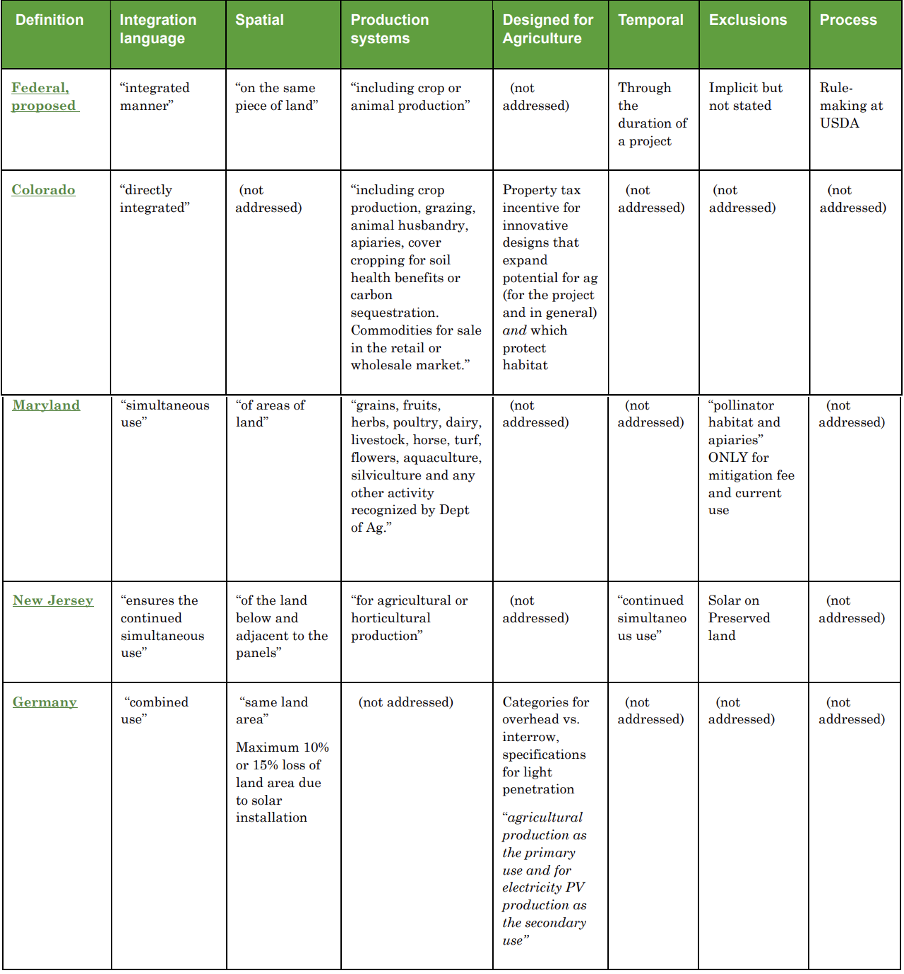
A common theme across AV literature is the importance of standard and concrete legal language. Since AV is a new and unfamiliar concept, the law is deficient in defining and including environmentally friendly terms, especially the word “agrivoltaics” itself (American Farmland Trust, 2025). It is imperative to define, share, and simplify legal phrasing to have explicit understanding and awareness of AV across jurisdictions and policies in the U.S. and beyond. Some suggestions are to first define common terms like “solar development” and “farmland” or to start with federal definitions that apply to multiple governments at once (Byrne et al., 2020), ensuring faster standardization. The American Farmland Trust, a non-profit organization committed to protecting farmers and their land, defined “agrivoltaics” as a planned agreement between farmers and experts to support both energy and agricultural production on the farmer’s land (American Farmland Trust, 2025). The Trust also documented specific states’ definitions related to AV that already appear in the law or lack thereof, from Colorado’s “directly integrated” to Germany’s “combined use” to address AV’s “dual-use” nature (Table 1). These compiled phrasings and drafted definition for AV provide preliminary insight into which terms need clarification in the law and how to standardize them across jurisdictions. Once environmental terms are clearly defined, an increased awareness of AV and clear rules around how to implement the system will grant AV recognition in the legal framework and encourage its adoption.
Table 1. Examples from U.S. and international jurisdictions organized by the American Farmland Trust of definitions for “agrivoltaics” that highlight the system’s multifunctionality.
Incentives
Incentives for farmers and the community to adopt an AV system will further facilitate the transition to this “win-win” and ecologically friendly take on traditional farming. There are multiple ways to incentivize AV, from giving locals a priority on solar energy use to making payments toward farmers who are interested in AV. Germany’s EEG Act already encourages AV through subsidies and direct payments in addition to the EU’s Common Agricultural Policy (CAP) that covers funds for the farmland itself (Steinkemper et al., 2025).
In cases where private farmland is converted to conservation efforts (more for EV systems), landowners need “compensation to justify conversion” (Dolezal, Torres, & O’Neal, 2021). To provide compensation, governments and legal systems can step in with monetary assistance. For example, the USDA Conservation Reserve Program (CRP) gives this type of support through public funding to aid various environmental causes through land conversion, which is promising for sustainable systems like AV (Dolezal, Torres, & O’Neal, 2021). Initiatives to implement monetary or other benefits (e.g. access to the energy provided from PV panels) for traditional farmers to embrace AV is likely to increase awareness of its advantageous “multifunctionality” and sustainability without uprooting their lifestyles or income stream (Tajima et al., 2022). If communities are promised benefits from an AV system that adds clean energy production to the preexisting agricultural use of land, local people will also see the system as a welcome change rather than a threat to rural customs.
Citing and Zoning Laws
The third component to making law and policy more compatible with AV is establishing standard siting and zoning rules. Zoning laws distinguish certain physical areas of land that have “incompatible uses” and are set for a certain purpose to prevent land use issues and disagreements (Guarino & Swanson, 2022). Across the world, countries deal with land use and energy regulations differently, and who has decision-making authority in those areas varies widely (Essa et al., 2021; Guarino & Swanson, 2022). England, for example, uses a “town and country planning system,” giving local and smaller towns the responsibility of siting and zoning rather than the central UK government (Wentworth, 2024). On a similar localized level, the United States, although under a federal system, leaves many siting and zoning laws to the states’ discretion, which means they differ among every state. Siting and zoning authority is scattered across the country as there are five possible types or levels of power over these laws: state, local, hybrid, dual, and unclear (Essa et al., 2021). Colorado and Georgia leave zoning decisions to local areas, Vermont has mostly state authority over solar siting, Rhode Island is mainly municipal authority, and Connecticut maintains a divided system of authority over solar land use (Byrne et al., 2020; Essa et al., 2021; Jackson et al., 2024). Siting and zoning laws’ effectiveness also relies on community incentives because a significant determinant of solar siting projects is public concerns (Essa et al., 2021).
Therefore, there is great need for standardized solar development rules and “farmland protections” to encourage AV implementation. Some states update laws to accommodate sustainable systems like AV; however, there is optimism for more legal revisions due to growing solar energy and PV demand with heightening “tension between energy development and agricultural land uses” (Byrne et al., 2020). As energy and agriculture become more intertwined, landowners are more accepting of the idea to merge both without having to choose between one or the other. Rhode Island provides a great example of harmonizing energy and agriculture through clear, sustainable laws: they establish siting locations on already disturbed, unused land while protecting the environment and ecosystem needs (e.g. soil health) (Byrne et al., 2020). Other states should look up to places like Rhode Island for codifying environmental protections and AV without undermining preexisting land use provisions and customs.
Qualitative and Quantitative Data
My research on the literature and potential solutions includes both qualitative and quantitative data. The former will make up most of my current information from a variety of literature on AV as my paper aims to provide a literary review and experimental proposal. Major categories of this literature include studies on current policies and legal barriers, case studies of U.S. state governments, comparative studies on international AV laws, and primary sources regarding siting and zoning laws or government legislation. Information from AV studies provided a foundation for my main question and proposal, with scholar’s contributions and observations of current laws relating to AV guiding the direction of my research. Primary sources also contribute to my data collection on types of definitions, incentives, and siting and zoning rules. To discern how law and policy can truly make an impact in promoting AV, my quantitative data will show how the number of solar farms or AV acreage compares to the number of AV-friendly laws (those incorporating the three recommended items: definitions, incentives, and standard siting and zoning laws).
Preliminary and Predicted Results
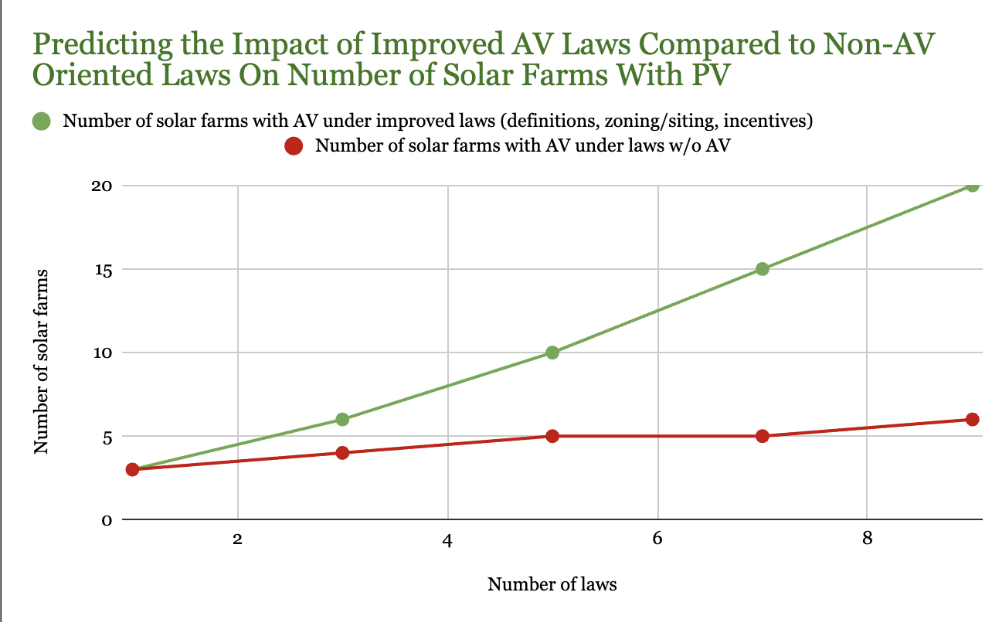
The quantitative data I collect will form the basis of testing my hypothesis through numerical means to see whether these improved laws will make a positive impact on solar farms, which I expect will happen over time as the number of improved laws increase (Fig.1). For example, as Figure 1 describes visually, if there are currently four AV farms in one state, I predict that number of farms to increase gradually over time when legislation facilitating AV implementation is passed in that state (e.g. an increase from four to ten farms correlated with five new AV-oriented laws). The type of data may change over the course of further research depending on what is determined to be the best way to track a positive correlation between improved law and a growing number of AV systems. Other possible quantitative data may consider the number of monetary incentives in USD granted to farmers and communities or incentives of all types (energy benefits) and currencies compared to the number of new acres of solar farm per year. The focus on incentives will highlight how the improved laws, measured in terms of benefits provided, promote AV on a national or global scale.
Conclusion and Implications
The legal system outlines the way decisions are made and directs how societies operate. Research on AV and other renewable energy systems in law and policy around the world is still developing and needs more in-depth studies on their long-term impact. Since the law determines the implementation of solar projects, there is great need for analyses on current energy, environmental, agricultural, and other regulations and their effect on new, multi-use systems like AV. My research’s purpose is to emphasize the importance of clear definitions of “agrivoltaics” and related energy terms, incentives or credits to farmers and the community to encourage AV adoption, and standardized siting and zoning laws. This three-pronged improvement plan aims to develop a multi-faceted and sustainable legal framework to expand AV worldwide and secure an environmentally focused future.
References
American Farmland Trust. (2025). Policy Recommendations to Increase Agrivoltaic Development. https://farmland.org/files/aft_final_policy_recommendations_to_increase_agrivoltaic_development_definition_and_incentives_final-2.27.25.pdf.
Bacon, T., Monlezun, A. C., Hong, M., Macknick J., de Vries, N., Edwards-Callaway, L., & Paustian, K. (2025). Agrivoltaic grazing systems for a sustainable future: A multi-disciplinary review & gap analysis. Earth’s Future, 13(8). https://doi.org/10.1029/2024EF005429.
Byrne, G. (2020). Farmland solar policy design toolkit: How to craft solar regulations that work for your state and community. Farm and Energy Initiative. https://farmandenergyinitiative.org/wp-content/uploads/2020/08/Final-FSPP-Toolkit-Report.pdf.
de Vries, N., & Monlezun, A. C. (2025). Ensuring that dual-use means multi-value: A framework for the co-prioritization of cattle grazing and PV energy generation. AgriVoltaics Conference Proceedings, 3. doi:10.52825/agripv.v3i.1374.
Diffendorfer, J. E., Sergi, B., Lopez, A., Williams, T., Gleason, M., Ancona, Z., & Cole, W. (2024). The interplay of future solar energy, land cover change, and their projected impacts on natural lands and croplands in the US. Science of The Total Environment, 947. https://doi.org/10.1016/j.scitotenv.2024.173872.
Dolezal, A. G., Torres, J., & O’Neal, M. E. (2021). Can solar energy fuel pollinator conservation? Environmental Entomology, 50(4), 757-761. https://doi.org/10.1093/ee/nvab041.
Gilbert, S. (2024). Under a Texas sun, agrivoltaics offer farmers a new way to make money. The Washington Post. https://www.washingtonpost.com/business/interactive/2024/solar-farms-agriculture-agrivoltaics/.
Guarino, J., & Swanson, T. (2022). Emerging agrivoltaics regulatory systems: A review of solar grazing. Chicago-Kent Journal of Environmental and Energy Law, 12(1). https://solargrazing.org/wp-content/uploads/2023/01/v12i1-2022-2023-1-Guarino_Swanson.pdf.
Kocsis, T., de Groot, A., van Beersum, F., Boer, J., Dimmers, W., Laros, I., Lammertsma, D., Polling, M., Schnerch, B., Villing, N., WallisDeVries, M. F., & Fijen, T. (2025). Mixed plant and arthropod biodiversity responses to solar park establishment on former agricultural lands. Journal of Applied Ecology, 62(11), 3078-3091. https://doi.org/10.1111/1365-2664.70170.
Lindsey, R. (2025). Climate change: Atmospheric carbon dioxide. https://www.climate.gov/news-features/understanding-climate/climate-change-atmospheric-carbon-dioxide.
NASA. (2024). Evidence: The rate of change since the mid-20th century is unprecedented over millennia. https://science.nasa.gov/climate-change/evidence/.
Nijsse, F. J. M. M., Mercure, J. F., Ameli, N., Larosa, F., Kothari, S., Rickman, J., Vercoulen, P., & Pollitt, H. (2023). The momentum of the solar energy transition. Nature communications, 14(1), 6542. https://doi.org/10.1038/s41467-023-41971-7.
Owley, J., & Morris, A. W. (2019). The new agriculture: From food farms to solar farms. Columbia Journal of Environmental Law, 44(2), 409-478. https://heinonline.org/HOL/P?h=hein.journals/cjel44&i=411.
Steinkemper, U., Becker-Boley, A., Friedle, T., & Berenz, T. J. P. (2025). CMS expert guide to agrivoltaics and floating photovoltaics in Germany. https://cms.law/en/int/expert-guides/cms-expert-guide-to-agrivoltaics-and-floating-photovoltaics/germany.
Sturchio, M. A., & Knapp, A. K. (2023). Ecovoltaic principles for a more sustainable, ecologically informed solar energy future. Nature Ecology & Evolution, 7, 1746-1749. https://doi.org/10.1038/s41559-023-02174-x.
Tajima, M., Doedt, C., & Iida, T. (2022). Comparative study on the land-use policy reforms to promote agrivoltaics. AIP Conf. Proc. https://doi.org/10.1063/5.0115906.
Taylor, M., Pettit, J., Sekiyama, T., & Sokołowski, M. M. (2023). Justice-driven agrivoltaics: Facilitating agrivoltaics embedded in energy justice. Renewable and Sustainable Energy Reviews, 188. https://doi.org/10.1016/j.rser.2023.113815.
Vollprecht, J., & Trommsdorff, M. (2024). New legal framework of agrivoltaics in Germany. https://www.tib-op.org/ojs/index.php/agripv/article/view/1071/1165#info.
Wentworth, J. (2024). Balancing competing land uses: A multifunctional approach. UK Parliament. https://doi.org/10.58248/HS79.
Zhao, H., Guo, S., & Fu, L. (2014). Review on the costs and benefits of renewable energy power subsidy in China. Renewable and Sustainable Energy Reviews, 37, 538-549. https://doi.org/10.1016/j.rser.2014.05.061.
Acknowledgements: I wish to express my enormous gratitude for my mentors Dr. Mark D. Hunter and Professor Steffney Thompson for their knowledge, guidance, and generous support as I continue to research. I equally appreciate the VIPR program and my team members for their help, collaboration, and hard work across disciplines, and I’m glad to keep working with you all. Thank you.
Citation Style: APA