The Ironic Implications of Bitonality on the Ursatz In Clara Schumann’s Fugue Op. 16 no. 2
by Madeline A. Finn
Hugh Hodgson School of Music

Despite Heinrich Schenker’s attempts at resolving the dissonance between form and structure, Schenkerian analytical techniques have a reputation as being notoriously cumbersome and sometimes downright ineffective at describing music in contrapuntal—namely fugal—textures (Marlowe 2020). In Free Composition, Schenker argues that, in the inevitable cases of discrepancy between structure and form, structure is less likely to deviate from tonal or organizational expectations because it is more deeply rooted in the music than form. Form as process lives at the foreground, whereas structure exists in the background (Smith). Clara Wieck Schumann’s Fugue Op. 16 No. 2 demonstrates the disconnect between form and tonal structure that results from her often forward-thinking harmonic language (Wollenberg). This paper examines the specific role that subject and answer entries play in both dissolving the expected template of fugal form while simultaneously, and ironically, enabling the emergence of a straightforward background structure. The resulting analysis reveals that select middleground subject and answer entries principally mark the dissolution of tonality in the fugue, with a bitonal final subject statement replacing a normative tonic recapitulation that occurs before the structural dominant. The perfect vertical alignment of this final entry underscores the unique role of the bass and brings to light a new reading on parallel bassline modeling, coining a new term—the shadow bassline—to describe this unique feature. Ultimately, this analysis showcases the ways in which Schenker’s methodology, while applicable to contrapuntal textures, can fail to capture the nuance of a fugue written in 1845.
Fugue, Schenker, Clara Schumann, form, tonality
Introduction and Background
Clara Wieck Schumann’s Op. 16
Through extensive study of Bach’s contrapuntal language, as well as creative collaboration with her husband, Robert Schumann, Clara Wieck Schumann composed a rich collection of fugues throughout her lifetime. Though in some ways Robert served as the overseer of their studies, as was the traditional role for men of the Romantic Period, Clara’s interest in strict fugal form quickly overtook her husband’s, with her Three Preludes and Fugues Op. 16 serving as the work that capitalized on her promise as a young composer (Wollenberg). She composed numerous works in her early life, including three unpublished fugues written in the likeness of J.S. Bach’s Well Tempered Clavier Book I subjects, which predated the publication of her 1845 Three Preludes and Fugues Op. 16 by only a few months.
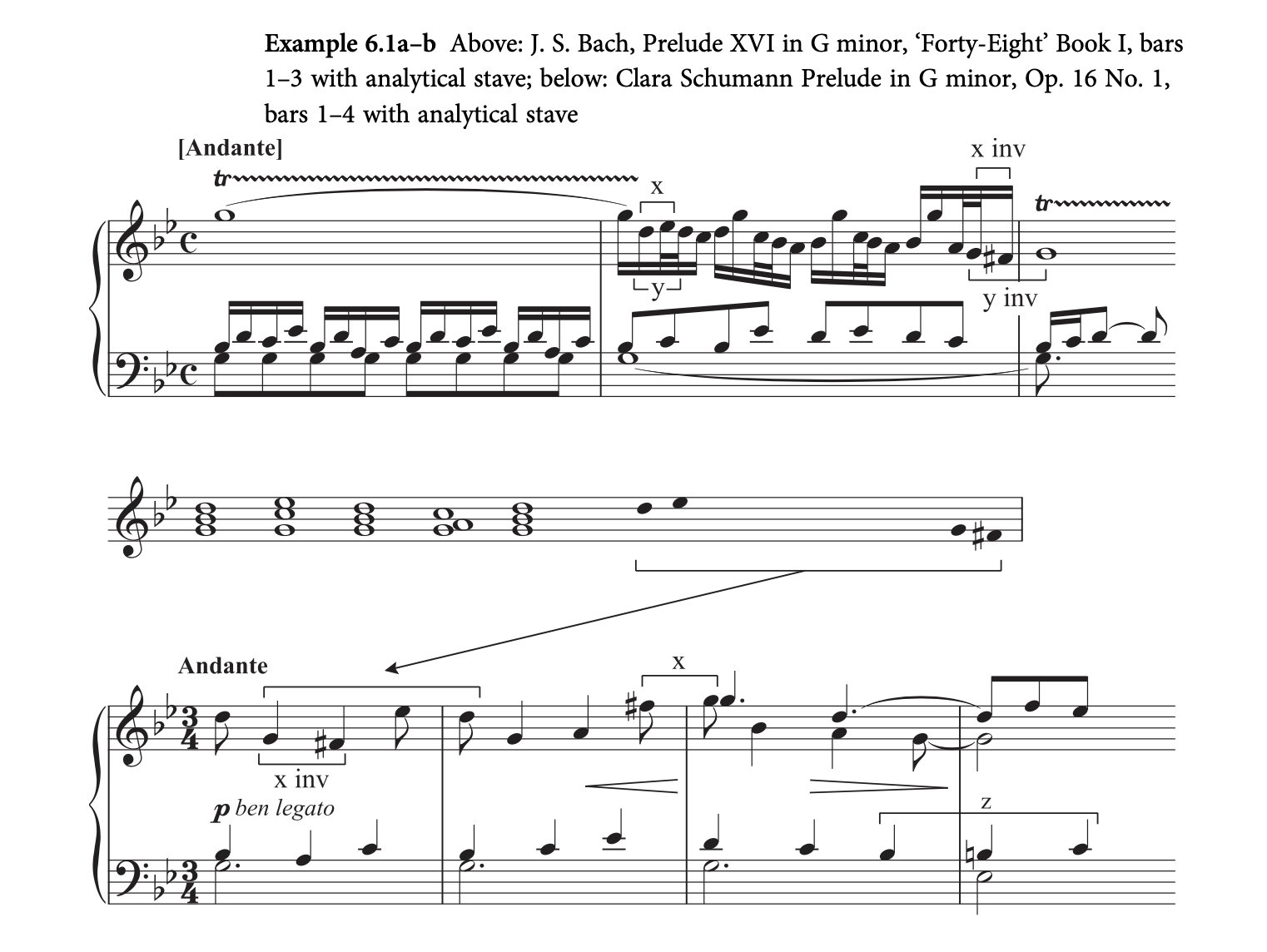
Scholars have examined the musical influence of J.S. Bach’s Well Tempered Clavier on Schumann’s contrapuntal writing in Op. 16 not only in overall form and musical language, but also in smaller-scale motivic borrowing from Bach. Susan Wollenberg’s chapter of Clara Schumann Studies highlights motivic borrowing between Schumann’s Op. 16 Fugue No. 1 in G Minor and Bach’s Prelude XVI in G Minor, for instance (see Reference 1). Even further, Wollenberg notes Schumann’s harmonic “traveling” in time between the tonal norms of various composers, such as Fanny Hensel. Nonetheless, as a somewhat traditional composer of the Romantic Period, Schumann’s writing tends to work conducively with Heinrich Schenker’s theory of a clearly defined functional harmonic background level, which must feature clear-cut tonality and ‘expected’ voice-leading behaviors of 18th- and 19th-century Western European lieder. Retrospectively, Schumann’s writing poses a juxtaposition between tradition in the background and innovation in the foreground, often using more progressive tonal progressions, while maintaining traditional structural norms.
Schenker on Form
Analyzing any fugue–whether directly out of the Well-Tempered Clavier or composed with little likeness to Bachian style–presents difficulties for the analyst like voice relationship portrayal when confronted with formal and (harmonic) structural tears. In his writings, Heinrich Schenker claimed the superiority of harmonic structure over form; however, he still believed strongly in the idea of form driving the listener’s ear in a piece of music. According to Jason Hooper, Schenker further defined form as a manifestation of motivic development with harmonic support, favoring the idea of “form-as-process” over “form-as-shape.” With form-as-process, a composition’s form organically arises through compositional development, whereas form-as-shape prescribes the ultimate shape—form—of the piece with the composer merely fitting the composition into the formal mould. Contrapuntal textures are seldom examined through a Schenkerian lens, yet Schenker’s concept of form being a motivically driven process would presumably suggest that his analytical techniques may provide insight when applied to a texture that uniquely prioritizes procedural motivic development. Though scholars often discourage or simply disregard the practice of applying Schenkerian structure to fugue because fugal form does not necessarily prioritize vertical relationships, Schenker’s prioritization of motivic ideas should encourage further consideration of contrapuntal study from a structural perspective, since form as a set shape is not his main priority.
Analyses of Schumann Op. 16 Fugue No. 2
Subjects and Answers at the Middleground
The fugue subject features a common interval treated in a less clear-cut manner. While typically fugue subjects with a perfect fourth open from “sol” to “do,” Schumann’s opens with “do” to “fa.” This subject construction, even with ‘predictable’ subject and answer relationships, already sets up a sense of tonal ambiguity, or at least impending ambiguity. In the exposition, Schumann composes the most straight-forward of her subject and answer pairings: I and V. With the subject in the home key of B-flat major and a real answer on the dominant–F major–the first subject and answer lay the groundwork for the harmonic expectations: a short tonic prolongation, single predominant, dominant prolongation, and tonic return (see Graph 1). The timing is back-to-back with no stretto overlap, allowing for either a countermelody or section of free composition to assist in guiding the ear to the tonal center. This repeats as expected for another subject and answer entry, completing the exposition in a predictable fashion that harmonically replicates the expositions of most Bach fugues. After an episode that briefly modulates to the dominant key of F major, this same pattern and time interval repeats on the dominant with an F major subject and C major answer (see Excerpt 1).
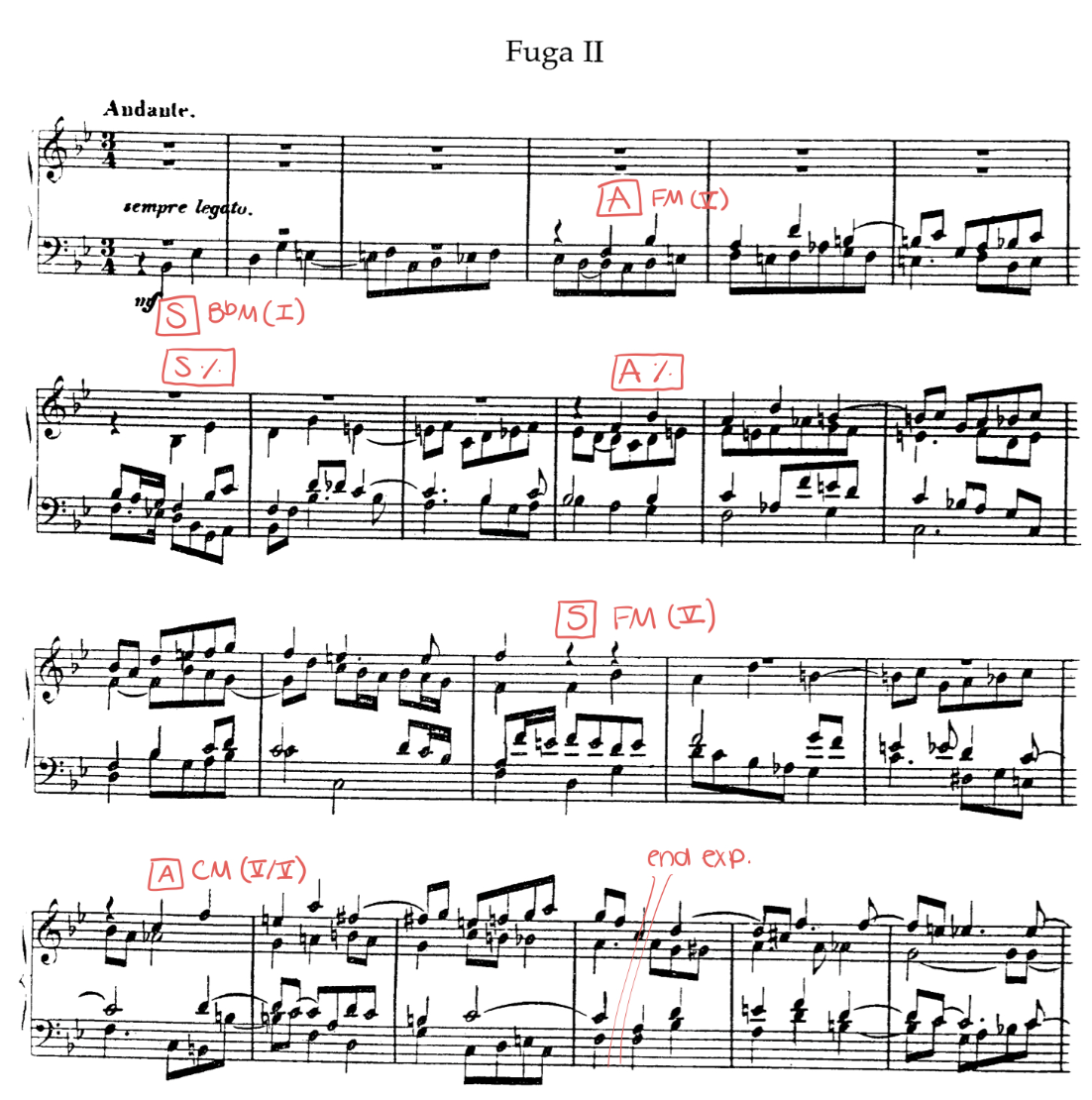
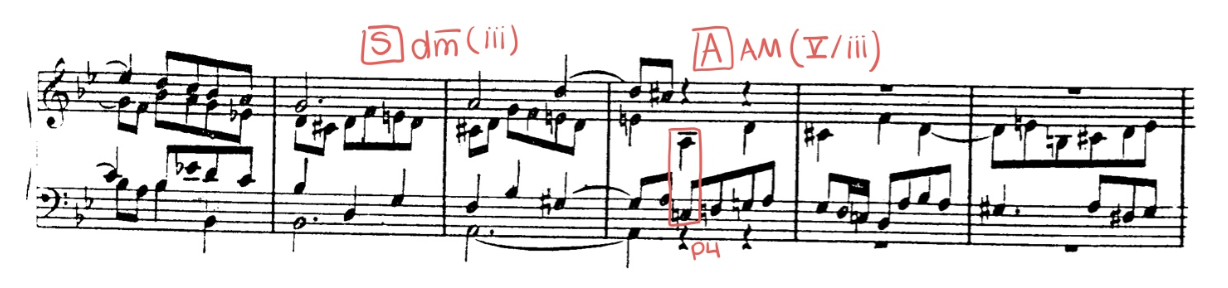
Next, Schumann bases an entry in the mediant key of D minor with a D minor subject and A major answer. This time, however, she employs a slight stretto overlap between the subject and answer entries. This is the first introduction to D minor as a potential temporary tonal center. Although the subject and answer pitch relationship is standard, with the answer up a perfect fifth, the stretto emphasizes the embedded dominant of the subject. When the answer enters, the subject has just resolved the local chromatic predominant–G-sharp–to the local dominant of A. The subject line chordally skips down to the dominant chordal fifth–E–and this is where the answer enters. This entry timing creates a perfect fourth between the two voices. Thus, while a D minor subject is introduced, the original B-flat tonality is still somewhat preserved in that Schumann answers the subject on a dissonant interval, indicating harmonic instability, rather than crafting a ‘resting point’ on D (see Excerpt 2).
Continuing to blur the sense of tonality, the next entrance appears in a closer stretto and the answer comes in a different interval relative to the subject: a third. In this iteration, the subject initially appears in the home key of B-flat major, and the answer, while unfinished and slightly rhythmically modified, responds in the mediant key of D minor. This juxtaposition of D minor appears on the tonic copy of the subject in the home key of B-flat major, which creates the interval of a double octave between the subject and answer. While the B-flat major theme in the bass voice is more complete than the D minor soprano line, this initial interval of a compound octave on D emphasizes the D minor iteration and immediately draws attention to the soprano line (see Excerpt 3).
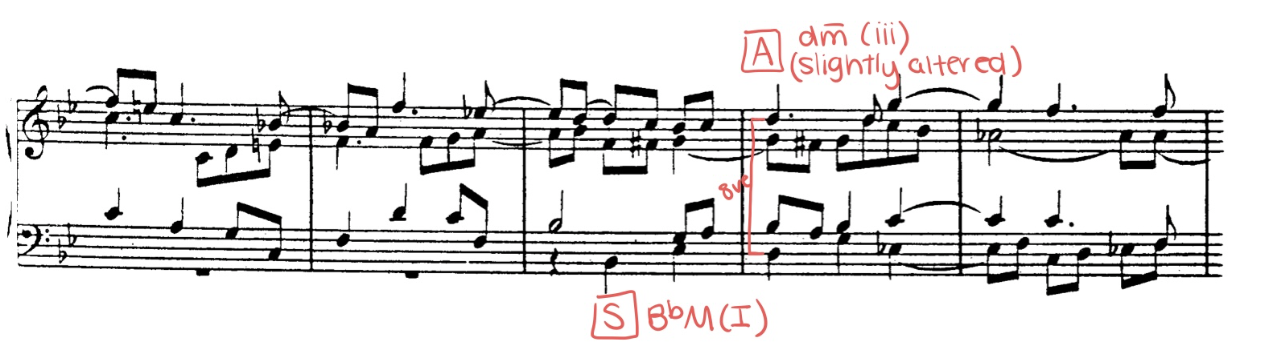
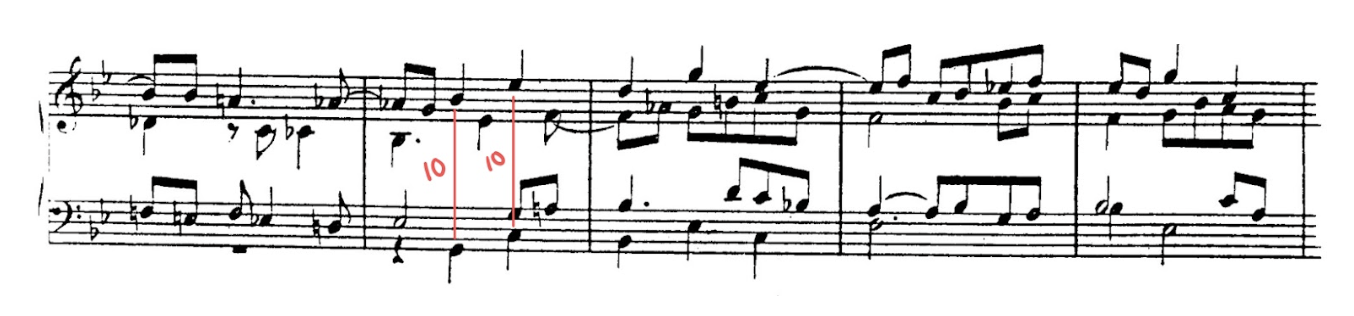
The final subject entry provides the most harmonic ambiguity with an implication of bitonality. In this entry, the subject comes in simultaneously in two voices–G minor in the bass and B-flat major in the soprano (see Excerpt 4). At this point in a predictable fugal process, a recapitulation of the subject in the home key could be expected. However, in this piece, although there is a B-flat major recurrence of the original subject content, it cannot be a true recapitulation of both motivic content and overarching harmonic arrival because at the background level. The entrance in measure 46 is still within the original structural tonic area. Schumann’s final entry also differs from the others in that it is the only entry in which there is no tonal center. This ambiguous melodic bitonality stems from a mirroring of the bassline in parallel tenths, originally masquerading as another subject, in the soprano line. Thus, the ‘bitonality’ here is not an overarching conflict between two keys, but rather, an ambiguity caused by conflicting subject lines melodically outlining two different tonal centers.
The Structural Background
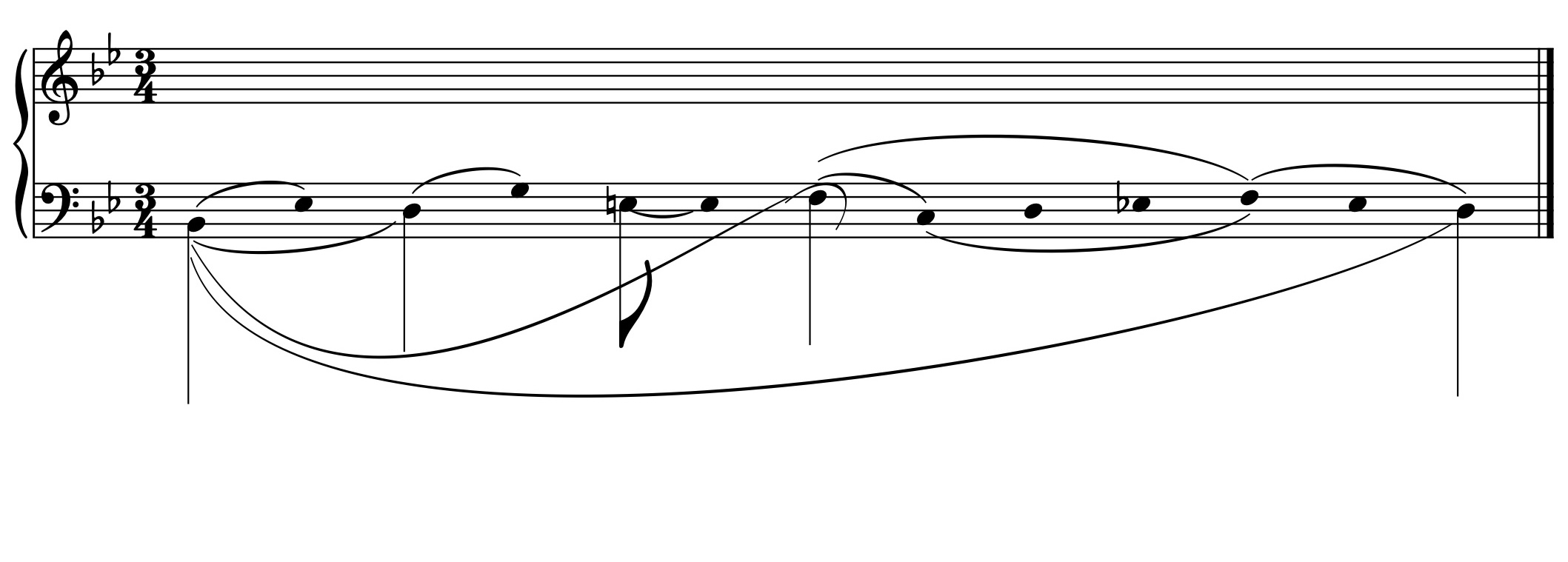
Ultimately, an analytical reading in the context of Schenker’s background layer most effectively clarifies the function of this tonal center deterioration and reformation. Starting by using the home key subject as an arpeggiated ascent to the head tone of F and slowly dissolving the tonic until a complete area of bitonality emerges, Schumann’s gradual breaking down of the originally stable B-flat tonal center actually underscores the background harmonic prolongation (see Graph 2). Considering tonic as the most stable function, each entry contains enough predictability to still be considered tonic. However, the voice-leading in the bitonal entry’s bass line pulls deceptively to a dominant which then ultimately leads to a background tonal area other than tonic. Each subject and entry, whether in relationship with one another or together in relationship with the context surrounding them, slowly breaks down tonic just to rebuild it at the background level. Each subject and answer is a clue into where tonic lies in relation to the background, with the background progressing towards a switch of functionality as harmonies and subject/answer relationships become increasingly unorthodox at the middleground level.
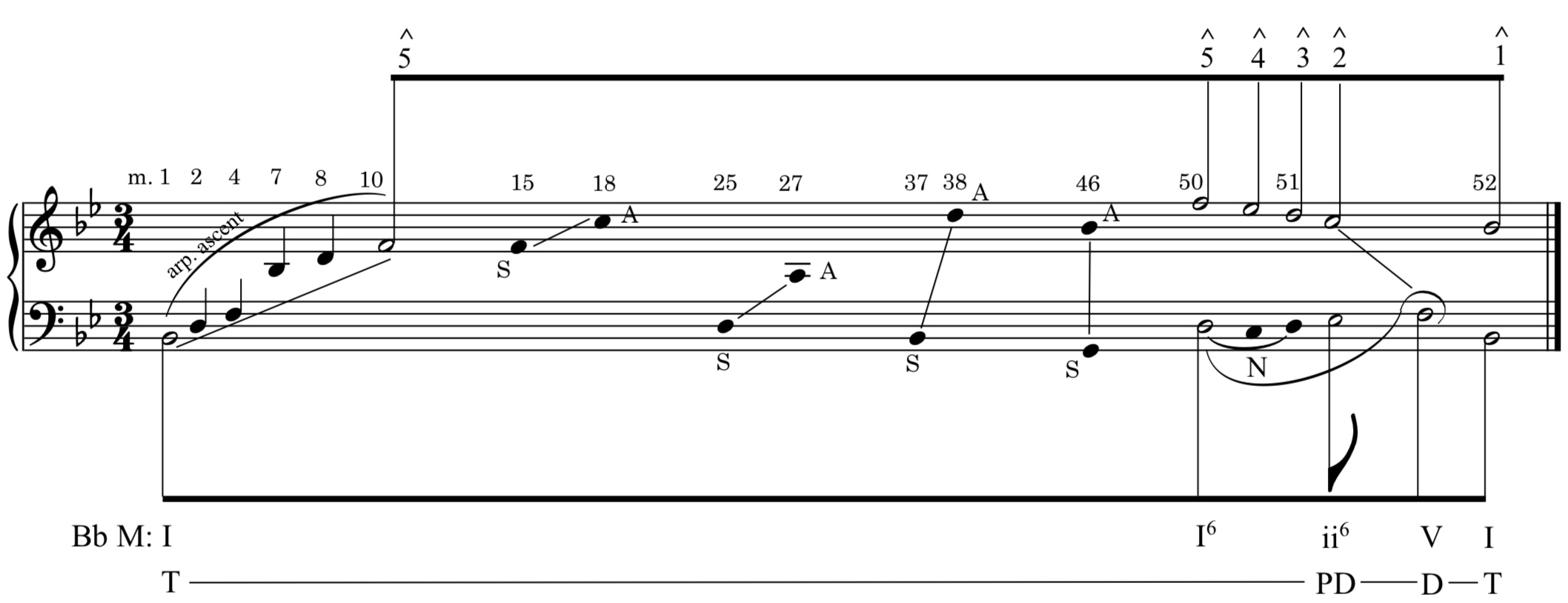
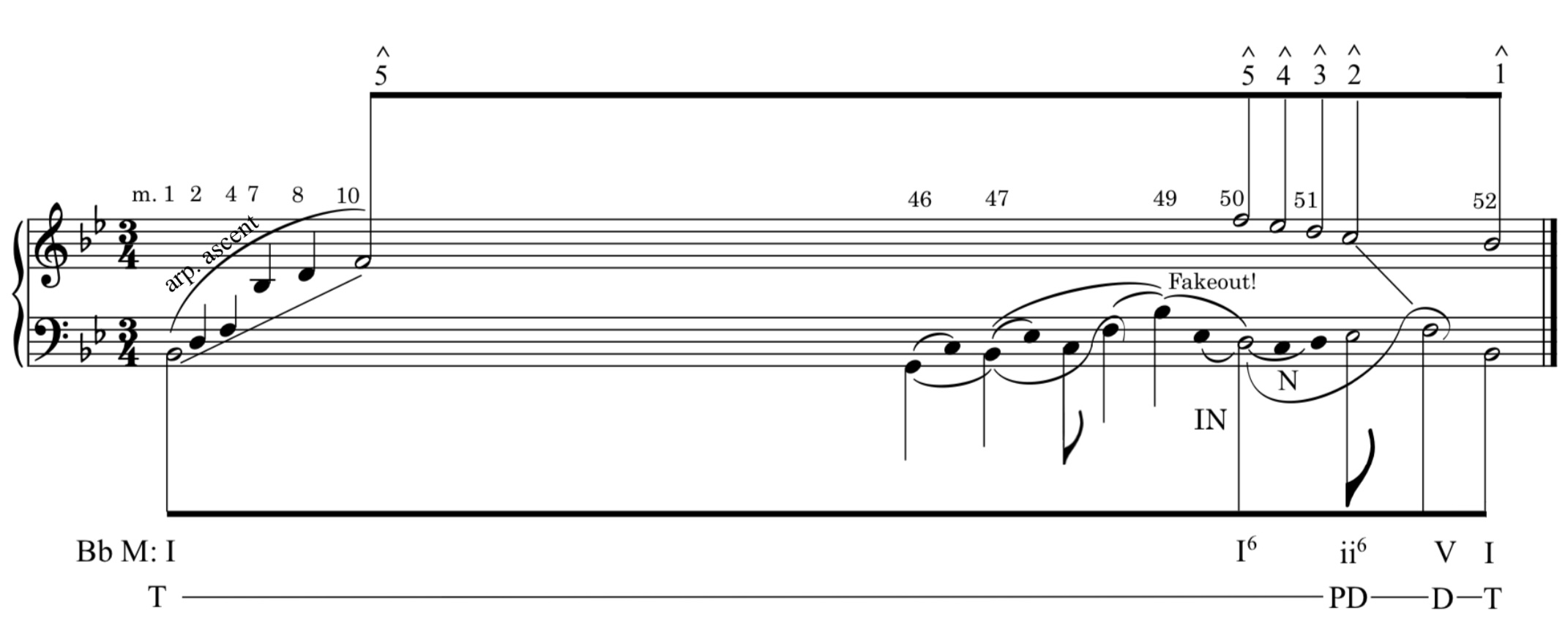
At the end of the structural tonic, the bitonal entry shatters the expected tonality and, more importantly, serves as a voice-leading device that leads to the structural predominant, with a dominant-to-tonic fakeout first (see Graph 3). In the midst of tonal disarray, the bassline G minor entry uses the subject’s intervallic pattern to repurpose the fifth note of the subject as a perfect fourth pull to a middleground dominant and ultimately to tonic, catalyzing the transition to the structural predominant. All the while, the soprano line mirrors the bassline in a tonic area complete iteration of the subject. Despite the generally consonant intervals between the subject lines in the bitonal entry, they only relate to each other in a triadic sense—they can technically vertically align, but the harmony is not functional in a tonal sense. The most salient relationship is between the subject lines as overlapping copies of the same melody transposed. Without regard for the voices to which they belong, neither of the melodies initially seem more important than the other as equivalent subjects; however, this bass voice plays an essential dual-role as both a subject and bass. In the bitonal entry, melodic intervals in each voice become increasingly important, foregrounding a bassline pull from C to F to B-flat. This sparks the finale of the background tonic prolongation after trickling down to the structural predominant. The tonic area officially ends at the bassline E-flat to F—the structural predominant and dominant, respectively.
Similar to Brent Yorgason’s theory of a “Shadow Urlinie” or even a “Role Reversion Urlinie,” I describe this mirroring as a “shadow bassline” (see Graphs 4, 5)1. As compared to Yorgason’s specifically Schenkerian term, though, my shadow bassline highlights a scenario in which the bass voice outranks the Urlinie in musical importance, even though the two voices contain identical yet transposed melodic content. Hence, the upper voice subject serves as the structurally embellishing shadow, not the bass. While the bass is used primarily for harmonic information in tonal music, with Schumann’s dual role of the subject as the bass, this bass voice is a lateral driving factor more than just the grounding point for harmony. It contains simultaneously vital melodic and harmonic information, both through a fugal procedure and Schenkerian lens. The melding of lateral and vertical emphasis is another unique feature of counterpoint as a whole, but this bassline takes its contrapuntal role a step further by illustrating critical voice-leading motion.
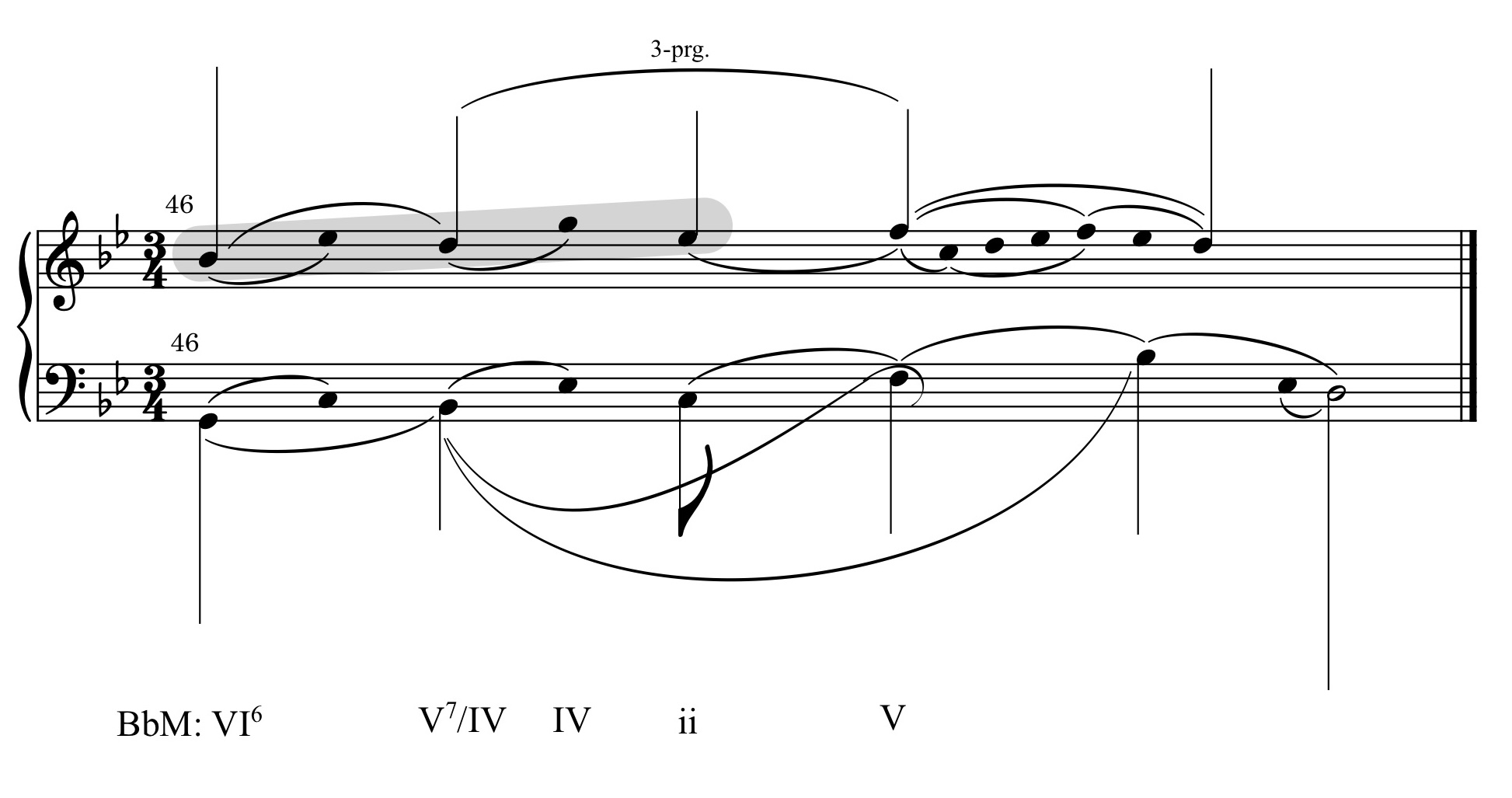
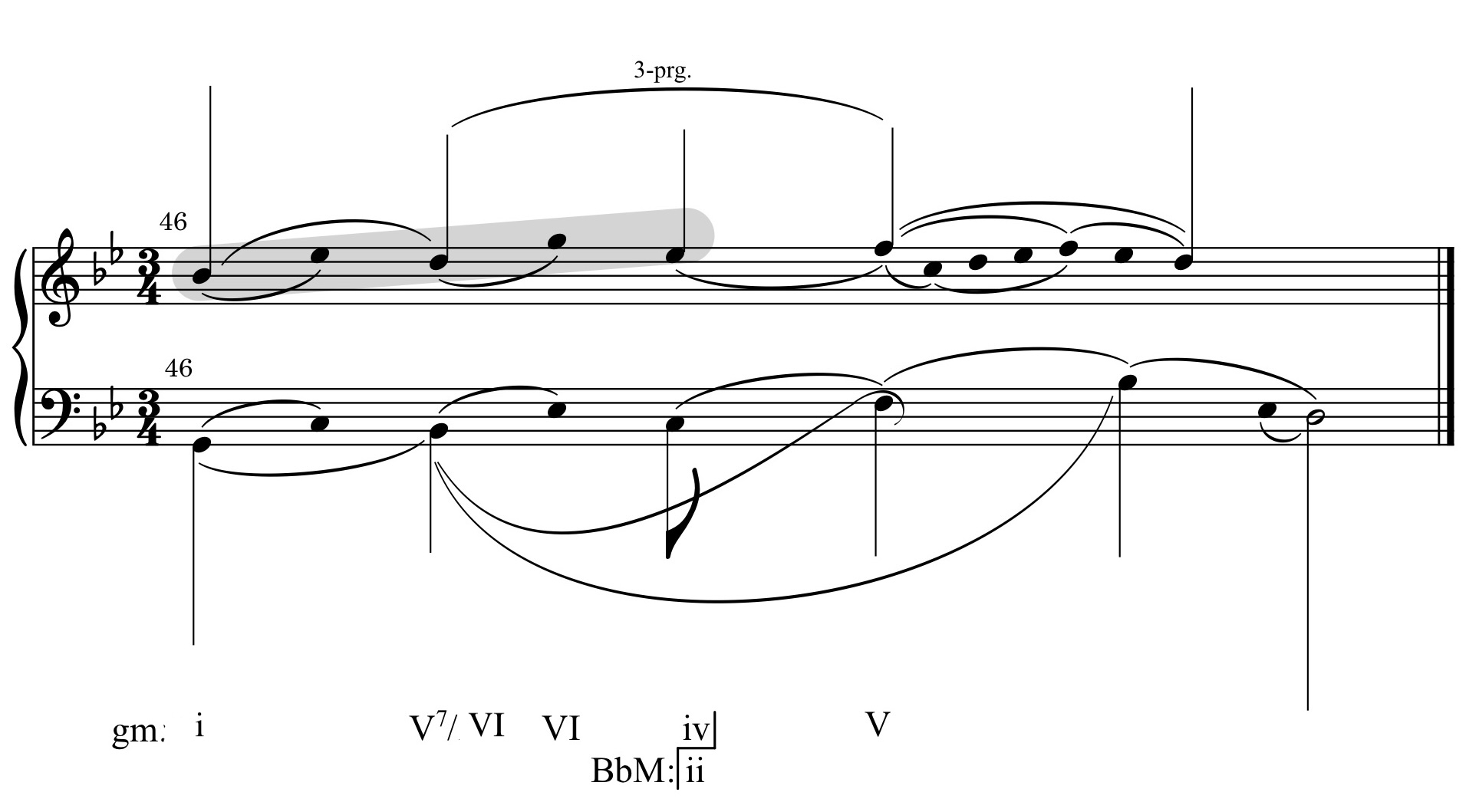
Schumann’s employment of increasingly unorthodox subject and answers builds a fugal development section and evaded recapitulation that actually supports Schenker’s background layer. Should structure and formal tonal development align, a true recapitulation would prematurely arrive back on tonic and cause a non-cadential tonic expansion throughout the whole fugue. Thus, ironically, Schumann’s tonic degradation ultimately serves to underpin an unambiguous structural background, and she relies on subject and answer entry relationships to achieve this.
Broader Implications
C. Wieck (Schumann) as a composer
In a period of fairly functional tonality, Clara Schumann was no exception to the Romantic Period and its compositional norms. Nonetheless, her motivic development throughout this fugue underscores her experimentality and consequent modernisms. The Op. 16 Fugue No. 2 paints a picture of Schumann as a composer living in two time periods, seemingly straddling the adjacent centuries. While the thought of Schenkerian language describing post-tonalisms is not a new concept, Schumann still did not lean forward far enough to capture the essence of a fully non-tonal composition. Works like Sarah Marlowe’s (2013) dissertation entitled, “Fugue in Context: A Schenkerian Approach to Select Works by J.S. Bach and Dmitri Shostakovich,” for example, explore the post-tonal-Schenkerian intersection. Therefore, this research encapsulates the reality of a composer who can simultaneously live in two spaces at once. There is a nature to Schumann’s writing that works ideally with Schenker’s analytical methodology while she simultaneously cohabitates with experimental and decentered tonality.
In a broader sense, Clara Schumann serves as the quintessence of the Romantic Period. Her marriage to functional underpinnings while experimenting with tonality encapsulates larger characteristics of Romantic Period writing. Analyzing this fugue from a Schenkerian perspective arguably says more about Clara Schumann as a composer—a dedicated scholar of Bachian language and simultaneous tonal experimentalist—than either fugue or Schenker. Emphasizing tertian relationships over functional tonality, Schumann’s forward-thinking harmony within the second fugue even calls upon the other two fugues in Op. 16—G Minor and D Minor. She employs tertian relationships both on the micro and macro levels. Thus, her Op. 16 can point to a new norm in fugue composition, highlighting the increasingly less predictable nature of fugal organization and tonal patterns as composers move away from true Baroque fugal writing and more into a Romantic style.
Schenkerian methodology
Some recent scholarship is overly accommodating to Schenker’s theory: just because it ‘can work’ does not mean that it can effectively articulate the unique musical construction of a piece. By examining the role that subject and answer entries play in Schumann’s Fugue Op. 16 No. 2—both dissolving fugal form and simultaneously enabling a straightforward background structure—we find that these entries principally mark the dissolution of tonality in the fugue. Moreover, a bitonal final subject statement replaces a normative tonic recapitulation that occurs before the structural dominant. Thus, a background Schenkerian reading of this moment ignores the most important nuances of this recapitulation: its bitonality.
This is not to insinuate that structure and formal sections must align, but this particular tear could be read as a musical contradiction—a bitonal recapitulation in the tonic area. However, the converse could also be true: a bitonal recapitulation before a structural close can enable the structure to emerge without conflict in the middleground or foreground. This poses a certain ambiguity between potential readings of this fugue. Each reading, whether the Ursatz is a cause of formal/tonal conflict or a catalyst for cleancut tonal closure, has ramifications on the possible conclusions drawn regarding the utility of Schenkerian methodology. I would argue, though, that this particular middleground play is a manifestation of Frank Samarotto’s (2008) contra-structural melodic impulse scenario no. 3.2
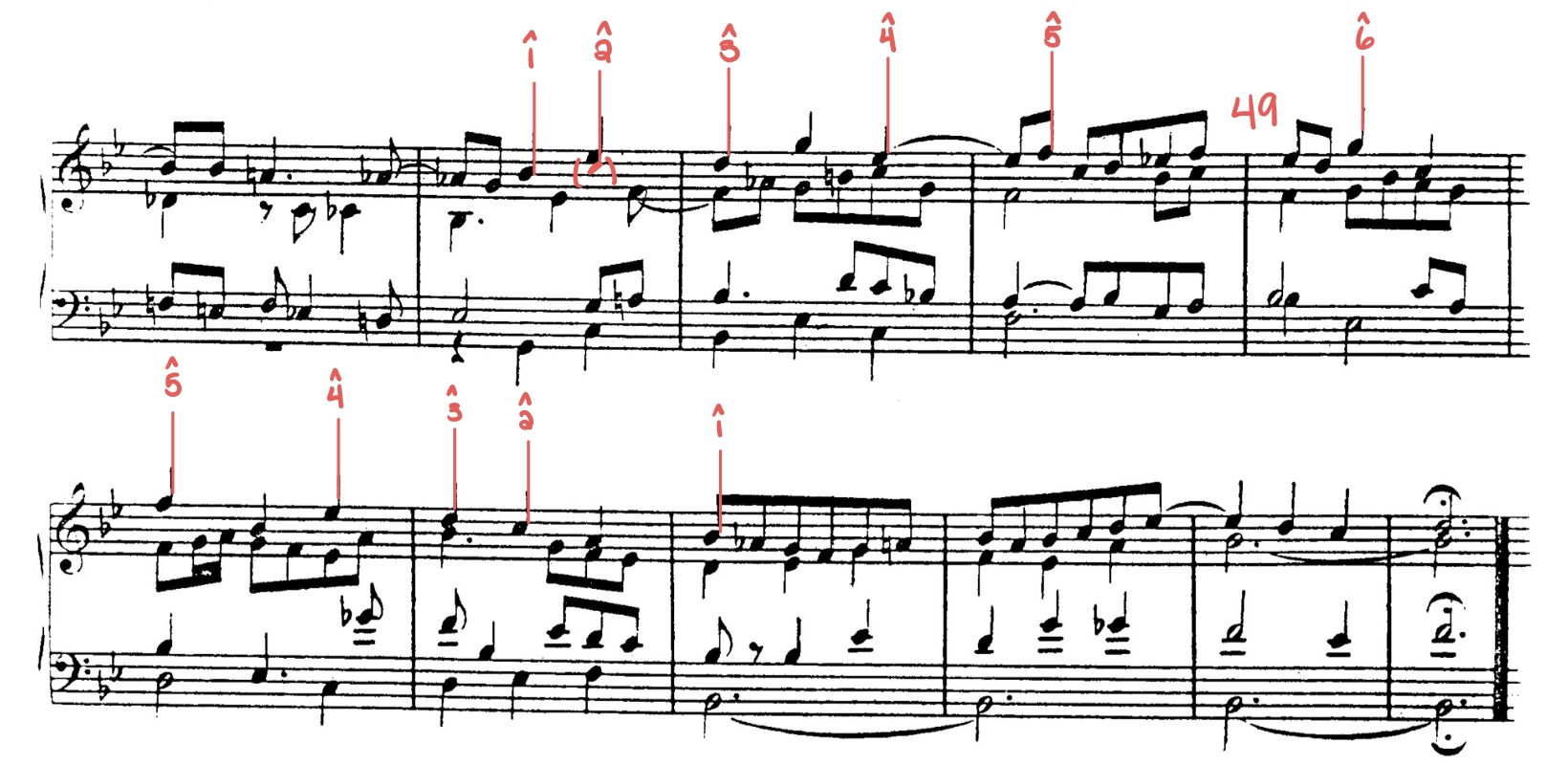
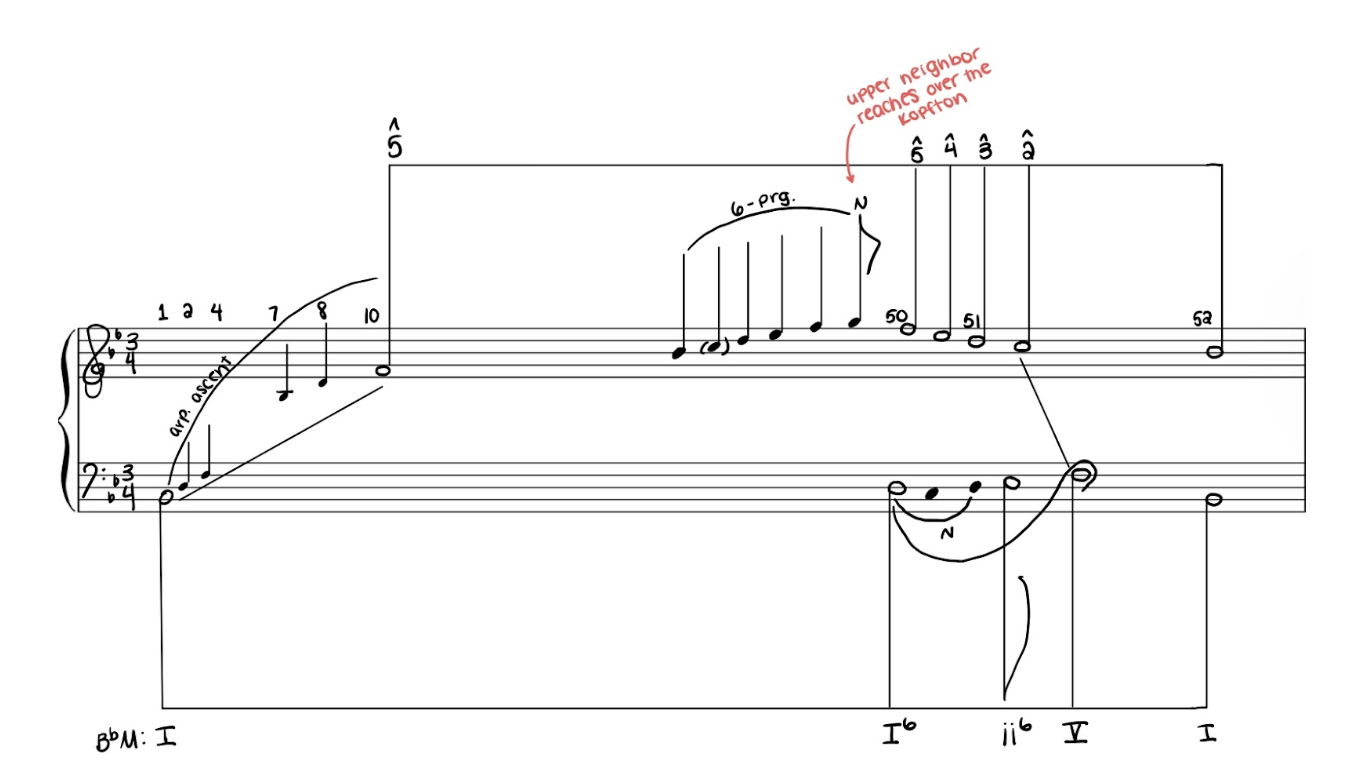
To solidify my claim, I would like to revisit the bitonal subject entry and its point of cadential evasion in the bassline. At the middleground level, there is a repeat in the soprano line of what was originally interpreted as the subject behaving as an arpeggiated ascent to the Kopfton. However, I allow myself a bit more flexibility with interpretation here, as the soprano line serves a double role, both as a subject and as a shadow of the bassline. Thus, I will reinterpret the soprano subject now as a 6th-progression ascending to the G5 in measure 49 (see Excerpt 5). As this line ascends, schematically speaking, the ascension elides with the fundamental descent. This G5, beginning the arpeggiated motion which serves as the Urlinie descent, simply falls back down into the 5-line. However, it is difficult to ignore this G as the actual peak of the line (see Graph 6). Nonetheless, I would argue that it, in a way, does not matter. The ascending and descending 6th, while unorthodox, does not need much more explanation, as the Urlinie promises what a tertian relationship does not provide in a tonal space: a harmonic close. While this Ursatz does not effectively articulate the structural elision and musical peak, the Urlinie makes up for Clara Schumann’s
Conclusions
Thus, in Schumann’s writing, as exemplified by her Op. 16 Fugue No. 2, deterioration of the tonal center at the middleground level can ironically be used to reinforce a well-defined structural background. While in typical fugal form, the development section obfuscates tonic, Schumann’s development breaks tonal expectations in a unique way: through both the timing and inherent harmonic implications of her subject and answer entries. Schumann’s unexpected time and pitch intervals between entries, ultimately resembling a bitonal ‘recapitulation’ that never fully recapitulates the subject, temporarily dissolves the fugue’s tonal center. Nonetheless, this final entry serves as the cornerstone of the fugue’s tonal structure, inducing the collapse of the tonic area and moving to the structural predominant. After visiting the structural dominant and returning to tonic, this background motion marks the fugue’s conclusion. All the while, possibly contradictory behaviors like the misaligned structure and tonal organization point to a uniquely contrapuntal quality: complete independence and consequent interdependence of voices.
A Schenkerian lens paints a traditional picture of Clara’s fugue: a contrapuntal work written by a Romantic-period composer who fastidiously studied Bach. However, a procedural lens highlights the unorthodox nuance of a composer who broke from tradition by deviating from tonal centricity and allowing tonal expectations, in the most traditional sense, to be thwarted. While it is possible to interpret this duality of readings alternatively, it is far less disputable that Op. 16 Fugue No. 2 serves as a marvelous example of the prodigal mind of Clara Schumann.
- Yorgason (p. 54) defines the shadowing scenario as “a shadow Urlinie in the upper voice faintly [echoing] a submerged Urlinie throughout, creating a mild form of what might be termed ‘Urlinie dissonance.’” He further defines role reversion as a scenario in which, “at a crucial moment of cadential resolution, a strongly submerged Urlinie reverts to a traditional bass role and an upper-voice Urlinie emerges from the shadows to take over the melodic role.” See his example 8 (p. 61) for shadow graph. ↩︎
- Samarotto describes this impulse scenario as an ascending line that lacks a resolution, and whose existence without resolution is permissible because the Ursatz promises ultimate tonal closure.
↩︎
References
Hooper, Jason. “2010 Patricia Carpenter Emerging Scholar Award: Heinrich Schenker’s Early Conception of Form, 1895-1914.” Theory and Practice, vol. 36, 2011, pp. 35–64.
Marlowe, Sarah R. “Fugue in Context: A Schenkerian Approach to Select Works by J.S. Bach and Dmitri Shostakovich.” Doctoral dissertation, Eastman School of Music. 2013.
Marlowe, Sarah. “Resolving Tensions between Outer Form and Inner Form in Fugue: A Case Study of J. S. Bach’s Fugue in D Minor (WTC I).” Music Theory Online, vol. 26, no. 3, 21 Oct. 2020. Accessed 14 Jan. 2025.
Marlowe, Sarah. “Schenkerian Analysis of Fugue: A Practical Demonstration.” Journal of Music Theory Pedagogy, vol. 33, no. 1, 1 Jan. 2019, https://doi.org/10.71156/2994-7073.1204. Accessed 6 Jan. 2025.
Samarotto, Frank. ““Plays of Opposing Motion.”” Music Theory Online, vol. 15, no. 2, June 2009, https://doi.org/10.30535/mto.15.2.4. Accessed 14 March 2025.
Schachter, Carl. 1994. “The Prelude from Bach’s Suite No.4 for Violoncello Solo: The Submerged Urlinie.” Current Musicology 56: 54–71.
Schenker, Heinrich. Free Composition = (Der Freie Satz) : Volume III of New Musical Theories and Fantasies. Edited by Oswald Jonas, Translated by Ernst Oster, Longman, 1979.
Smith, Charles J. 1996. “Musical Form and Fundamental Structure: An Investigation of Schenker’s Formenlehre.”
Stefaniak, Alexander. Becoming Clara Schumann : Performance Strategies and Aesthetics in the Culture of the Musical Canon. Bloomington, Indiana, Indiana University Press, 2021.
Todd, R. Larry. “From the Composer’s Workshop: Two Little-Known Fugues by Mendelssohn.” The Musical Times, vol. 131, no. 1766, 1990, pp. 183–87. JSTOR, https://doi.org/10.2307/966257.
Wollenberg, Susan. “Clara Schumann and Bach.” Clara Schumann Studies. Ed. Joe Davies. Cambridge: Cambridge University Press, 2021. 117–138. Print. Cambridge Composer Studies.
Yorgason, Brent. “Submerged Urlinien, Shadow Urlinien, and Urlinie Play in the Left-Hand Melody Piece.” Music Theory Spectrum, vol. 42, no. 1, 2020, pp. 54–80. JSTOR, https://www.jstor.org/stable/27141584.
Acknowledgements: Dr. Emily Gertsch (independent research advisor)
Citation Style: MLA