Carlisle Floyd’s ‘Great American Opera’: The Importance of Susannah (1955) to the American Musical Canon
by Phoebe Feibus
Hugh Hodgson School of Music
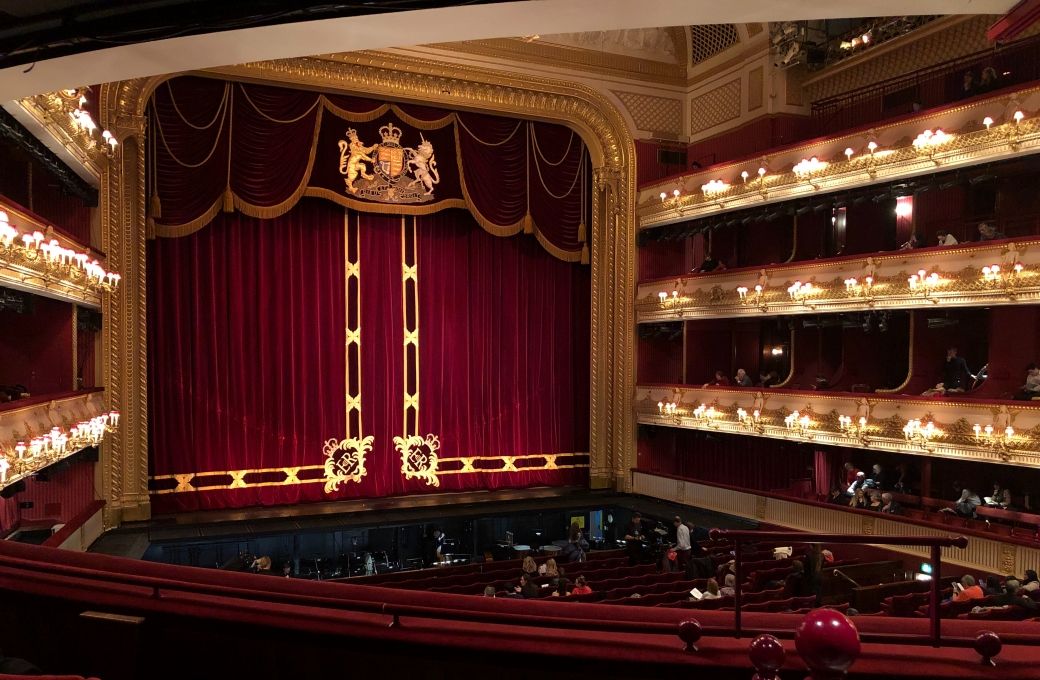
A ‘canon’ is an accepted body of works considered to advance or typify a specific genre. Musicologists and scholars are preoccupied with defining which composers and works fall into various canons, as modern music theory and performance hinge on studying and analyzing work from the past. Defining an authoritative body of work inherently presents problems, and there are no objective solutions to debates over which pieces of music are “quality” enough to merit inclusion in “the canon.” It is more instructive to build a canon around a certain ideal, theme, or goal towards which all included works point. In studying music from the United States, it is important to consider pieces which offer insight into the nation’s history, problems, identity, and values. The United States musical canon, then, becomes a tool for understanding and interacting with the country’s unique spirit and experience. This paper aims to provide historical context and musical analysis of Carlisle Floyd’s 1955 opera Susannah, which is one of the most frequently performed American operas. In doing so, the paper explores why this opera is important to the national body of music and deserves a place in musical study.
Opera, American History, Music
Introduction
Shortly after the American Civil War, during the literal and cultural reunification of the country, John William De Forest originated the term “Great American Novel.” The “Great American Novel,” or GAN, became a shorthand and measuring stick for literary critics and the
American public, embodying the country’s search to define its own identity through artwork. Across GAN candidates span a pattern of thematic and moral concepts which speak to our nation’s unique challenges and spirit, including the veracity or possibility of the American Dream. The nation’s self-conception and desire to build its own identity is not only expressed in novel form, with much of the United States’ music lending itself to the development of national pride, spirit, and culture. Composer and librettist Carlisle Floyd’s midcentury opera Susannah is a prime example of a major musical work that “[relates] directly to profound conflicts within contemporary America,” written during a crucial period of “Americanism” after the Second World War and during the contentious Red Scare of the 1950s. Close analysis of techniques and motifs in Floyd’s score and libretto, examination of commentary on the opera from its 1955 premiere, as well as contextualization of Floyd’s personal background and intentions, reveal these ideas. In exigence, inspiration, form, and content, Carlisle Floyd’s Susannah embodies an inherently “American” work of art and, consequently, merits inclusion in the United States musical canon.
Background and Historical Context
Carlisle Floyd conceived Susannah during his time as a professor at Florida State University, initially to be an entry into the Mannes School Opera Competition. In collaboration with Sam Blount, a mutual friend and colleague, Floyd chose the Apocryphal story of Susanna and the Elders from the Book of Daniel as his subject matter. Floyd translated the tale of a young woman named Susanna accused by elders of adultery to the fictional New Hope Valley, Tennessee. He depicts Susannah Polk (her name changed to a more American spelling) as a young woman accused by church elders of sexual indecency during a Christian revival camp meeting. The New Hope Church elders accidentally find Susannah bathing in a creek, and overcome with their own lust and guilt, they ostracize the girl and demand she publicly confess to her wickedness. When she refuses, the preacher Olin Blitch seeks her out to pray for her and then, in a shocking reversal of morality, rapes her. Outraged, Susannah’s brother Sam (also excluded from the community for his alcoholic behavior) shoots and kills Blitch. The New Hope Valley community blames Susannah for his death, and she chooses to remain in their exile. The story ends as Susannah, equipped with a shotgun, wards off the mob of zealous townspeople threatening violence at her house. The opera was first performed at Florida State in 1954 but was not the winner of the Mannes School Competition. However, Floyd’s work premiered at the New York City Opera in 1956 and won the New York Critics Circle Award that year. Since its debut in New York City, and the resulting critical acclaim, Susannah remains one of the most frequently performed American operas.
To understand the cultural impact of Susannah, it is useful to note the cultural movements and political trends which underline the opera’s inspiration and exigence. Evangelical Christianity is an important part of the setting of Susannah. In the early twentieth century, a fervor of religious fundamentalism (a more militant sub-sect of evangelicalism) swept the United States, leading some to join the Christian identity with American values and traditions. Carlisle Floyd was raised in a fundamentalist community in rural South Carolina, as the son of a Methodist preacher who militantly impressed his religious views on his family. Floyd’s work reflects his religious upbringing and negative reactions to the hypocrisy, suspicion, and fanaticism of his surrounding community, seen in his characterization of New Hope Valley’s strictly moralistic and hypocritical, religious residents. In his stage directions, he describes the New Hope Valley revival meetings, inspired by his own firsthand experience, as producing “tension, effrontery, and terror.” The Protestant fundamentalists, like Floyd’s familiar South Carolina Methodists, exerted a “powerful force on American religion and politics,” and their conflation of “Christian” and “American” in popular media and consciousness continued well beyond the 1920s.
It was under these conditions that two different surges of anti-Communist hysteria gripped the nation. Between 1919 and 1920, the United States government, at the state, local, and federal levels, began conducting raids and deporting suspected “radicals” in a wave of post-industrialization, post-World War I anxiety. Similarly, after World War II, anti-Communist sentiment surged, driven by the United States’ conflict with the Soviet Union. As the Cold War escalated, Senator Joseph McCarthy instigated widespread panic, driving the Senate to publicly question government employees, political figures, celebrities, and even the United States Army, over fear of Communist conspirators subverting the “American way of life.” Both of these waves were called “Red Scares,” and the public’s reaction and rhetoric pushed Christian morals and democratic values in response. Anti-radical propaganda and hysteria further intertwined American culture with the perceivably pure, patriotic Christian ideology.
The ‘National Mythology’
Floyd’s personal experience in the artistic and intellectual community during the second Red Scare shaped his criticism of hypocrisy and blind suspicion in Susannah. Biographer Thomas Holliday describes Floyd’s interaction with the “decade of Cold War-fueled mass hysteria, paranoia, and suspicion tantamount to guilt, accusation to conviction.” He explains that several students and professors close to Floyd were questioned, expelled, and, for one individual, driven to suicide over the rampant suspicion of communists and sexual deviants. Florida State University’s president terminated the employment of those under the suspicion of Florida governor Charley Johns, a local parallel to Senator McCarthy, and required all faculty to sign “loyalty pledges, attesting that they did not personally advocate, or belong to organizations that advocated the overthrow or subversion of the United States government.” Rachel Hutchins-Viroux notes, in her analysis of the Red Scare’s influence on Floyd’s work, that the country’s political environment “terrified and enraged [Floyd],” and his depiction of American preoccupation with theocracy, sexual repression, conformism, and righteousness embeds his work within, what she terms, the “national mythology.” This means that the opera is “characteristic of the national temperament,” like “the body of national literature” which includes Miller’s The Crucible, Hawthorne’s The Scarlet Letter, Dreiser’s An American Tragedy and other works with similar themes. Through his depiction of a repressive Southern town modeled on the suspicion and terror of both fundamentalist and McCarthyist America, Floyd criticizes the interaction between the country’s Christian roots, the American legal system, and the execution of justice. These ideas are key pillars of the United States Constitution and other founding documents. His voice resonates with American audiences who look to the “national mythology” to define the American experience and the nation’s values.
Popular Hymns as Inspiration
Floyd’s opera is unique in its combination of hymn tunes, American folk conventions, and Southern American dialect. The opera draws heavily on the musical, religious, and cultural heritage of the United States, producing a work which “speaks to Americans in their own language.” The chorus sings several hymnary tunes, composed by Floyd to mirror church music that the audience would find familiar. This music is diegetic, and the characters sing the tunes to themselves and others throughout the opera, giving a sense that this music could be heard outside of the opera’s fictional American community. Musicologist Helen Smith points to the revival meeting in Act 2, Scene 2 as a clear example of this musical realism, where the libretto description calls for a representative church gathering with a pulpit, altar, choir loft, wooden pews, and an engaged congregation that “in no way should be a parody but, instead, at all times should aim at projecting . . . a revival meeting of this nature.” In this scene, the choir sings two hymn tunes, “Are You Saved from Sin, Ready to Meet Your Lord?” And “Come, Sinner,” both featuring musical elements, lyrical conventions, and Biblical language common to American church services. In fact, later in the scene, Rev. Blitch delivers the Aaronic Blessing directly lifted from Numbers 6:24-26: “May the Lord bless you and keep you; the Lord cause his face to shine upon you and be gracious to you; the Lord lift up his countenance unto you and grant you peace.” The Act 2 hymn “Are You Saved from Sin?” which precedes this line features the lyrics:
Are you saved from sin,
Ready to meet your Lord?
Has His blood made you free
From the avenging sword?
Get down upon your knees,
Accept the saving grace.
Are you ready to meet
Your Savior face to face?
Free from sin, yes Lord!
Free from sin, am I
And I’m going to meet Him
With the saints on high.
The lyrical content features typical hymnal rhetorical questions, calls to action, simple rhyme scheme, and common images, like the blood of Christ and the sword of His word. The insistent rhetorical questions parallel many 19th century Protestant hymns, such as “Are You Washed in the Blood of the Lamb?” by Elisha Hoffman and “There’s a Great Day Coming,” by Will L. Thompson, which repeatedly asks “Are you ready for the Judgment Day?”Floyd’s “Are you saved from sin?” closely resembles Julia Ward Howe’s famous hymn “The Battle Hymn of the Republic” or “Glory, Hallelujah.” The tune was popular among early 19th century Methodist camp meetings, and during the American Civil War, it became popular among Union soldiers as a rallying song.After an 1862 battle in Washington, D.C., abolitionist Julia Ward Howe rewrote the lyrics to feature equal parts religious fervor and nationalistic intent, implying that the “terrible swift sword” of God would come down on the side of the abolitionists and Union Army. Drawing on this deeply patriotic and religious context, Floyd’s hymn borrows from the hymn’s structure, imagery, harmonic and rhythmic content, as well as melodic idea.
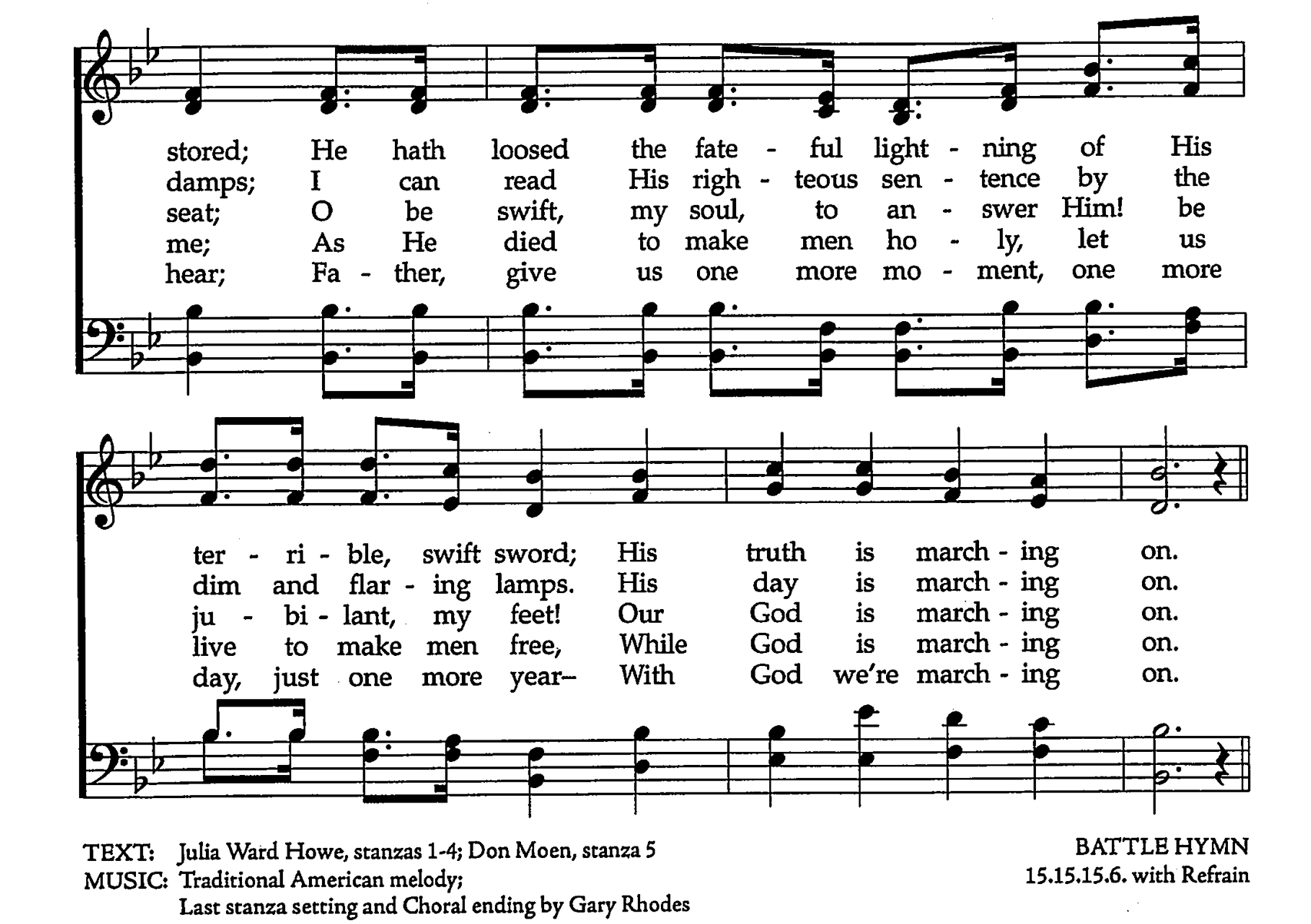
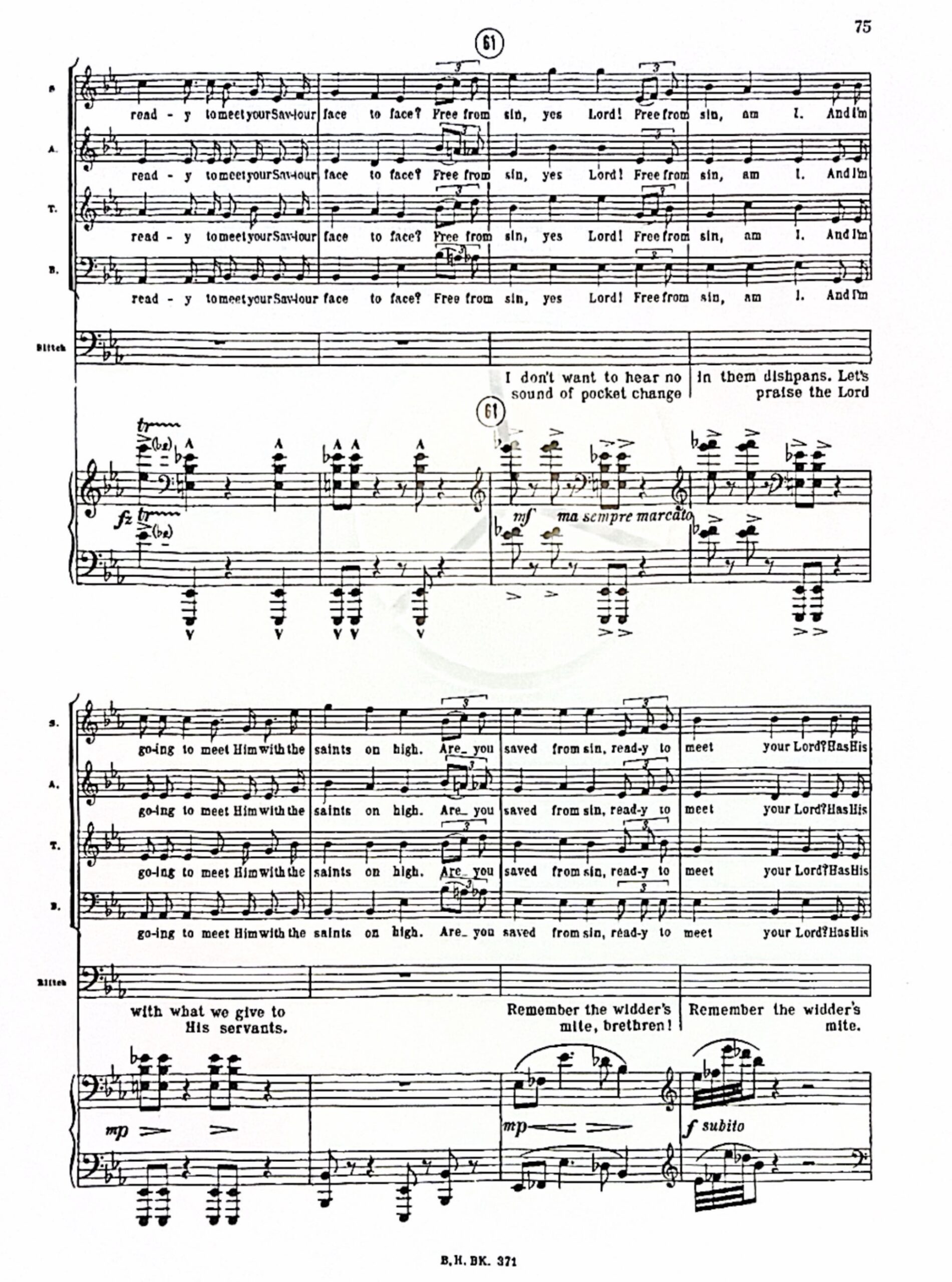
As seen in the figures above, both melodies prominently feature the “hornpipe” (dotted eighth and sixteenth note) rhythm contrasted with notes of longer duration. This recognizable rhythmic gesture as well as the similar phrase structure (four measure phrases preceded by syncopated anacrusis) links Floyd’s “Are you saved from sin?” with the model of Howe’s “Battle Hymn.” By linking his music with a hymn indicative of patriotism, national divide, justice, and righteousness in this specific period of American history, Carlisle Floyd deepens his exploration of the moral questions of the American experience.
American Folk Music Influences
Floyd, in addition to writing tunes inspired by popular, recognizable hymns, wrote music reflecting American folk traditions in order to enliven the opera’s “locale and provincial color.” The first scene of the opera introduces a folk-inspired, dance melody for fiddle, the tune of which returns as Susannah hums to herself following the dance. The violin’s melody is angular (predominantly disjunct motion), and the supporting chords are open. This is characteristic of early American music, rooted in hymnody of early 18th century settler churches. Colonial American (referred to as “Yankee”) music distinguished itself from European sacred traditions with this unique style, seen earliest in print with William Billing’s 1770 hymn collection, The New England Psalm-Singer. Traveling teachers established singing schools around the country propagating this style, providing the basis for much of the country’s folk music — particularly in the Southern United States.
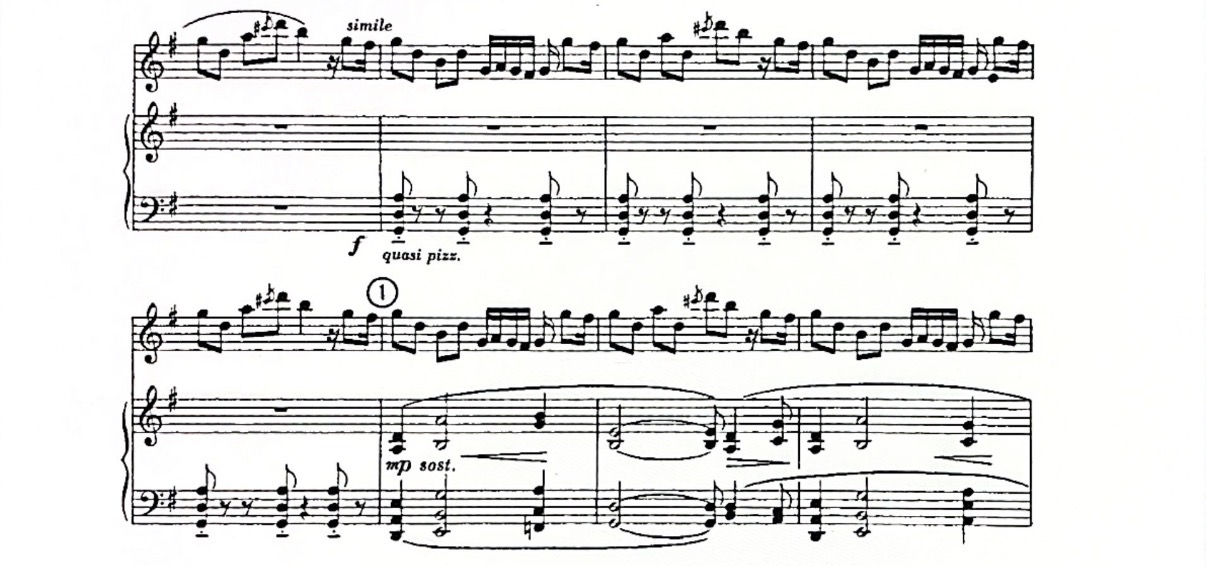
The orchestration of this moment is minimal: solo violin (fiddle) and pizzicato strings underneath. This simplicity, balancing a distinctive folk melody with sparse accompaniment, is reminiscent of another famous American composition — Aaron Copland’s ballet Appalachian Spring. Widely lauded as the fist composer to cement the “American sound” and winner of the 1944 Pulitzer Prize for Music, Copland famously featured an early Shaker hymn “Simple Gifts” at the end of the ballet. A solo clarinet plays the melody over strings and winds playing quiet, but lively and syncopated, open fifths which are a clear model for Floyd’s opening dance. Floyd’s inspiration from well-known, national music enlivens his opera’s familiar setting. The music sounds like the country, and its personality, that Floyd aims to examine. It is the “provincial color” and Floyd’s seemingly authentic Southern voice which appealed and continue to appeal to American audiences.
Impact of Regional Dialect
The opera’s characteristic setting is explored further through the use of Southern American English instead of American Standard English diction. Heard throughout the opera, the characters’ southern community is realized through the recognizable dialect of the Southern Appalachian region, not commonly heard in operas. Susannah’s Act I aria “Ain’t it a pretty night,” features omitted final consonants and “o”s replaced with open “e”s. The title itself uses the common Southern contraction “ain’t,” and the last line substitutes the word “them” where Standard American English speakers would say “those.”
I wonder if I’d get lonesome fer the valley though
Fer the sound of crickets an’ the smell of pine straw
Fer soft little rabbits an’ bloomin’ things
An’ the mountains turnin’ gold in the fall
But I could always come back I get homesick fer the valley
So I’ll leave it someday an’ see fer myself
Someday I’ll leave an’ then I’ll come back
When I’ve seen what’s beyond them mountains
The use of this regional dialect contrasts the notion that opera, as a genre, is “too rarified an art form, too high class and […] too European” to depict Southern folk stories. Americans engaging with a production of Susannah see cultures closer to home represented on stage, connecting their experiences to a seemingly esoteric and foreign genre. It is understandable, then, that original productions of the opera were lauded for their overtly American aspects.
Critical Reception
Upon Susannah’s New York debut in 1956 and its European premiere at the Brussel’s World Fair in 1958, The New York Times music critic Howard Taubman was particularly impressed with the opera, writing several positive reviews of various productions. In a review contrasting revivals of old “dead” European operas with the production of new, American works, he declared that “[Floyd’s] is a voice of our own country and people.” Taubman made sure to highlight the later production of Susannah as an impressive American entry to the 1958 Brussels World Fair. He lauded the event as a “powerful native product” and a “resounding success” which proved to skeptical European audiences that the US can “export” opera along with other, more typical American products. As a European art form in origin, American composers were not considered part of the opera canon. In a 1956 television interview, acclaimed Broadway composer and producer Arthur Schwartz and Viennese opera conductor Eric Leinsdorf discuss developments in American music and theatre since the 1920s. Speaking to the United States’ efforts to distinguish its own music theatre traditions and style, Leinsdorf characterizes the emergence of American music as blurring the lines between popular and classical music to create an art form “which will be our own.” The post-war, cultural mentality, surrounding politics, visual art, and especially music can, then, be seen as rejecting European roots in favor of defining a unique national identity. Taubman’s review of the New York City Center debut of Susannah as well as Leinsdorf and Schwartz’s roundtable discussion posit Floyd’s opera as a shining example of “American” classical music, valuing the work largely on its representation of national themes and sentiments. Its favorable reception and frequent reproduction in later years can be attributed to American audiences resonating with the material that brings their own cultural experience to the stage.
Conclusion
In considering a body of work that encapsulates the United States’ musical history, Carlisle Floyd’s Susannah reflects the country’s desire to distinguish itself and its culture from European and outside influences. Themes underlined in the work’s inspiration, stylistic elements, content, and even its reception, characterize the nation’s self-determinative spirit and reflect the country’s history. Continuing to study, perform, and consider Floyd’s opera as part of the United States musical canon demonstrates art’s power to define identities of not only people, but also of nations. As the United States perpetually pursues and evaluates the “American experiment,” it is important for Americans to look to works of art that examine our history in order to inform our understanding of what it means to be an American.
References
“American Music.” Funk & Wagnalls New World Encyclopedia, September 30, 2021, 1. EBSCOhost.
Barnes, William H. “Fundamentalism.” In The Oxford Companion to the Bible. Oxford University Press, 1993. Accessed September 22, 2025.
Buell, Lawrence. The Dream of the Great American Novel. Cambridge: Harvard University Press, 2014. Accessed December 6, 2025. ProQuest Ebook Central.
Copland, Aaron. Appalachian Spring. Boosey & Hawkes, 1945.
ESV Study Bible: English Standard Version. Crossway Bibles, 2016.
Floyd, Carlisle. Susannah. Vocal Score with Piano Reduction edited by Ross Reimueller. Boosey & Hawkes, 1967.
Holliday, Thomas. Falling Up: The Days and Nights of Carlisle Floyd, the Authorized Biography. Syracuse University Press, 2013. ProQuest Ebook Central.
Hutchins-Viroux, R. “Chasse aux sorcières, théocratie et hypocrisie: Le McCarthysme dans Susannah de Carlisle Floyd et The Crucible de Robert Ward/Witch Hunts, Theocracies and Hypocrisy: McCarthyism in Arthur Miller/Robert Ward’s Opera The Crucible and Carlisle Floyd’s Susannah,” La Revue LISA/LISA e-Journal: Literature, History of Ideas, Images and Societies of the English-Speaking World, 6(2), 2017, 140–148. https://doi.org/10.4000/lisa.1140
Lornell, Kip, Kip Lornell, and Introducing American folk music. Exploring American Folk Music: Ethnic, Grassroots, and Regional Traditions in the United States / Kip Lornell. 3rd ed. University Press of Mississippi, 2012. EBSCOhost.
McCollum, Sean. 2020. “Battle Hymn of the Republic.” Kennedy-Center.org. 2020. https://www.kennedy-center.org/education/resources-for-educators/classroom-resources/media-and-interactives/media/music/story-behind-the-song/the-story-behind-the-song/the-battle-hymn-of-the-republic/.
Miller, Todd R. “Religious Elements in Three Operas of Carlisle Floyd.” PhD diss., University of Houston, 2002. https://www.proquest.com/dissertations-theses/religious-elements-three-operas-carlisle-floyd/docview/305538215/se-2. ProQuest (3089809)
Noggle, Burl L., and Christy Jo Snider. “Red Scare.” In the Salem Press Encyclopedia, January 1, 2023. https://research.ebsco.com/linkprocessor/plink?id=8f76dd28-fa3b-3737-8214-8941907d8cb6.
Pacun, David. “Floyd, Carlisle.” Visible Ink Press, 2001. https://research.ebsco.com/linkprocessor/plink?id=28414873-7eb9-30c3-aafe-25f75b5b3e62.
Prince, K. Michael, “Carlisle Floyd,” in Making Notes: Music of the Carolinas, edited by Ann Wicker. Novello Festival Press, 102.
Smith, Helen. “Faith and Love in New Hope Valley: A Consideration of Community in Carlisle Floyd’s Susannah.” American Music Research Center Journal 21 (January 2012): 67–91. EBSCOhost.
“Susannah” Interview and Excerpts, 1956. Video, 25 min., 41 sec. Creative Arts Television, 2007. https://research.ebsco.com/linkprocessor/plink?id=8edf0103-0c81-34aa-b044-3e4480a957e9.
Taubman, Howard. “A Tale of Two Cities: New York City Opera Invests in Future with ‘Susannah’ as San Francisco Group Stakes Lifeless ‘Francesca’ Vintage Work Good Gamble Determination” New York Times (1923-), Oct 07, 1956. https://www.proquest.com/historical-newspapers/tale-two-cities/docview/113733072/se-2.
Taubman, Howard. “Opera: ‘Susannah’ at Fair: Floyd’s Work Scores a Hit in Brussels.” New York Times (1923-), Jun 26, 1958. https://www.proquest.com/historical-newspapers/opera-susannah-at-fair/docview/114570994/se-2.
The Celebration Hymnal. Word Music Distributing Company, 1997.
The Library of Congress. “Battle Hymn of the Republic,” 2015. https://www.loc.gov/collections/patriotic-melodies/articles-and-essays/battle-hymn-of-the-republic/.
Webb, Shawncey. “Aaron Copland.” Salem Press Biographical Encyclopedia, July 31, 2021. EBSCOhost.
Citation Style: Chicago Notes and Bibliography