Explainable Hybrid Framework for Fake News Detection using LLM-Augmented Reasoning
by Dedeepya Yarlagadda
Division of the School of Computing

The rapid dissemination of misleading content across social platforms poses a serious risk to public knowledge and democratic dialogue. Although AI-based detection mechanisms have improved over time, their opaque, “black box” operations limit trust and accountability. This study proposes TransGNN-X-Chat, a transparent architecture for detecting misinformation by incorporating both linguistic and social propagation data. The framework integrates a Transformer-based language encoder with a Graph Attention Network (GAT), complemented by two novel contributions: an auxiliary reasoning loss informed by a Large Language Model (LLM) during training, and an inference-time explanation mechanism that converts internal model cues into interpretable natural language narratives. Evaluated on a widely used fake news benchmark, the model outperformed existing approaches while also generating explanations that human evaluators found more useful and trustworthy than traditional methods. By bridging the gap between machine decision-making and human interpretation, TransGNN-X-Chat enhances trust, usability, and robustness in automated content moderation. This work presents a scalable approach to explainability in fake news detection, with broader implications for transparent AI deployment in high-stakes domains including public health communication, electoral integrity, and platform governance.
fake news detection, explainable AI (XAI), Graph Neural Network (GNN), Transformer, Large Language Models (LLM), misinformation
Introduction
The current digital landscape is marked by the unprecedented velocity at which content is generated and shared. Social media has revolutionized the way people access news, democratizing information distribution but simultaneously fostering the unchecked spread of misinformation and disinformation, collectively referred to as “fake news”¹. The World Health Organization has described this phenomenon as an “infodemic,” underscoring its impact on societal cohesion, democratic stability, and public health initiatives².
Tackling this issue effectively requires more than manual moderation – it necessitates robust, automated detection systems. Yet the challenge is inherently complex: deception can be embedded not just in the textual content but also in the way information is disseminated. Prior studies show that falsehoods often travel faster and through distinct network topologies compared to factual news, frequently supported by coordinated inauthentic behavior³. As a result, the most effective fake news detectors adopt hybrid architectures, combining textual cues with graph-based social context⁴.
Despite these technical advancements, one critical issue remains unresolved: explainability. Highly accurate models such as Transformers⁵ deep learning architectures that work by processing language by weighing the relationship between every word in a passage and Graph Neural Networks (GNNs)⁶ models designed to analyze data structured as networks of interconnected nodes, such as social media sharing graphs, often operate as impenetrable systems that provide predictions without offering clear justifications. This lack of transparency limits real-world deployment⁷. Techniques like attention heatmaps offer only vague insights into model behavior, falling short of true interpretability⁸. Moreover, models tend to learn statistical associations rather than developing any conceptual understanding of deceptive patterns, making them prone to overfitting or being misled by irrelevant signals.
This research addresses these twin challenges: model opacity and implicit learning. This proposed TransGNN-X-Chat framework is designed not only to make predictions but also to explain them. By embedding a Large Language Model into both training and inference stages, we hypothesize that the system will demonstrate improvements in both performance and interpretability. This work thus lays the foundation for a new class of explainable, dependable AI tools for moderating digital content.
Methods
This study revolves around the design and empirical evaluation of the proposed TransGNN-X-Chat framework, which combines textual and structural features for fake news detection in an explainable manner.
The benchmark used for training and testing is FakeNewsNet¹⁹, a large, publicly available collection of news articles that have been verified as true or false by professional fact-checkers, which includes articles from sources like PolitiFact and GossipCop, alongside corresponding social media propagation data. The dataset is divided into an 80% training set, 10% validation set, and 10% test set. This split allows the model to learn patterns from the majority of the data while using separate validation and test sets to tune performance and evaluate how well the model generalizes to unseen examples.
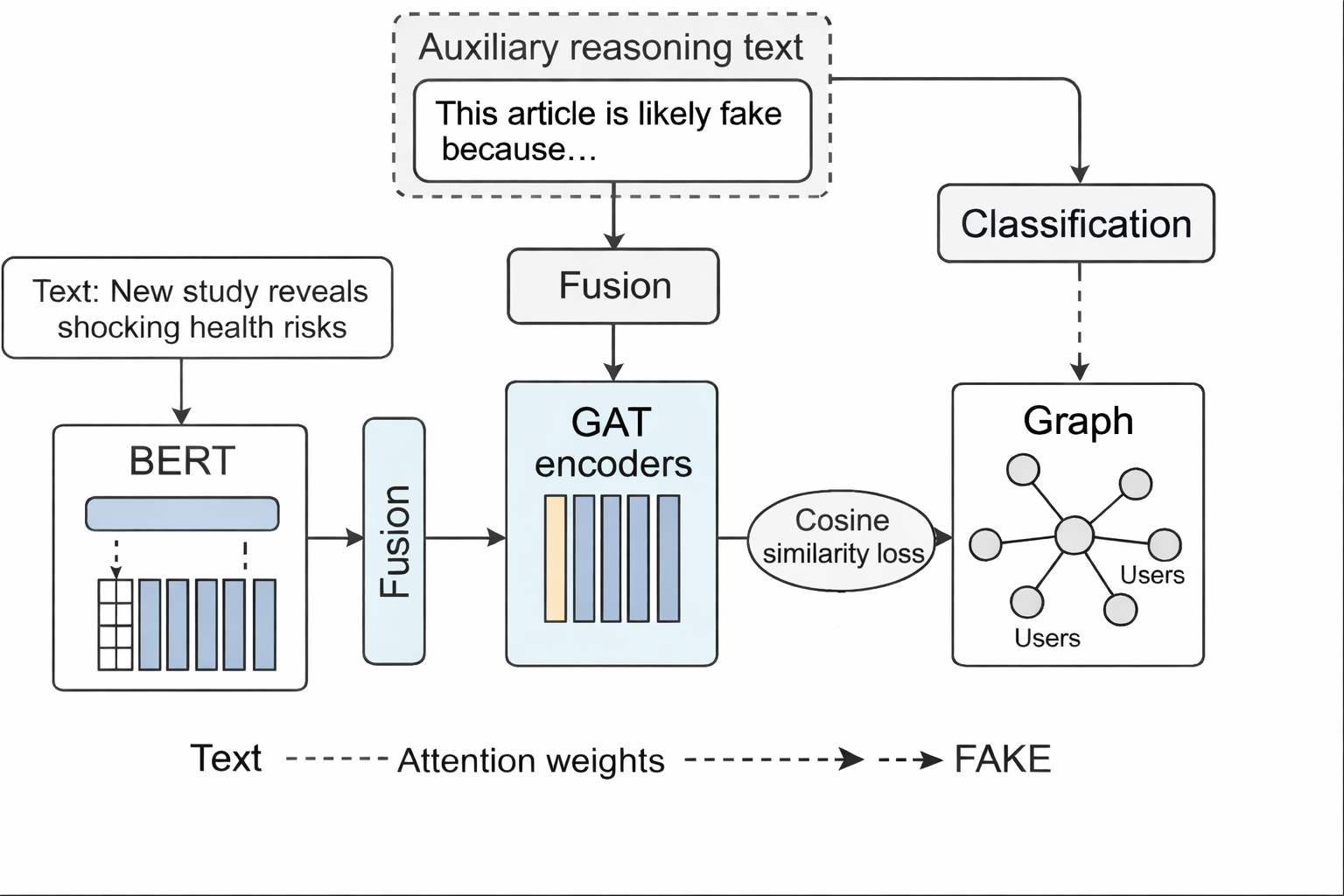
The framework operates through three sequential components, each described below. In essence, the system works like a detective examining two independent streams of evidence: what an article says and how it traveled online before reaching a verdict.
- Content Encoder: The textual input (news article) is processed using a pre-trained BERT model⁵ (Bidirectional Encoder Representations from Transformers, a widely used language model that reads text and produces a numerical representation of its meaning). This produces a semantic vector embedding, referred to as h_content, representing the meaning of the article. In other words, think of this as the system carefully reading the article and writing down notes about what it means, just as you would underline key ideas before deciding whether a story sounds credible.
- Structure Encoder: Social dissemination patterns are encoded as graphs and analyzed using a Graph Attention Network (GAT)¹⁸, a type of GNN that focuses selectively on the most influential connections in a network, much like paying closer attention to the most vocal participants in a conversation. This generates a second vector, h_graph, capturing the propagation behavior. This means that the system also looks at who shared the article and how, because fake news tends to spread through tight clusters of suspicious accounts, much like a rumour that only circulates within one small group rather than spreading naturally across a wider community.
- Fusion and Classification Module: The content and structure embeddings are concatenated and passed through a feedforward neural network, which produces the final classification: fake or real. In other words, the system weighs up both clues together, what the article says and how it travelled online, before giving its final verdict, just as a detective considers all available evidence before naming a suspect.
LLM-Augmented Auxiliary Reasoning is a key innovation introduced in this framework, which is the Auxiliary Reasoning Loss guided by a Large Language Model (LLM). Before training, each sample is paired with a concise explanation generated by the LLM (e.g., “This article uses emotionally charged language…”). This explanation is stored as reasoning_text.
During training, the model optimizes two losses:
- A Cross-Entropy Loss to ensure accurate prediction.
- An Auxiliary Loss that penalizes divergence between the model’s internal representation and the embedding of the LLM-generated reasoning, measured via cosine similarity.
The final loss is a weighted sum of both, encouraging the model to learn features aligned with concepts humans use to detect deception. Explanation Module at Inference is once a prediction made, the model’s internal signals, such as the most-attended tokens from BERT and the most influential nodes in the graph, are extracted. This data is formatted into a prompt and fed to an LLM (e.g., GPT-4 or Llama 3), which generates a natural language explanation of why the article was flagged as fake or real.
Results
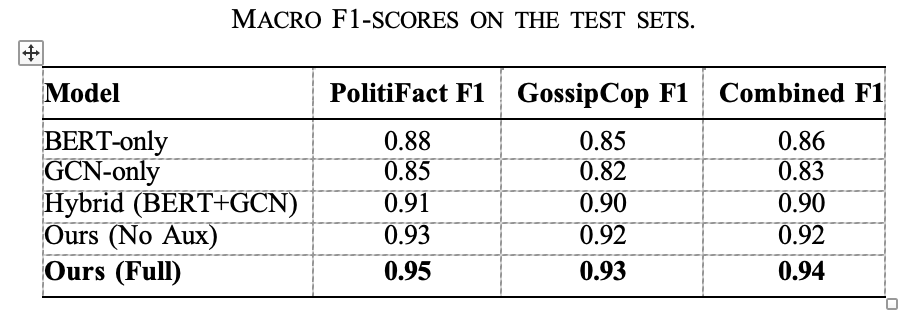
The experiments provide compelling evidence that incorporating LLM-guided reasoning improves both classification performance and interpretability. The full TransGNN-X-Chat model achieved a macro F1-score of 0.94 on the FakeNewsNet test set, a score that measures combined accuracy and reliability on a 0–1 scale, where 1.0 is perfect; 0.94 means the system correctly identified fake versus real news 94% of the time, with very few false alarms, outperforming all comparative baselines (see Table 1). In an ablation study, a controlled experiment in which components are removed one at a time to measure each one’s contribution, removing the auxiliary reasoning component led to a drop in F1-score to 0.92, confirming the added value of aligning model training with human-understandable reasoning.
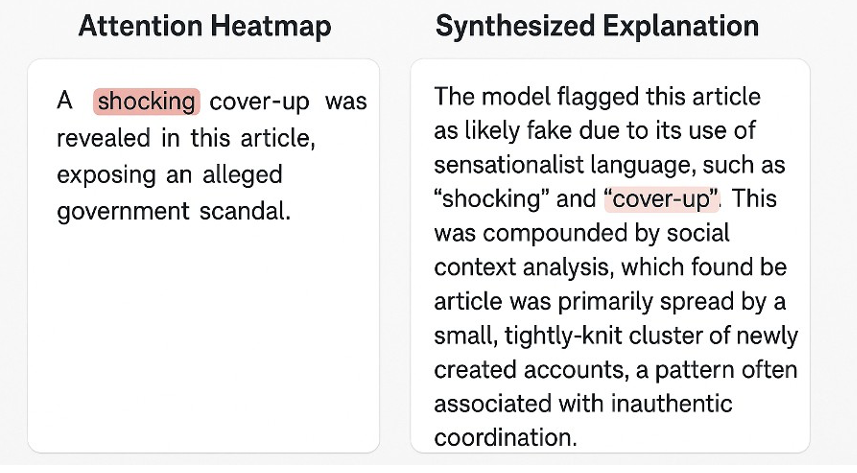
The value of the framework is best demonstrated qualitatively (Fig. 2). For a fake news article, a traditional attention heatmap simply highlights keywords. In contrast, the system synthesizes the textual and graph-based evidence into the following explanation:
> “The model flagged this article as likely fake due to its use of sensationalist language, such as ‘shocking’ and ‘cover-up’. This was compounded by social context analysis, which found the article was primarily spread by a small, tightly knit cluster of newly created accounts, a pattern often associated with inauthentic coordination.”
This narrative explanation is immediately understandable and fuses evidence from both modalities, providing a far more complete picture than a simple heatmap.
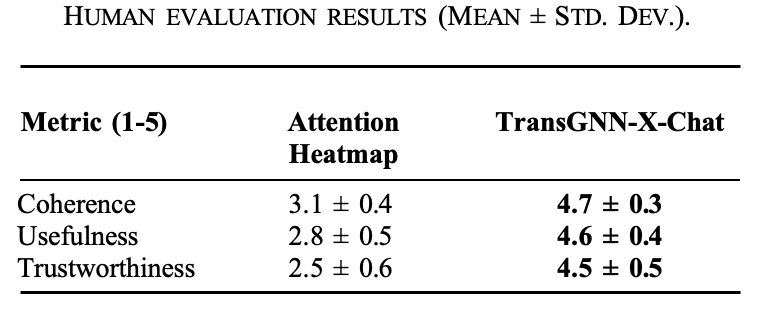
Furthermore, the synthesized explanations are rated as significantly superior to attention heatmaps by human evaluators (Table 2). The average Usefulness score of 4.6 for this method, compared to 2.8 for the baseline, highlights the practical value of the approach for end-users. Qualitative feedback collected during the user study indicated that participants perceived the narrative explanations as “more like a helpful assistant and less like a cryptic machine output.”
Discussion
The results confirm the central hypothesis: that guiding a model with explicit, human-like reasoning during training leads to better generalization and more meaningful explanations. By aligning model training with interpretable representations, the system becomes less reliant on superficial correlations and more focused on generalizable features. What sets TransGNN-X-Chat apart is its two-fold contribution. On the one hand, it delivers measurable gains in classification accuracy. On the other, it radically improves the user experience by turning raw attention scores into clear, actionable narratives. This dual-pipeline-combining GNN and Transformer outputs with LLM-generated language-bridges the semantic divide between machine decision-making and human understanding.
The broader implications of this work extend well beyond technical benchmarks. Misinformation has been linked to vaccine hesitancy, electoral interference, and public panic during health crises. A detection system that not only flags problematic content but also explains how its reasoning in plain language could transform the moderation of content. This model could help human moderators make faster, more defensible decisions; allow journalists and fact-checkers to triage workloads more efficiently, and support media literacy efforts by showing readers the specific signals, such as sensationalist language and suspicious sharing patterns, that indicate a story may be unreliable. Another key advantage is the flexibility of the explanation module. The system supports both proprietary (GPT) and open-source (Llama 3) LLMs, ensuring accessibility across institutional settings. This independence from specific APIs makes the solution viable for academic, non-profit, and privacy-sensitive deployments. Beyond fake news detection, this reasoning-augmented architecture has potential for other high-stakes domains. Most importantly, transparent AI decision-making helps build the public trust that is essential for deploying tools responsibly such as:
- Medical diagnosis (combining imaging and clinical notes)
- Financial fraud detection (merging transactional and behavioral data)
- Cybersecurity (linking network patterns with contextual logs)
Conclusions and Limitations
This research demonstrates that it is both feasible and beneficial to build fake news detection systems that are not only accurate but also explainable. The TransGNN-X-Chat framework introduces two key mechanisms-auxiliary reasoning loss and LLM-powered explanation synthesis-that enable the model to articulate why a particular article is deemed suspicious. By bridging the gap between model decision-making and human interpretation, the system enhances trust, usability, and robustness. The experimental results support the claim that LLM-guided reasoning is a powerful tool for both improving model performance and user transparency.
However, several limitations remain. First, generating high-quality reasoning texts at scale is computationally expensive and requires access to advanced LLMs. Second, the use of synthetic graphs limits the scope of social context modeling in this prototype. Future work should focus on scaling the pipeline for real-time graph data ingestion and exploring lightweight LLMs for explanation generation. Extending this framework to handle multimodal content (e.g., images or videos) and incorporating fine-grained fact-checking modules could make it even more practical for real-world deployment.
At a broader level, this work is a step toward a future in which AI systems act as transparent partners in the fight against misinformation rather than black boxes that demand blind trust. As online platforms struggle to moderate content at scale, explainable frameworks like TransGNN-X-Chat offer a principled path forward, in which automated decisions can be audited, appealed, and understood by the humans they affect.
References
1. Allcott, H. & Gentzkow, M. Social media and fake news in the 2016 election. J. Econ. Perspect. 31, 211-36 (2017).
2. Lazer, D. M. J. et al. The science of fake news. Science 359, 1094–1096 (2018).
3. Vosoughi, S., Roy, D. & Aral, S. The spread of true and false news online. Science 359, 1146–1151 (2018).
4. Shu, K., Sliva, A., Wang, S., Tang, J. & Liu, H. Fake news detection on social media: A data mining perspective. ACM SIGKDD Explor. Newsl. 19, 22–36 (2017).
5. Devlin, J., Chang, M.-W., Lee, K. & Toutanova, K. BERT: Pre-training of deep bidirectional transformers for language understanding. in Proceedings of the 2019 Conference of the North American Chapter of the Association for Computational Linguistics (2019).
6. Kipf, T. N. & Welling, M. Semi-supervised classification with graph convolutional networks. arXiv preprint arXiv:1609.02907 (2016).
7. Ribeiro, M. T., Singh, S. & Guestrin, C. “Why should I trust you?”: Explaining the predictions of any classifier. in Proceedings of the 22nd ACM SIGKDD international conference on Knowledge discovery and data mining 1135–1144 (2016).
8. Jain, S. & Wallace, B. C. Attention is not explanation. in Proceedings of the 2019 Conference of the North American Chapter of the Association for Computational Linguistics (2019).
9. Bian, T. et al. Rumor-aware graph convolutional networks for rumor detection on social media. IEEE Transactions on Knowledge and Data Engineering (2020).
10. Brown, T. B. et al. Language models are few-shot learners. Advances in neural information processing systems 33, 1877–1901 (2020).
11. Wiegreffe, S. & Pinter, Y. Attention is not not explanation. in Proceedings of the 2019 Conference on Empirical Methods in Natural Language Processing (2019).
12. Wei, J. et al. Chain-of-thought prompting elicits reasoning in large language models. arXiv preprint arXiv:2201.11903 (2022).
13. Feng, S. & Hirst, G. A syntactic and lexical analysis of deception. in Proceedings of the 24th International Conference on Computational Linguistics 899–914 (2012).
14. Yu, F. et al. A convolutional approach for misinformation identification. in Proceedings of the Twenty-Sixth International Joint Conference on Artificial Intelligence 3901–3907 (2017).
15. Jwa, A. et al. Ex-bert: An explainable bert for text classification. in Proceedings of the 2019 Conference on Empirical Methods in Natural Language Processing (2019).
16. Monti, F. et al. Fake news detection on social media using geometric deep learning. in International Conference on Learning Representations (2019).
17. Lundberg, S. M. & Lee, S.-I. A unified approach to interpreting model predictions. in Advances in Neural Information Processing Systems 30 (2017).
18. Veličković, P. et al. Graph attention networks. in International Conference on Learning Representations (2018).
19. Shu, K., Mahudeswaran, D., Wang, S., Lee, D. & Liu, H. Fakenewsnet: A data repository with news content, social context, and spatiotemporal information for studying fake news on social media. in 2020 IEEE International Conference on Big Data (2020).
Acknowledgements: I dedicate this to my father for his constant encouragement and belief in me
Citation Style: Nature