Harnessing Wind Energy:
An Analysis of Offshore Wind Farm Development in Long Bay, North Carolina
by Kayleigh Everhart
Franklin College of Arts and Sciences, Ocean Sciences
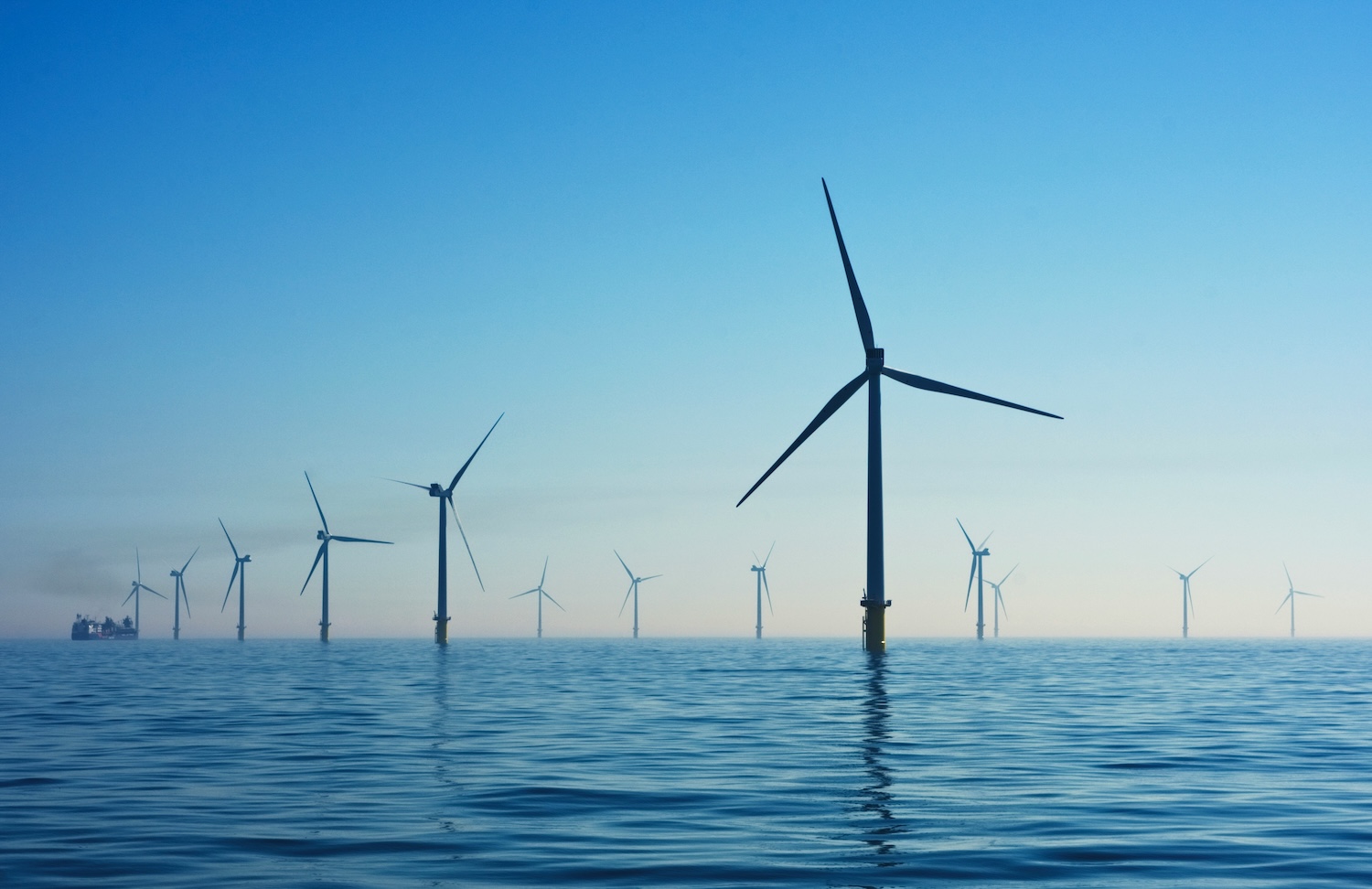
In recent years, offshore wind farms (OWFs) have emerged as a promising renewable solution to the ongoing energy crisis. The South Atlantic Bight (SAB), characterized by a wide and shallow continental shelf and strong tides, is under consideration for OWF development. With appreciate mean winds year-round, two sites off Long Bay, North Carolina—OCS-A 0545 and OCS-A 0546—have been leased for OWF construction. While OWFs can provide clean energy to coastal communities, they don’t come without challenges. Construction processes can disturb sediments and create noise that may affect marine mammals. Mitigation strategies such as turbine placement, seabed protection, and bubble curtains can minimize potential impacts. OWFs also have the potential to increase benthic ecosystem production and restore previously disturbed communities. This paper aims to evaluate the potential impacts of OWF development in the South Atlantic Bight and argues that the implementation of OWFs will, in the long run, protect and vitalize the surrounding environment.
offshore wind energy, South Atlantic Bight, hydrodynamic forcing, sediment transport, marine ecosystems, renewable energy
Introduction
The rise of coal and oil usage in the last century has resulted in massive amounts of greenhouse gases released and trapped in the atmosphere,1 invoking worldwide concern at the frequent and intensifying consequences of decades-long fossil fuel burning. With rising global temperatures and increasingly disastrous environmental events, many are calling for adjustments to the way we approach energy use, with a growing focus on generating new, renewable sources of energy that might serve to combat this ever-growing issue. One such energy source that has emerged in the last few decades is offshore wind farming, a potentially key innovation in renewable energy development. Offshore wind farms (OWFs) are patches of ocean dedicated to the construction of wind turbines, which utilize the consistent and relatively strong winds often characteristic of coastal areas to generate electricity. While expensive, with operating costs per project estimated at $125 per megawatt-hour (MWh) and leasing blocks alone generating costs in the hundreds of millions, they have the potential for enormous amounts of energy return and have even been successfully implemented for years in some locations.2 Most of the world’s OWFs can be found in northern Europe and Southeast Asia, though the United States currently has construction and operation efforts on the northern continental shelf of the Atlantic, and has several sites in the planning process along the east and west coasts and the Gulf of Mexico.1
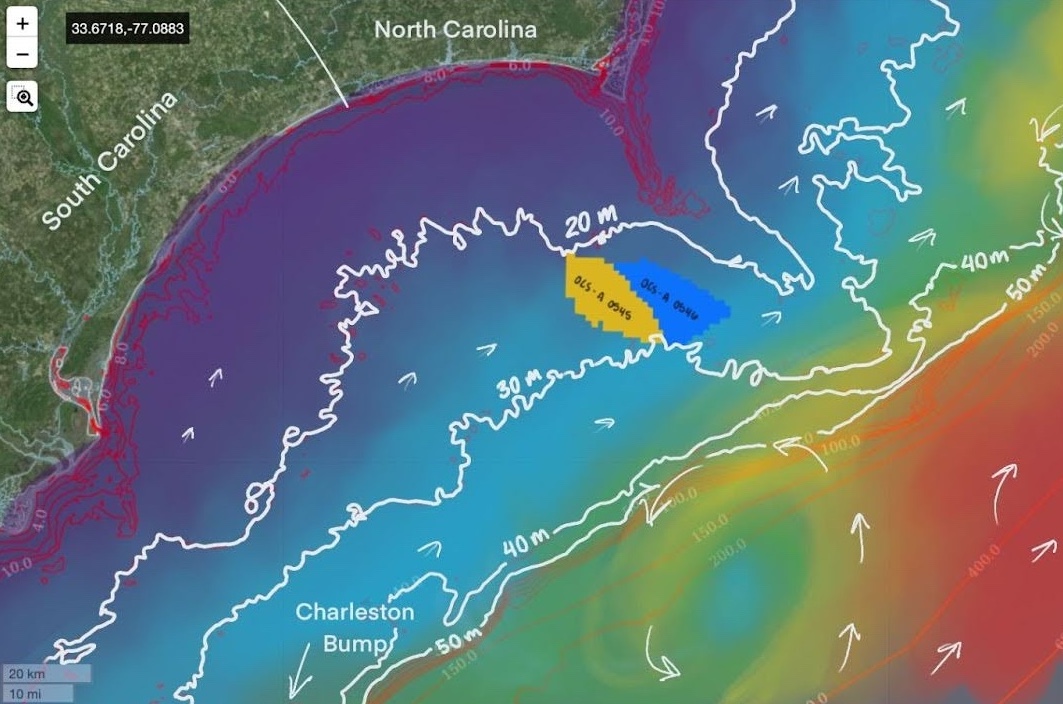
While the majority of operational OWFs in the United States are located on the northeast coast, primarily along the outer continental shelf, the South Atlantic Bight (SAB)—the curved stretch of coast along the southeastern United States—has emerged as a promising location for offshore wind farm development.2, 3 The characteristically strong winds and intense tidal forcing that the area experiences make it a potentially ideal site for renewable energy development. In an effort to reduce domestic carbon emissions and bolster local energy production, the Bureau of Ocean Energy Management (BOEM) has leased two sites—OCS-A 0545 and OCS-A 0546, obtained by TotalEnergies Renewables for $160 million and Duke Energy Renewables for $155 million, respectively—for OWF development.3 Both are located on the continental shelf of the SAB just off the coast of Long Bay, North Carolina, between the 20- and 30-meter isobaths, or lines of equal depth marked on a map (Figure 1). Site assessment and construction at the two sites is expected to begin in the coming years.3 Understanding the unique characteristics of the SAB and the impacts OWFs may have on the area is crucial for successful implementation, and OWFs, like all renewable energy strategies, have their fair share of setbacks. While the development of these OWFs could present significant energy benefits, concerns have arisen for the physical and biological processes surrounding the lease sites. Local hydrodynamics in this area establish ideal baselines for implementation, while both construction and operation could result in disturbances to local sediment transport and ecosystem structure. By drawing on previous OWF implementation in other parts of the world, this paper aims to examine how the construction of offshore wind farms on sites OCS-A 0545 and OCS-A 0546 may affect the surrounding localized environment, and how this infrastructure will, with careful site selection and evaluation, provide a viable and necessary strategy for sustainable energy production in the South Atlantic. Given the current administration’s hard stance against OWF development and the recent executive order halting new or renewed OWF leases (and subjecting existing leases to review)4, it is more crucial than ever to objectively examine the possible impacts of implementing OWFs in the SAB and consider how the benefits may far outweigh the disadvantages.
Hydrodynamics
Part of BOEM’s criteria for OWF development is the presence of strong, steady annual winds and shallow depths.3 With smaller tides and year-round winds alone,5 the hydrodynamics in the mid-shelf zone off North Carolina make for an ideal location. Hydrodynamics is the process by which water moves and circulates. The SAB is primarily controlled by wind-driven currents, tidal forcing, and the Gulf Stream.5, 6 These factors play important roles in regulating the biogeochemical processes in the bight, such as nutrient cycling, sediment transport, and productivity. In turn, these processes create a diverse ecosystem that supports many coastal communities and environments.5 This section aims to explore how each of these dominant processes shapes the potential for OWF construction.
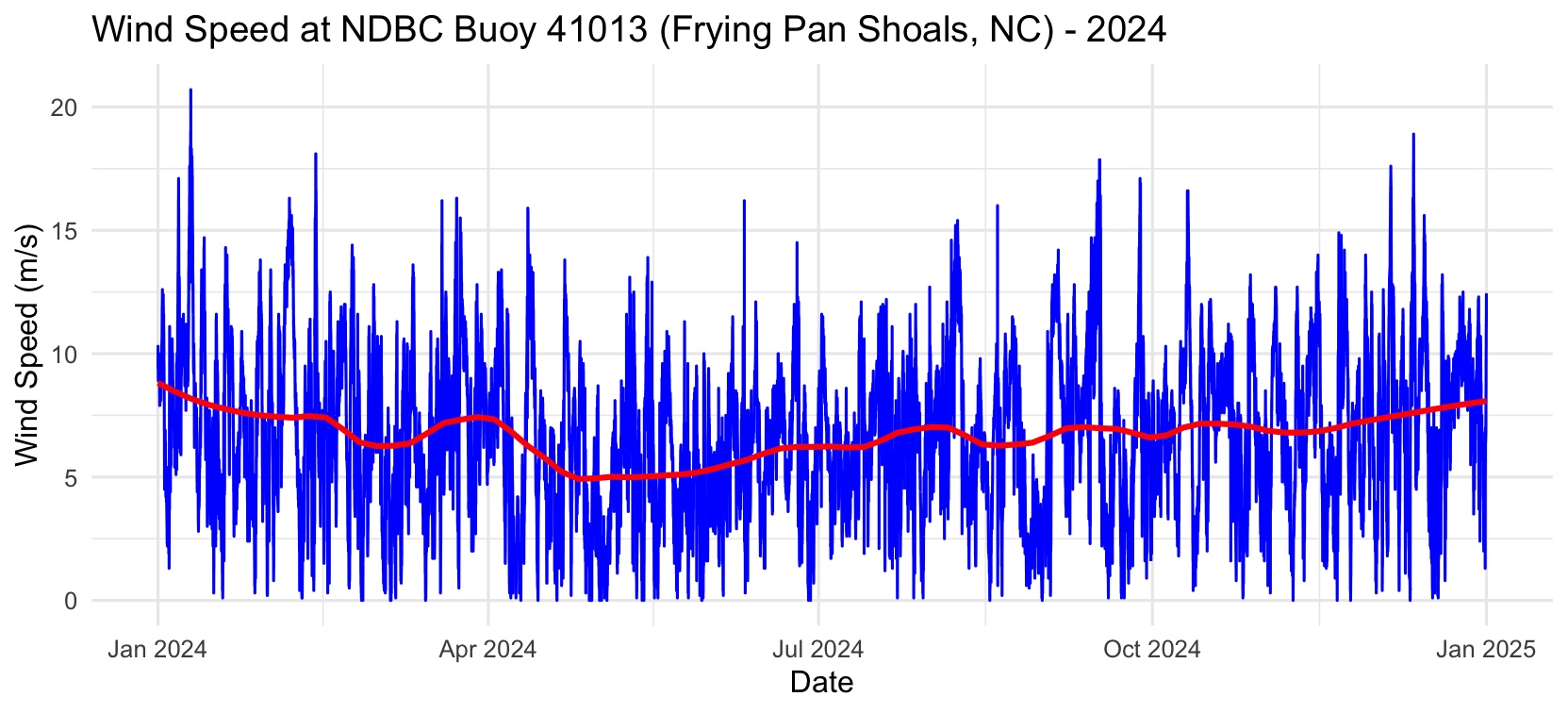
One of the many unique characteristics of the SAB is the continental shelf. Like most shelves on passive margins, where the continental-oceanic crust transition exists over seismically inactive regions, the continental shelf of the SAB is wide and shallow.5 This means that wind-induced circulation is much more important in this area, and the friction between the wind and the water’s surface can drive significant flow. Most major wind systems in the SAB are driven by atmospheric pressure systems, with more intense effects closer inshore.7 Winds in this area are generally steady year-round, a major factor when considering OWF placement (Figure 2).
Tidal variations play a larger role throughout the inner and middle shelves, where the lease blocks lie, than the outer shelf. The maximum tidal range in the SAB occurs on the Georgia coast and decreases northward, with North Carolina experiencing weaker tidal ranges between 0.4 m and nearly 4.0 m.7 Stronger tidal forcings, like those that occur near Georgia, could potentially accelerate deterioration of the metal and machinery that make up individual turbines; accordingly, large tidal ranges may have negative effects on operational conditions, construction, and maintenance. The lesser tidal variation and influence in the North Carolina region indicate a more ideal location.
A prominent physical characteristic of the SAB is the Gulf Stream, as illustrated in Figure 1. It’s one of the world’s most significant drivers of heat transport and influences a large portion of production in the outermost parts of the SAB.7 While the Gulf Stream spans the entirety of the SAB, the area of focus here is just north of the Charleston Bump, a deepwater bottom feature that lies about 90 miles southeast of Charleston, South Carolina (Figure 1). Once the Gulf Stream reaches the Charleston Bump, the current’s direction is deflected seaward.6 This deflection is, in part, what makes sites OCS-A 0545 and OCS-A 0546 ideal for OWF development. Gulf Stream forcing, including meandering eddies that consistently detach and widen the Gulf Stream’s influence, does not appear to significantly influence the area where these two OWFs are planned (Figure 1). The deflection from the Charleston Bump creates a “safe zone” space on the shelf where mean winds are strong enough to consider OWF development without direct influence from Gulf Stream currents, as illustrated in Figures 1 and 2.
Sediment Transport and Dynamics
While winds, tides, and the Gulf Stream play important roles in site selection, perhaps an even more pertinent consideration is the potential impact of OWF development on surrounding sediments. While they may not seem relevant to the economic aspects of OWFs, sediments can play crucial roles in nutrient availability, production, and benthic, or bottom-dwelling, habitat structure. OWF construction and operation can influence both deposition and transport, potentially changing the sediment structure in surrounding areas.
On a short-term scale, the most intense sediment disturbance occurs during construction. Construction is the most intrusive and damaging part of the OWF process and can result in a complete upheaval of the entire ecosystem—driving multiple 800-foot-tall wind turbines into the ocean floor will cause significant alterations. Methods like pile driving, which is a process by which a turbine is driven into the ground by repeated impact, and dredging, which is an excavation of the seafloor, can resuspend sediments at massive rates, increasing turbidity, or the overall cloudiness of a liquid, and reducing light availability throughout the vertical water column.8 These sediments will stay suspended in the water before resettling, though the exact rate at which sediments in the SAB will settle after a large-scale disturbance like this is unknown.8 The relict, or ancient, sands in the SAB may result in more intense resuspension, as the larger, looser grains are easier to disturb. On the other hand, the larger grain size and weight may also result in faster resettlement and recovery, clearing up the water column before significant long-term damage can be done. Continuous monitoring of previously-introduced OWFs8, 9 in other areas are required to effectively understand how these processes may affect local ecosystems.
Impacts on sediment are not relegated to the short-term construction phase, either. The presence of multiple turbines planted in the seafloor can cause long-term changes to the surrounding seabed. For example, modeling efforts in the North Sea revealed altered sediment flow and accumulation surrounding individual turbines.9, 10 Turbine foundations obstruct natural water flow, creating turbulence and altering circulation patterns. Scour pits, or depressions in the seafloor, form from accelerated water flow around the base of the turbine. The turbulence resulting from obstructed water flow causes small eddies to form, eroding sediment and changing the bathymetry (topography) on very localized scales.10, 11 In addition, tidal movement can change the way sediments accumulate around the base of a turbine, creating a sort of square spatial pattern—the “walls” of the turbine accumulate sediments while the “corners” lose them (this is where the scour pits form).8 While previous studies in the North Sea conclude sediment impacts lie purely on a very localized scale—from turbine to turbine—and do not generally impact shorelines on larger scales,9 sediment alterations in the SAB could be more significant. Over very long timescales, shoreline sediment composition and accumulation could change, especially on vulnerable coasts, such as those in the SAB, where barrier islands are common. Processes like longshore transport and beach accumulation could be accelerated. Though these processes are common and occur due to the natural flow of currents over time,12 it is unknown how the implementation of OWFs might affect sediment flow rates or if implementation will cause changes in the first place. The potential effects on benthic ecosystems remain prevalent, too, as changing sediment resuspension, settlement, erosion, and deposition influence habitat structure and the circulation of organic matter. Overall, existing OWFs indicate changes in sediment flow, if any, remain extremely localized to individual turbines and do not have significant chances of impacting coastal structure.11, 12
While the potential effects of sediment alteration seem severe, several strategies exist for protecting the surrounding seabed. The simplest is the spacing of the turbines themselves. Planning the exact locations for turbines and adequately spacing them out can minimize disruptions to local sediment transport patterns by spreading out the points of disturbance to the seabed. In addition, implementing heavy mats or rock anchors to the bottoms of turbines could impede erosion and mitigate the effects discussed previously.8
Potential Impacts on Surrounding Ecosystems
The ecological impacts of OWF construction and operation stretch across the food web. Noise pollution, habitat alteration, and long-term changes in community composition can all occur and should be closely examined for future OWF implementation.
One of the primary issues is the noise pollution associated with construction, and pile driving, in particular. The repeated hammering of massive metal structures creates an extremely loud pulsing noise that could disrupt behavioral patterns in marine mammals, though specific impacts remain largely unknown.13 In the SAB, a most pressing concern is the North Atlantic right whale, a critically endangered species sensitive to low-frequency acoustic disturbances.14 Right whales, like other species of marine mammal, rely on sound for communication and orientation. Both OCS-A 0545 and OCS-A 0546 lie directly within critical seasonal right whale migration, feeding, and reproduction grounds, making the consideration of this species even more crucial for OWF development here. Mitigation strategies are possible, though, and can range in complexity. Bubble curtains, for example, are a noise-reduction strategy designed to create a barrier of air bubbles around the construction site. Theoretically, this would reduce the noise produced from pile-driving and protect marine mammals from harmful frequencies.14 These processes are hard to implement, though, and can be both expensive and experimental. Other strategies, such as only conducting construction during non-critical seasons or hiring a crew for whale watching and warning, are also being considered as potential solutions to the disruption of marine mammal behavior.
Seabirds are another group likely to be negatively impacted by OWFs. While the construction process is generally the most disruptive below the surface, the opposite is true for marine birds. Once the OWF is fully operational, the moving turbine blades pose collision risks for birds. Placing multiple turbines in one spot could also disrupt migration and cause avoidant responses to important habitat sites.8 In the OCS-A 0545 and OCS-A 0546 lease blocks and surrounding areas, species potentially at risk include Bonaparte’s gull, red-throated loon, northern gannet, and herring gull.14 Year-round models show population distributions in and around the lease blocks, especially during the winter season, indicating these areas may serve as migratory paths.14 While OWFs could be substantial obstacles for marine birds, much is unknown about how these particular species will respond. Some may avoid the sites altogether, while others may be attracted to the turbines, and there is little data on species-specific flight heights and patterns.15 Developing collision risk models is dependent on these specifics, so the extent to which these birds will be impacted remains in question.
The most positive potential impact lies in the build-up of benthic communities. If constructed with the health of surrounding wildlife in mind, the bases of turbines can serve as artificial reef structures that build up coastal ecosystems and can even help restore previously damaged communities.16 The metal structures can enhance biodiversity by providing shelter and habitat for multiple species. The bases provide areas where suspension feeders—such as barnacles, mussels, and anemones—can settle and feed. The organic matter produced by these organisms settles at the bottom and provides food for both primary producers, like benthic algae and seagrass, and larger consumers like crustaceans and bottom-dwelling fish.16 In addition, with proper construction and monitoring, OWFs could serve as sanctuaries for marine species. Without continuous anthropogenic activities like commercial fishing and ship traffic, vulnerable species can thrive and heal, and coral restoration efforts could benefit enormously.
Conclusion
The SAB, with its strong, steady winds and shallow shelf, provides an ideal location for OWF development. Though challenges exist, and thorough site selection and consideration of the dynamic environment in the SAB is crucial when considering implementation, the lasting benefits are immense. By adopting mitigation strategies such as optimized turbine placement, seabed protection, and noise reduction methods, OWFs can become a crucial stepping stone to a sustainable future by reducing greenhouse gas emissions, protecting marine environments, and providing clean energy for millions of people. This discussion becomes especially important in the context of current political developments, wherein OWFs are facing intense scrutiny as executive orders slow or even halt development altogether. The development of sites OCS-A 0545 and OCS-A 0546 can serve as a model for future implementation, offering a clear path to reducing carbon emissions and making their development a necessary strategy for combating climate change and creating a sustainable future for everyone.
References
- Bilgili, M., Tumse, S., Nar, S. Comprehensive overview on the present state and evolution of global warming, climate change, greenhouse gasses and renewable energy. Arab J Sci Eng 49, 14503–14531 (2024).
- McCoy, A., Musial, W., Hammond, R., Hernando, D. M., Duffy, P., Beiter, P., Pérez, P., Baranowski, R., Reber, G., Spitsen, P. Offshore wind market report: 2024 edition. National Renewable Energy Laboratory (2024).
- U.S. Department of the Interior, Bureau of Ocean Energy Management. Offshore renewable activities. (2021). https://www.boem.gov/renewable-energy/state-activities/carolina-long-bay
- The White House. Temporary withdrawal of all areas on the outer continental shelf from offshore wind leasing and review of the federal government’s leasing and permitting practices for wind projects. (20 Jan 2025). https://www.whitehouse.gov/presidential-actions/2025/01/temporary-withdrawal-of-all-areas-on-the-outer-continental-shelf-from-offshore-wind-leasing-and-review-of-the-federal-governments-leasing-and-permitting-practices-for-wind-projects/
- Gutierrez, B. T., Voulgaris, G., Work, P. A. Cross-shore variation of wind-driven flows on the inner shelf in Long Bay, South Carolina, United States. Journal of Geophysical Research-Oceans 111, (2006).
- Lee, T., Yoder, J., Atkinson, L. Gulf Stream frontal eddy influence on productivity in the southeast U.S. continental shelf. Journal of Geophysical Research 96, 22191–22205 (1991).
- U.S. Department of the Interior, Minerals Management Service. South Atlantic physical oceanography final report year five. Volume I, Executive Summary. Report No. 1984-8, (1984).
- Bailey, H., Brookes, K., Thompson, P. Assessing environmental impacts of offshore wind farms: Lessons learned and recommendations for the future. Aquatic Biosystems 10, 8 (2014).
- Christie, E., Li, M., Moulinec, C. Comparison of 2D and 3D large scale morphological modeling of offshore wind farms using HPC. Coastal Engineering Proceedings 1, 33 (2012).
- Grashorn, S., Stanev, E. Kármán Vortex and turbulent wake generation by wind park piles. Ocean Dynamics 66, 1543-1557 (2016).
- De Borgor, E., Damveld, J. H., Borsje, B. W., Hulscher, S. J. M. H., Soetaert, K. Footprint: Effects of offshore wind farms on sediments in the coastal North Sea. Netherlands Center for Coastal Research (2022).
- Enwright, N. M., Wang, L., Dalyander, P. S., Osland, M., Wang, W., Mickey, R. C., Jenkins III R. L., Godsey, E. Assessing habitat change and migration of Barrier Islands. Estuaries and Coasts 44, 2073–2086 (2021).
- Bailey, H., Senior, B., Simmons, D., Rusin, J., Picken, G., Thompson, P. M. Assessing underwater noise levels during pile-driving at an offshore wind-farm and its potential effects on marine mammals. Marine Pollution Bulletin 60, 888–897 (2010).
- Mooney, T., Andersson, M., Stanley, J. Acoustic impacts of offshore wind energy on fishery resources. Oceanography 33, 82–95 (2020).
- Wigh, R., Keferl, E., Campbell, B., Lotz, W., Bowles, E., Calver, S. Winter bird observations on the South Atlantic Bight, Long Bay, South Carolina. The Oriole 77, 25–35 (2012).
- Degraer, S., Carey, D., Coolen, J., Hutchison, Z., Kerckhof, F., Rumes, B., Vanaverbeke, J. Offshore wind farm artificial reefs affect ecosystem structure and functioning. Oceanography 33, 48–57 (2020).
Acknowledgements: I would like to thank Dr. Catherine Edwards for her invaluable guidance, feedback, and patience through this research. Her considerable experience and knowledge regarding the physics of the South Atlantic Bight assisted me tremendously in analyzing and compiling data and were instrumental to the completion of this paper.
Citation Style: Nature