Okefenokee Swamp:
Its Relationship with Humans and Fire over Time
by Eleni Witte
College of Agricultural and Environmental Sciences
Department of Crop and Soil Sciences
Okefenokee Swamp is the largest blackwater wetland in North America, located in the southeast corner of Georgia and a bit of Florida. The swamp has existed for thousands of years with countless organisms comprising its ecosystems. Okefenokee was originally a forest thick with streams until the land flooded and a layer of peat accumulated, creating a large swamp whose water cycle is mainly dependent on evapotranspiration from the swamp’s area itself. Humans have interacted with the swamp for thousands of years, and many communities have claimed its winding waters and trees as home, fostering a unique relationship with it. Over time, humans have lived with the swamp, extracted resources from it, and protected it. Part of the swamp’s preservation involves beneficial wildfires that keep the swamp’s fauna from overgrowing and turning the swamp back into a forest. The Timucuan tribe used prescribed fire to tend to the swamp, a tradition that was eventually picked up by colonial settlers, however, the technique was abandoned for decades when the logging company took over, before being reintroduced recently. Unfortunately, some fires swell to dangerous sizes due to climate change. Non-threatening fires are allowed to burn to preserve the swamp, and managers must decide which to fight. The potential to lose a cultural and natural landmark is high due to shifts in climate conditions. Increasing temperatures threaten the health of organisms and humans in the swamp, and in turn the swamp’s ecosystem and future. By mitigating the effects of climate change and continuing to shift our perspective on natural wildfires, humans can save this ancient ecosystem and move towards a beneficial coexistence.
Okefenokee, swamp, fire, climate change, history, humans
Okefenokee’s Natural History and Significance
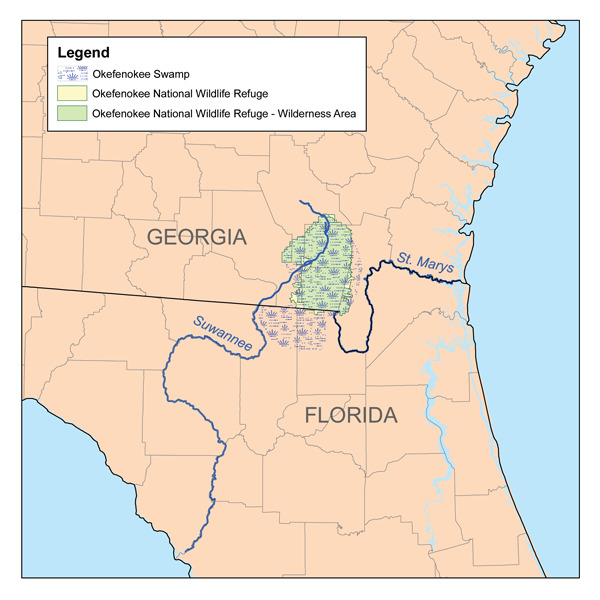
Okefenokee Swamp comprises more than 164,000 hectares of land, making it the largest blackwater wetland ecosystem in North America (“The Okefenokee Swamp,” 2024). The swamp hosts more than 850 plant species and 400 vertebrates, including threatened and endangered animals like the red-cockaded woodpecker, wood stork, gopher tortoise, and eastern indigo snake (“Natural History,” 2023). Most of the Georgia portion of the swamp is part of the Okefenokee National Wildlife Refuge, providing a protected habitat for these organisms (“Okefenokee National Wildlife Refuge,” 2025).
Before it was a swamp, Okefenokee was a forest, most likely pine and oak (Edwards & Costello, 2024). Okefenokee was thick with streams and wetlands around islands of dry land. When the water tables rose, the land flooded and peat started to accumulate, creating a swamp. Patches of dry land called islands dot the watery landscape. The swamp mostly feeds itself, with water evaporating and coming back as rain. Some water comes into the swamp from rivers while subsequently flowing south into Florida (Edwards & Costello, 2024). The swamp is a funnel of recycled water, nutrients, and organisms.
Many different amphibians thrive in the swamp, including the oak toad and pig frog (“Okefenokee Swamp Check List”, 2024). Amphibians are often used as indicators of environmental health, making the Okefenokee of interest to the global scientific community (“Animals in the Okefenokee Swamp,” 2024). The swamp also hosts owls, which keep rodent populations in check and reduce disease spread (“Animals,” 2024). Over 15,000 alligators live in the swamp and mold the ecosystem by digging “alligator ponds” that become habitats for other organisms and mix nutrients into the soil (“Animals”, 2024). The diverse multitude of species create many niches for each other to prosper in the swamp.
Indigenous People, Settlers, Logging Company, State, Scientists, and Tourists
Humans have lived in the region for 10,000 years, and in the swamp itself for 4,000 years (Trowell, 2022) (“Human History,” 2023). Early Indigenous tribes hunted in the swamp in the late Archaic period (O’Steen et al., 2002). Since then, human residents have included Timucuans, Seminoles, escaped enslaved persons, impoverished immigrant settlers and prosperous logging companies (“Human History,” 2023).
The human groups that have inhabited the Okefenokee created a rich and diverse cultural history. Several different indigenous groups spent time in the Okefenokee (O’Steen et al., 2002). In the late Archaic period, tribes built more permanent settlements and traded goods from far across the Americas. The tribes relied heavily on freshwater shellfish as a food source, evidenced by the trash mounds of shells they left behind. Members cremated and buried their dead and started to construct mounds. The Timucuan people were an important group that moved into Okefenokee from elsewhere and lived in the swamp for hundreds of years (“End of a Culture,” 2015). The Timucuans managed the swamp with controlled fires to clear overgrowth and built canoes using materials from the land to navigate the Okefenokee’s countless water routes.
Over the years, the swamp’s human population grew, prompting new societal relations and tensions between groups as they lived closer together (O’steen, et al., 2002). When the Spanish arrived, they killed and enslaved the Timucuans and spread deadly smallpox (“End of a Culture,” 2015). Very little information remains about Timucuan society due to the decimation by the Spanish. The remaining members assimilated with other tribes and are completely gone today (“End of a Culture”, 2015). In more recent history, the Seminoles stayed in the swamp as a refuge after they were driven from their home by European settlers during wartime (Luken, 2010). The Seminoles also took in escaped enslaved people, which angered white Americans once the U.S. was established (Luken, 2010). The United States tried to remove the Seminoles violently, waging war against them for twenty-five years until ultimately forcing the Seminoles to Oklahoma in the 1830s (Adams, 2021; Luken, 2010).
Conflict and tragedy continued to be a hallmark of the swamp into the nineteenth century. Americans of European descent settled in the swamp in the 1850s, living on Trail Ridge and islands within the swamp (“Human History,” 2023). These settlers hunted, fished, raised small amounts of livestock, kept bees, and practiced subsistence farming (“Human History,” 2023). They used controlled burns to hunt and manage the habitat, similar to the Timucuans (“Okefenokee National Wildlife Refuge”). Railroads emerged to connect a few key points of the settlements with the wider area (“Okefenokee National Wildlife Refuge”). Despite this relatively peaceful coexistence with the swamp, many of the settlers did not have legal titles to the land, and the State of Georgia forced them off in 1889 when it sold the swamp to the Suwannee Canal Company (“Human History,” 2023).
The company tried to drain the swamp which, had it been successful, would have destroyed the natural system. Still, technological advances in railroads and timber harvesting allowed lumberjacks to eventually cut down many of the bald cypress trees in the swamp without widespread drainage (McQueen and Mizell, 1926). Workers built railroads to logging locations and pulled them up to reuse in the next area after each location was harvested (Quarterman, 2023).
The Canal Company ran a company town on an island in the swamp called “Billy’s Island,” where their employees lived (Quarterman, 2023). Company towns provided housing and amenities for workers in isolated locations without a preexisting town. They also helped the companies keep control of the workers and made sure most of their wages went back into the company’s pocket. “Billy’s Island Town” had a theater, a garden, a cemetery, a barbershop, and a doctor’s office (Quarterman, 2023). The workers and families grew food, got their hair cut and beards shaved, had their injuries and illnesses treated, and buried their dead on that island. Lumberjacks and their families attended segregated churches and schools on the small island (Quarterman, 2023). The town was around from 1918 to 1927, and the railroads and logging lasted from 1889 to 1942 (Quarterman, 2023). In the hundred years since the harvesting, the cypress trees have regrown and prominently dot the landscape once more.
Wildfires and Prescribed Burns’ Roles in Okefenokee
Fire is the swamp’s most frequent guest that humans have been forced to adapt to. Swamps are susceptible to fire due to their composition of deep layers of combustible peat under shallow water (Caldwell, 2017). When the peat is moist, low-burning fires caused by lightning strikes are usually beneficial (McQueen and Mizell, 1926). The fires serve to maintain the regular composition of wetlands and the cycle of nutrients (Osborne et al., 2013). Without fire, hardwood trees would take over and islands would expand, turning Okefenokee from a swamp back into a forest (Caldwell, 2017).
Indigenous people and early American settlers used to tend the swamp with controlled burns, but when the state forcibly removed them from the area, destructive wildfires took over in the absence of those burns (“Okefenokee National Wildlife Refuge”; Gordon, 2024). Today, wildfires are allowed to burn if they are not close to the edges of the swamp and do not pose a threat to people (Caldwell, 2017). Government departments like the Georgia Forestry Commission and the Georgia Department of Transportation conduct prescribed burns in the area to keep it healthy (“Prescribed Fire,” 2025). These controlled fires burn surface fuels and reduce the chances of uncontrolled fires during droughts. (Edwards & Costello, 2024).
Climate change increases the intensity of droughts, making wildfires larger and more likely to burn the canopy and negatively impact the swamp by decreasing the trees’ ability to photosynthesize and killing organisms that live in the leaves. In managing the swamp, officials must identify which fires are beneficial and which are harmful to decide whether to contain and extinguish them.
Current Human Interactions with Okefenokee
Today, the swamp is a natural treasure where people come to enjoy beauty and peace. Scientists study the ecosystem and local species while tourists visit to see a unique landscape. Okefenokee houses Stephen C. Foster State Park, which is a certified dark park, or a place where light pollution is negligible and people can easily view the stars and Milky Way unaided (“Human History,” 2023). People kayak, canoe, and boat on the water, as well as photograph the swamp and stargaze. While the Timucuan’s canoes were built from the swamp itself, current canoes and boats are made from all over the world. Thousands benefit from this natural and cultural landmark.
Scientists are currently researching the swamp for its pollutant levels. UGA graduates recently found high levels of mercury in alligators from Okefenokee, as well as from Jekyll Island and Yawkey Wildlife Reserve. Mercury spreads quickly through the food web and can harm humans who eat game from land near the swamp (Peat, 2025).
Threats to the Swamp from Climate Change
Unfortunately, the Okefenokee Swamp is currently at risk of irreparable harm from climate change. The amount of North American inland wetlands is projected to decrease as the hotter summers dry out the swamps, killing many organisms (Xu et al., 2024). The Okefenokee is vulnerable to droughts, which means its long-term survival is threatened as droughts lengthen and intensify due to human-caused climate change. These droughts not only put the organisms inhabiting the swamp at risk but also the water tables the swamp exists.
Climate projections predict that the area containing the swamp will spend 11 – 17 weeks of the year above 95 degrees Fahrenheit (Lustgarten et al., 2020). Humidity levels will also increase, creating wet bulb conditions—where heat and humidity combine to make lower hot temperatures deadly (Huber, 2022). Humidity prevents humans from sweating when there is a greater concentration of water outside in the air than in their sweat (Huber, 2022). Climate projections of moderate emissions show only a couple of days a year of wet bulbs in Okefenokee, but if there are higher emissions, there will be five to ten per year (Lustgarten et al., 2020). These heat waves and wet bulbs would make the area uncomfortable and even dangerous for humans to spend long periods of time outside. Reducing people’s ability to stay for long in the swamp would decrease their ability to work in and visit it, threatening conservation, tourism, and research.
Heat stress can kill animals or reduce their ability to get food, reproduce, and travel in the swamp (Xu et al., 2024). The increased temperatures could shift the species makeup of the swamp and decrease its biodiversity and stability.
Currently, the niche area of temperature and precipitation suitable for human settlement includes much of the South (Lustgarten et al., 2020). This niche will move north due to climate change, however (Lustgarten et al., 2020). With fewer people remaining in the area, it will be even harder to protect Okefenokee. If society successfully limits and reduces climate change, humans might be able to save the swamp and continue experiencing and managing its unique beauty and character. If not, then we will have lost an ancient natural and cultural landmark. Okefenokee played a prominent role in the region’s history and enables us to reflect on and learn from our past.
Conclusion
Many groups have lived in the swamp, and each has had a different relationship with it (“Human History,” 2023). To the Timucuans, the swamp was an ancestral home where they flourished. They managed it with fire and navigated its waters with canoes built from materials from the swamp itself. To the Seminoles and escaped enslaved people, it was a refuge that became a home until Americans’ greed and bloodlust drove them from it. To the white Americans that came after, it was their own share of the American Dream, a wild land that they could live off and call their own. The settlers learned to live with the swamp and tend it with fire like the Timucuans, only to be forced off by the state in its thirst for industry and wealth. The lumberjacks made a living from the swamp by altering its landscape and clearing it of cypresses. Today, it is a haven of peace and beauty for tourists and naturalists, a source of knowledge for scientists, and an important preservation site of nature and endangered species for environmentalists. Although it is threatened by climate change, if humans can mitigate the effects of this upheaval, we might be able to save an ancient ecosystem from ourselves.
Works Cited
Adams, Chris. “The First Peoples of Okefenokee.” Okefenokee Heritage Center, Okefenokee Heritage Center Newsletter, Jan. 2021, okefenokeeheritagecenter.org/newsletters/NL01-03-2021.pdf.
“Animals in the Okefenokee Swamp: U.S. Fish & Wildlife Service.” FWS.Gov, U.S. Fish & Wildlife Service, 6 May 2024, www.fws.gov/story/2024-05/animals-okefenokee-swamp.
Caldwell, Mary. “Okefenokee Swamp Fire: Why Swamps Burn.” AJC, The Atlanta Journal-Constitution, 19 May 2017, www.ajc.com/news/disasters/okefenokee-swamp-fire-why-swamps-burn/Nu803TLFPjM8xvAQsr2hNL/.
Edwards, Leslie, and John Costello. “The Georgia Botanical Society.” Swamp Article-Georgia Botanical Society, Georgia Botanical Society, www.gabotsoc.org/articleOkefenokee2003.htm#:~:text=For%20a%20time%2C%20the%20Okefenokee %20was%20not%20a,the%20Okefenokee%20Swamp%20as%20we%20know%20it%20today. Accessed 15 Nov. 2024.
“End of a Culture.” National Parks Service, U.S. Department of the Interior, 14 Apr. 2015, www.nps.gov/timu/learn/historyculture/timucua_end_culture.htm#:~:text=Today%20there%20are%20 no%20known,Native%20Americans%20who%20call%20themselves%20Timucuan.
“Fire Ecology.” National Parks Service, U.S. Department of the Interior, 14 Apr. 2015, www.nps.gov/bicy/fire-ecology.htm#:~:text=It%20is%20recognized%20that%20cypress,measured%20by%20its%20insulating%20properties.
Gibbons, Whit. “Natural History of the Okefenokee Swamp – New Georgia Encyclopedia.” New Georgia Encyclopedia, New Georgia Encyclopedia, 6 Sept. 2002, www.georgiaencyclopedia.org/articles/geography-environment/natural-history-of-the-okefenokee-swamp/.
Huber, Matthew. “What Happens If the World Gets Too Hot for Animals to Survive?” Bulletin of the Atomic Scientists, Bulletin of the Atomic Scientists, 20 July 2022, thebulletin.org/2022/07/extreme-heat-animals-livestock-wildlife/.
“Human History and Recreation & Tourism of Okefenokee.” The River Basin Center, University of Georgia, 11 Apr. 2023, rivercenter.uga.edu/the-okefenokee-swamp/okefenokee-human-history-recreation-tourism/.
Luken, Ann. “In the Middle of History: South Georgia and the Seminole Wars.” Moody Air Force Base, 9 Nov. 2010, www.moody.af.mil/News/Commentaries/Display/Article/212240/in-the-middle-of-history-south-georgia-and-the-seminole-wars/.
Lustgarten, Abrahm, Al Shaw, Propublica, Jeremy W. Goldsmith. “New Climate Maps Show a Transformed United States.” ProPublica, ProPublica, 15 Sept. 2020, projects.propublica.org/climate-migration/.
“Natural History of the Okefenokee Swamp.” The River Basin Center, University of Georgia, 11 Apr. 2023, rivercenter.uga.edu/the-okefenokee-swamp/okefenokee-swamp-natural-history/.
Peat, Savannah. “New Study Shows Alligators Aren’t All That’s Lurking in Georgia’s Swamps.” UGA Today, University of Georgia, 23 July 2025, news.uga.edu/georgia-alligators-show-high-levels-of-mercury/.
“Okefenokee National Wildlife Refuge.” FWS.Gov, U.S. Fish & Wildlife Service, 5 May 2025, www.fws.gov/refuge/okefenokee#:~:text=The%20Okefenokee%20National%20Wildlife%20 Refuge,value%20on%20an%20international%20scale.
“Okefenokee National Wildlife Refuge.” FWS.Gov, U.S. Fish & Wildlife Service, www.fws.gov/refuge/okefenokee/about-us#:~:text=The%20first%20settler%20community%20in,and%20the%20area’s%20commercial%20center. Accessed 7 Nov. 2025.
“The Okefenokee Swamp.” The River Basin Center, University of Georgia, 6 June 2024, rivercenter.uga.edu/the-okefenokee-swamp/.
“Okefenokee Swamp Check List.” iNaturalist, iNaturalist, www.inaturalist.org/check_lists/3546049-Okefenokee-Swamp-Check-List. Accessed 6 Nov. 2025.
Osborne, Todd Z., Leda N. Kobziar, Patrick W. Inglett. “Fire and Water: New Perspectives on Fire’s Role in Shaping Wetland Ecosystems – Fire Ecology.” SpringerOpen, Springer International Publishing, 1 Apr. 2013, https://doi.org/10.4996/fireecology.0901001.
O’Steen, Lisa D., R. Jerald Ledbetter, Daniel T. Elliot. “Archaic Period – New Georgia Encyclopedia.” New Georgia Encyclopedia, New Georgia Encyclopedia, 8 Aug. 2002, https://www.georgiaencyclopedia.org/articles/history-archaeology/archaic-period-overview/.
Quarterman, John. “Logging Railroads in the Okefenokee Swamp 1889-1942.” WWALS Watershed Coalition (WWALS) Is Suwannee Riverkeeper®, WWALS Watershed Coalition, 26 Nov. 2023, www.wwals.net/2023/11/26/logging-railroads-in-the-okefenokee-swamp-1889-1942/.
“SR 177 to Okefenokee Swamp Park Prescribed Fire” Facebook, Ware County Fire Rescue, 10 Feb. 2025, www.facebook.com/permalink.php/?story_fbid=953445283628548&id=100068892562670.
Trowell, C. T. “Human History of the Okefenokee Swamp – New Georgia Encyclopedia.” New Georgia Encyclopedia, New Georgia Encyclopedia, 3 Feb. 2022, www.georgiaencyclopedia.org/articles/geography-environment/human-history-of-the-okefenokee-swamp/.
Xu, Donghui, Gautam Bisht, Zeli Tan, Eva Sinha, Alan V. Di Vittorio, Tian Zhou, Valeriy Y. Ivanov & L. Ruby Leung. “Climate Change Will Reduce North American Inland Wetland Areas and Disrupt Their Seasonal Regimes.” Nature News, Nature Publishing Group, 18 Mar. 2024, www.nature.com/articles/s41467-024-45286-z.
Acknowledgements: Dr. Jason Gordon and Jacob Thomas Knox, for editing and guidance.
Citation Style: MLA