The Power of A Name
by Aarya Merchant
Franklin College of Arts and Sciences, Institute for Women’s and Gender Studies
This paper explores how names carry expectations about identity, culture, and belonging. While names are often seen as simple markers of who we are, they frequently come with assumptions about a person’s ethnicity, religion, and place within a community. Drawing from my own experiences growing up in a multifaith household influenced by both Hindu and Muslim traditions, I reflect on how my name and background shaped the way others interpreted who I was and where they believed I belonged. What seems like a personal label often becomes something others use to categorize and judge before truly knowing the individual.
Alongside these personal experiences, this paper examines how women are often expected to embody religious and cultural ideals that are rooted in historical interpretations of sacred texts. In both Hindu and Muslim contexts, female figures from religious stories are frequently presented as models for how women should behave, dress, and structure their lives. However, these expectations are often shaped more by patriarchal cultural interpretations than by the teachings of the religions themselves.
By discussing examples from the Quran, the Bhagavad Gita, and feminist scholarship, this paper argues that women are often burdened with upholding cultural and religious identities through their behavior and choices. Ultimately, it suggests that women should have the freedom to define themselves rather than being confined by the expectations attached to their names, religions, or cultural roles.
Names, Women, Identity, Patriarchy, Muslim, Hindu
I never thought names could hold so much power in today’s modern age.
Sure, they did throughout history–the Romans used multiple names to signify lineage, and members of tribal societies introduced themselves by clan. But I always assumed that now, names were just a practical way to get someone’s attention. What I’ve come to realize through studying women’s and gender politics, and through my own experiences, is that names are far more complicated. A name is supposed to reflect an individual identity, but long before it can do that, it carries stereotypes, histories, and expectations that formed well before the person existed.
Names that fall outside what a community considers “normal” often draw extra attention or suspicion. A name that should give someone a sense of identity instead becomes something others use to decide who that person is, where they belong, and how they should be treated. In this way, names become tools within systems built around majority identities, making people who fall outside those categories more vulnerable to being misunderstood, marginalized, or seen as “out of place.” For women, these pressures are often amplified, especially when their identities are measured against religious expectations.
Women are frequently compared to female figures from religious texts– individuals shaped by historical contexts and circumstances entirely unlike those of women today. Even though these examples are rooted in distant, outdated eras, communities still use their idealized portrayals to dictate how modern women should behave, dress, and structure their lives. And when religious values get tied to politics, women are almost always the first to feel the consequences. Historically and today, women’s identities and choices are used to uphold patriarchal cultural and religious systems that advance larger social and political agendas, which is something that I came to understand through my own name.
For most of my life, I didn’t know why my parents chose it. I believed it was the result of months of debate over whether I should have a Muslim name like my father’s side or a Hindu one like my mother’s. They eventually settled on “Aria,” a name they believed transcended religion and culture– then made it more complicated with a unique spelling that no one could pronounce correctly.
It wasn’t until a few years ago that I understood why my parents truly named me Aarya. While it honored both religions, it was also a way to maintain neutrality. I realized this during a normal shift at my healthcare job, when several Spanish-speaking patients began speaking to me in fluent Spanish, assuming I was Latina. Later, my coworker explained that it wasn’t surprising– I looked Hispanic, and my name, sounding like the increasingly common “Aria,” didn’t reveal anything about my background. Only then did I understand that, out of all the Indian girls’ names my parents could have chosen, they intentionally chose one that wouldn’t invite the immediate stereotyping that would’ve come with a traditional Indian name.
This reason only became more apparent in the few months following this incident at work. I was a senior in high school at the time, applying to college, and my father had told me not to indicate my race on my application if I could avoid doing so. He made the joke that they had “thought long and hard when naming me so that college admissions wouldn’t think, ‘oh, here’s another Indian kid.’” Although lighthearted at the time, I knew that there was some truth to that statement– and was he wrong? Could you tell what ethnicity, culture, or religion “Aarya Merchant” is without having ever met her? Neither the first nor the last name is basic in any particular culture or ethnicity, leaving the reader confused and trying to glue the pieces together.
The sad part is that this pressure to choose a “neutral” name, or even go as far as to go by a “fake name” to avoid discrimination, is something many immigrant parents feel today, but not everyone in the same ethnic or religious group experiences it equally. Unlike their first child, my parents took a different approach when naming my twin brothers six years later. They named one of them “Aayan”– a Muslim name, and the second one “Aahan”—a Hindu name. And to a certain extent, maybe my parents succeeded with this decision. They wear the rudraksha bracelet—sacred prayer beads in Hinduism made to represent the tears of the god Shiva and worn by followers to protect them and help them attain spiritual growth—and a “gaatpath” thread—a red and green striped bracelet also meant for protection that is given out by our mosque. Moreover, they wear them on the same wrist everywhere, including the temple and mosque, and don’t get questioned about it at all.
My mother and I, on the other hand, haven’t had the same experience. While my brothers’ names seem to represent the coexistence my parents hoped for, our journey toward acceptance has been more complicated. Still, I believe we were luckier than most because both of our communities were remarkably open compared to other sects in Hinduism and Islam. When my mom converted to Islam, our community was incredibly welcoming, and she found mentors who were eager to teach her about the faith. Still, there were small moments that reminded us how easily people can blur the line between what’s acceptable and what’s not in religion. When I was in middle school, I auditioned to say prayers in front of the mosque for a festival that we had coming up. I had braces at the time, so I developed a bad habit of slurring my words and, as a result, failed to articulate some of the words of the prayer correctly. Instead of kindly rejecting me, the woman told me at the end of the audition that I didn’t say the prayer with the “correct Arabic accent.” Confused, as I had never been told this before, I went to my mom later that evening and asked if I should’ve been praying with an accent this entire time. My mother, being the tiger mom she is, went to confront the woman and ask what she meant by her comment, to which the woman responded that my mom wouldn’t understand because she wasn’t a “real Muslim.”
That was the first time I’d seen my mom cry that hard in years. She had always felt so included by our community, but the underlying insecurity of not belonging ran so deep that this small comment was enough to set her off. I believe that this insecurity existed in both of us. While she felt constantly on edge that she would be called out for not being a true Muslim or for losing her Hindu beginnings, I always felt as if I could never have an opinion on either religion.
In a social studies class in late elementary school, my school decided to take us to the local temple–the temple I grew up going to–for a field trip to better understand Hinduism and its places of worship. Since I went to a predominantly white, Christian school, everyone knew me as the girl who was both Muslim and Hindu. As I sat listening to the priest explain the stories of the gods, one of my classmates tapped me on the shoulder and asked how I could pray to statues. Then she followed it up with, “Didn’t Muslims break statues? How would they feel if they knew you prayed to the same ones they broke?”
Overwhelmed with anger, I was trying to gather my words to answer her when she cut me off with, “Whatever, you probably don’t know the answer anyway,” and walked over to the only other South Asian girl — the one she figured would know more since she was just Hindu — brushing me off completely.
Although this is a more extreme example of the scrutiny I’ve faced from practicing both religions, it was one of many experiences where I was questioned—mostly by those who didn’t follow either religion—about my involvement in both, which only deepened my sense of imposter syndrome. However, as I got older and immersed myself in both religions, I realized that they share many similarities, such as fasting during Ramadan or Navratri as a form of gratitude. Even their myths and stories, like The Ramayana, which tells of a son who goes into exile to honor his father’s wishes, and The Battle of Karbala, which recounts a grandson of the Prophet refusing to pledge allegiance to a corrupt ruler even at the cost of his life, both teach similar lessons about personal sacrifice in the service of righteousness and moral duty.
As I began to see the parallels between these two religions, I wondered why, for my entire life and for much of my mother’s, we had been interrogated so heavily—as if we were committing a crime by practicing both. The moment that helped me understand this came unexpectedly. I was learning about the Mahabharata—a Hindu epic about a war of succession between two groups of princely cousins, one righteous and the other unjust, serving as a broader metaphor for the fight between good and evil. The “just” cousins were five brothers who were all married to the same woman, Draupadi. Originally, one of the older brothers, Arjun, won her hand in marriage, but when he went with his brothers to introduce her to his mother, his mother absentmindedly told him to “share whatever he earned with his brothers,” sealing Draupadi’s fate as the wife of all five brothers.
Although she strongly protested and pleaded with her husband to take her side, she was eventually forced to give in to this new fate because the oldest and “wisest” brother decided that she would remain the common wife to avoid jealousy and dispute among the men.
The fact that this forced marriage is a plotline so normalized, and that almost everyone overlooks the reality that Draupadi’s wishes were cast aside for the benefit of men, shows how women and their subjugation have long been used as the basis for religious and cultural teachings. In their own way, “Muslim” and “Hindu” are names themselves—and it’s women who bear the greatest weight of those names.
Of course, when I say that religion subjugates women, I don’t mean the religion itself. Rather, I mean the culture built around how men have interpreted sacred texts in ways that allow them to enforce patriarchal ideals. In Islam, for example, the hijab, niqab, and burka can be meaningful expressions of faith for women who choose to wear them. However, many young girls in Muslim countries, regardless of their faith, are forced to wear them long before they can decide whether they see it as an act of devotion or a form of control. This expectation distorts the Quranic verse that calls for both men and women to act with modesty, specifically in “Surah Al-Ahzab,” which states:
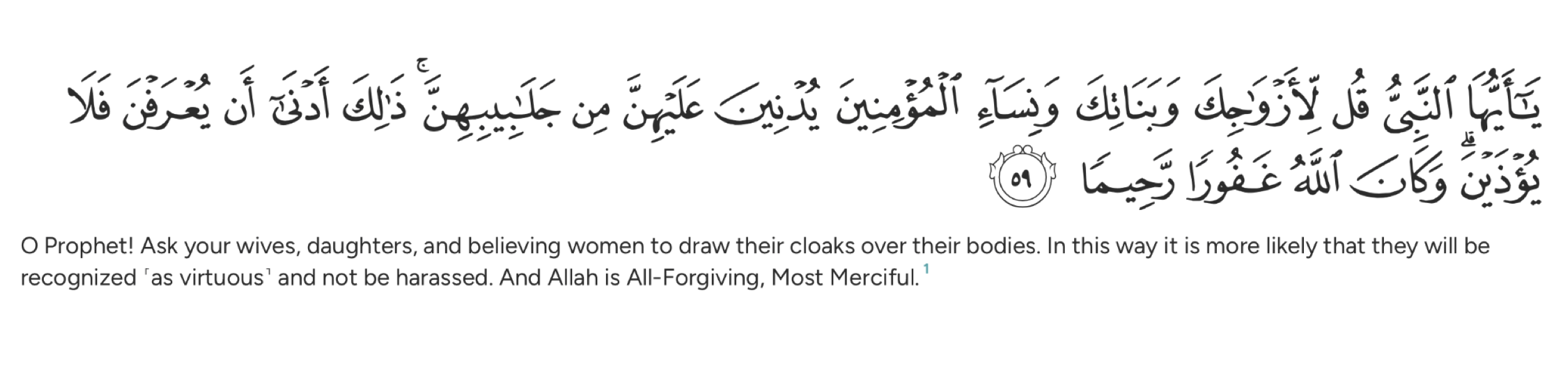
This verse was presented to Prophet Muhammad at a time when both Muslim men and women were being subjected to harassment by those who believed Islam was a sham religion. Therefore, followers were instructed to wear an outer garment when going out of their homes so that they would not be harassed. The purpose of this head covering was to make it safer for women to go about their daily lives rather than be confined to their homes. Furthermore, even the surah in the Quran that specifically addresses the covering of women, Surat An-Nur, claims that women should “wrap a portion of their headcovers over their chests and not expose their adornment”, which is referred to and even translated in many English translations as their breasts or upper chests. The verse has nothing to do with the actual covering of a woman’s natural head, hair, face or hands, but with the exposure of their intimate areas.
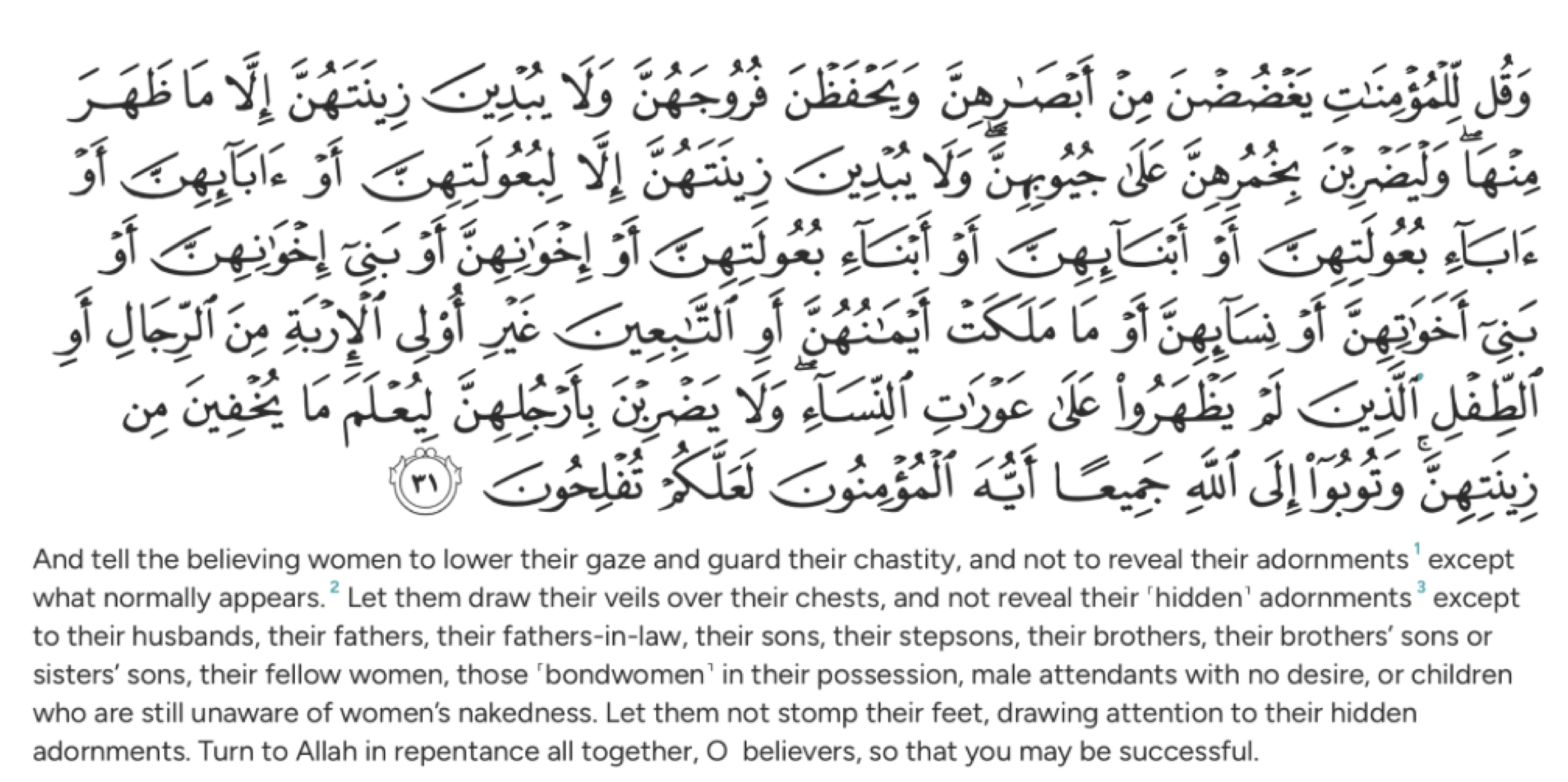
Despite the direct nature of these translations, today we often see this guidance used in the opposite manner: to control women and demand that they cover their features in the name of religion so that they are not “shamelessly tempting” men to give in to their supposed innate sexual desires.
Proponents of veiling further defend the practice by claiming that Prophet Muhammad’s wives all wore hijabs. What patriarchal leaders who enforce veiling often ignore is that the Prophet’s wives originally wore cotton veils as a sign of status or as protection from the desert heat. Unlike many women who are forced to wear similar clothing today, they were also independent businesswomen who enjoyed a fair amount of freedom for women at the time. The truth is that veiling, in many cases, has become less about faith and more about controlling women’s visibility and power.
Similarly, in Hindu extremism, women are placed on a pedestal as Bharat Mata, or “Mother India,” and reduced to symbols of purity and devotion, much like veiled Muslim women. In this role, women are celebrated for being obedient wives who care for their families, remain quiet, and devote themselves entirely to their husbands. This interpretation stems from Chapter 1, verses 40–44 of the Bhagavad Gita, in which the warrior Arjun worries that the social chaos from the Kurukshetra war in the Mahabharata will lead to the “corruption of women”, which then disrupts family lineage and social order. In this passage, Arjun is expressing fear that the breakdown of social order during war will destabilize family structures and traditional gender roles. However, just like the Quran, this is a skewed interpretation of the role of women in society. The verse does not blame women for society’s problems. Instead, it shows that when women lose respect, it is an early sign that families and social order are falling apart. The full verse reads:
When irreligion prevails in the family, O Krishna, the women of the family become corrupted; and when women are corrupted, O descendant of Vrishni, unwanted progeny arises. An increase in unwanted progeny leads both the family and those who destroy the family to hell. The ancestors of such corrupted families fall, because the offerings of food and water for them are no longer made. Through these faults of those who destroy family traditions, the eternal family duties and social order are ruined. We have heard that those whose family traditions are destroyed dwell in hell for a long time.
(Bhagavad Gita 1.40–44)
Furthermore, women are excluded from certain religious spaces, such as temples and prayer halls, during menstruation to maintain this ideal of purity. I remember being told when I first got my period that I couldn’t enter the temple until the bleeding slowed, as if something natural about my body made me unworthy of prayer. Although the Bhagavad Gita does not directly address menstruation or ritual purity, later cultural interpretations of Hindu traditions have often used ideas about purity to justify excluding women from certain religious spaces. However, treating menstruation as “unclean” contradicts the morals presented in the Bhagavad Gita, since menstruation is a natural biological process tied to fertility, and a woman’s fertility is held sacred in the text. In Chapter 14, Verse 4, Krishna describes himself as the bringer of life and the one who places the “seed” in the universal womb:
It should be understood that all species of life are made possible by birth in this material nature, and that I am the seed-giving father.
(Bhagavad Gita 14.4)
Furthermore, as Chandra Mohanty, a South Asian professor in the Women’s and Gender Studies Department at Syracuse University, notes in Defining Genealogies, there have been reports of a recent increase in cases of the ancient practice of sati, in which a woman either voluntarily or under coercion commits suicide by throwing herself on her husband’s funeral pyre (Mohanty, 21). Although sati is a criminal act in India and is associated with a loss of autonomy and inheritance rights for women, some reports suggest that its occurrence has increased in recent years under the leadership of Narendra Modi and the BJP, a conservative Hindu nationalist party.
The prevalence of these practices, especially sati, illustrates how certain religious and cultural traditions, rather than reflecting the humanism and moral values central to Hinduism, can be used to reinforce male authority and consolidate political power, even at the cost of women’s lives.
Beyond these controls, the expectation that women marry only within their religion is another way patriarchal ideals are enforced. Hindu women are often raised to fear non-Hindu men, particularly Muslim men, as dangerous or morally suspect. By restricting women’s romantic autonomy under the guise of protection, extremists ensure that women create “acceptable” families—Hindu households that uphold the religion and pass its ideals to the next generation. In this way, a woman’s body and choices become tools for upholding cultural and religious ideals.
This association of women’s roles with men is visible in today’s society as well, showing that it is influenced by more than just religion. In Living a Feminist Life, Sara Ahmed describes opening the index of a book and finding only a few references to women—most defined in relation to men, such as “partner of a male artist” or “daughter of a male god” (Ahmed, 151). This pattern reflects the expectations I saw the women in my life navigate as I grew up. It is considered normal for women to inherit their father’s last name and later adopt their husband’s, meaning their identities are shaped through men at every stage of life. Yet despite being defined through men’s names, women are the ones expected to uphold what those names represent. This expectation of proper conduct often extends to their behavior as well. As Mitsuye Yamada notes in Asian Pacific American Women and Feminism, Asian women are traditionally viewed as “not attuned to being political” because they are “too happily bound to their traditional roles as mothers and wives” (Yamada, 308). From birth, women—especially Asian women—are taught to value family and the collective over their own desires: daughters are raised to protect the family’s honor, serve as the moral center of the home, and eventually embody the ideal wife and mother. These widespread beliefs, even among people who are not Muslim or Hindu, demonstrate that these traditional ideals are not inherent to religion itself, but rather reflect patriarchal culture using religion as a tool to enforce its norms.
Any woman who resists these expectations, by refusing to veil herself, focusing on a career, or—as in my mother’s case—marrying outside her religion, is judged not only personally but also for the cultural and religious roles her “names” demand she uphold. Just as my name, Aarya Merchant, carries assumptions about my ethnicity, religion, and identity, women are judged based on the roles their names and religious labels are expected to uphold. These names dictate what is considered acceptable behavior, what spaces women can enter, and even whom they can love or marry.
It doesn’t have to be this way. Women like my mother and I have shown that it is possible to live outside the rigid cultural expectations often justified by patriarchal agendas disguised as religion. My parents married at 22 and 23 after being abandoned by my father’s family for being in an interfaith relationship. Despite this, my mother attended medical school, became a doctor, raised a family, and ran her own business.
The idea that women can be confined by an identity they are born with is false. Accepting the limits imposed by the ‘names’ assigned to us restricts our true potential. Instead, we should embrace our names—ones that reflect not only our beginnings, but also the identities, values, and choices we cultivate ourselves. Theorists such as bell hooks, who chose to use a pen name rather than her given name, show how names and identities can be fluid and deliberately shaped by the individual.
Today, I am Aarya Merchant: a girl who embraces both sides of herself and chooses what defines her and the path she will take in life. The person I am today will likely differ from who I become in the future—and that is okay. Only by owning the fluidity of our own names, rather than the rigid labels imposed by cultural expectations, can women fully realize their potential.
References
Mohanty, Chandra Talpade. “Defining Genealogies: Feminist Reflections on Being South Asian in North America.” New Writing by Asian American Women, edited by Elaine H. Kim, Beacon Press, 1997.
Ahmed, Sara. Living a Feminist Life. Duke University Press, 2017.
Yamada, Mitsuye. “Asian Pacific American Women and Feminism.” Feminist theory: a reader, edited by Wendy K. Kolmar, Frances Bartkowski, The McGraw-Hill Companies, Inc, 2010.
“The Noble Quran.” Quran.Com, quran.com/. Accessed 14 Mar. 2026.
Boray, Giridhar. “The Bhagavad Gita .” The Bhagavad Gita Based on HH Sri Raghavendra Teertha’s Gita Vivruti & Lectures by HH Sri Vidyasagara Madhava Teertha, 2023, ebooks.tirumala.org/downloads/The%20Bhagavad%20Gita.pdf.
Acknowledgements: To my mother, who inspired me to always unapologetically be myself, no matter who tries to tell me otherwise, as well as all of the women out there who are afraid of speaking out against ideals or practices that don’t align with them out of fear of ostracization by their loved ones. Take the risk of always staying true to who you are and what you believe, and you’ll find yourself in a stronger community that loves you for you.
Also to Dr. Cecilia Herles, who continues to inspire all of the students in the Women’s and Gender Studies Department to display their voices by sharing with us opportunities that allow us to publish or present our work. You’ve been an amazing mentor these past two semesters.
Citation Style: MLA